

Engineers develop AI-driven six-legged robot modeled on stick insect locomotion
A newly designed hexapod platform uses artificial intelligence to mimic stick insect mechanics, allowing real-time gait adaptation across unpredictable terrain.
By The Global Wire Newsroom · Reported from Jijo Malayil
Link preview · horizonglobalnews.com
Engineers develop AI-driven six-legged robot modeled on stick insect locomotion
A newly designed hexapod platform uses artificial intelligence to mimic stick insect mechanics, allowing real-time gait adaptation across unpredictable terrain.
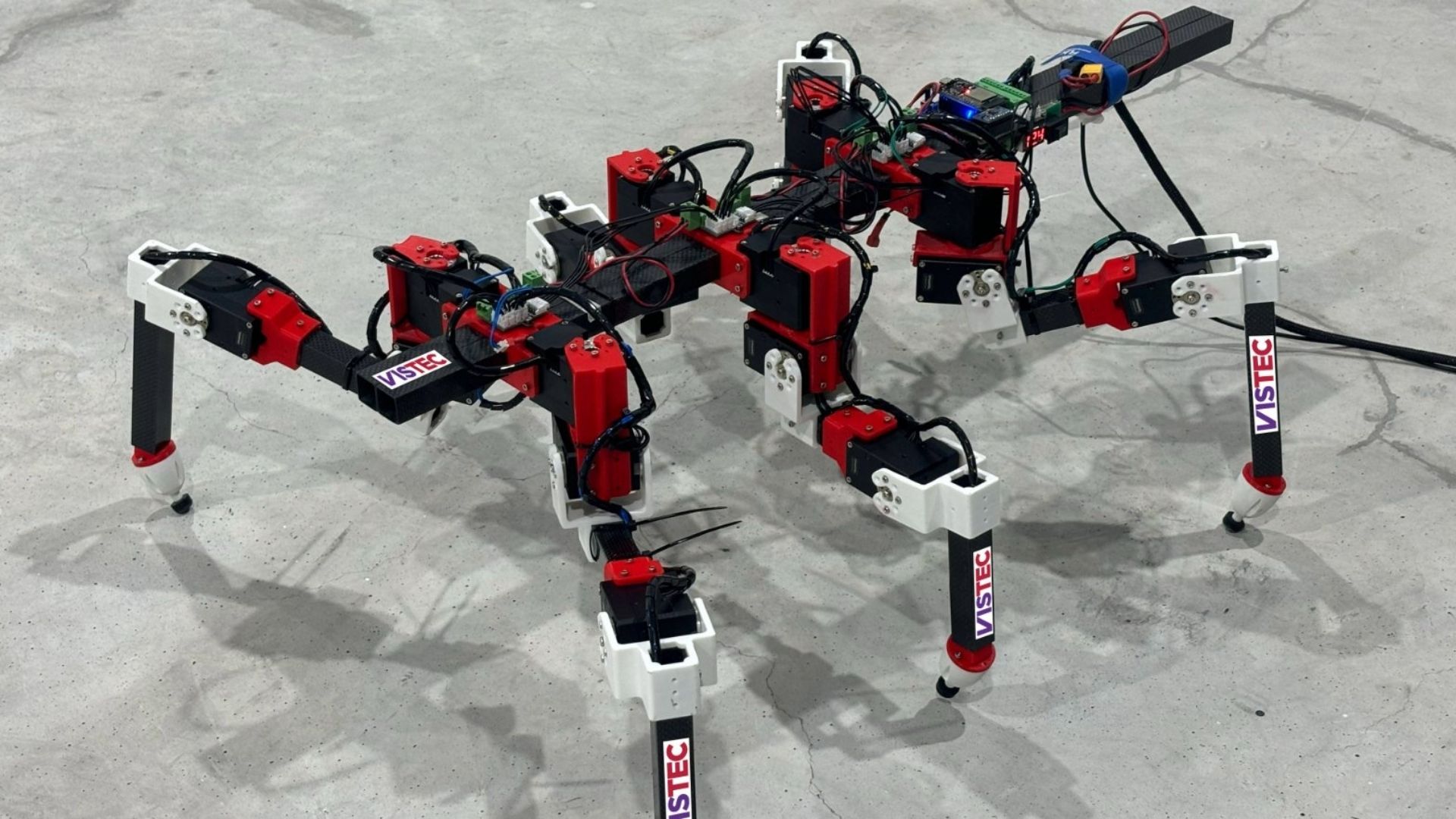
Robotics researchers have introduced a six-legged autonomous robot that uses artificial intelligence to replicate the adaptive locomotion of stick insects, enabling the machine to dynamically alter its gait across highly irregular and difficult terrain. Reported on August 28, 2026, by tech journalist Jijo Malayil, the system combines biological motion principles with machine learning algorithms to solve one of the persistent challenges in mobile robotics: navigating unpredictably rough surfaces without falling, stalling, or requiring manual recalibration. By observing how stick insects negotiate complex natural obstacles, the developers trained the hexapod platform to independently adjust leg trajectories, foot placement, and body clearance in real time.
Key facts
What happened
According to reporting by Jijo Malayil, the project centers on training a hexapod—a six-legged robot—to mirror the flexible, decentralized leg coordination seen in insects belonging to the order Phasmatodea, commonly known as stick insects. Unlike rigid quadrupeds or wheeled systems that depend on pre-mapped pathing, this robotic system relies on an artificial intelligence control structure designed to process physical feedback from the environment and instantly reconfigure its walking strategy.
Stick insects in nature excel at climbing over gaps, loose debris, and steep vertical variations because each of their six limbs can operate with a high degree of local autonomy while remaining coordinated with the rest of the body. To translate this biological capability into hardware, researchers trained neural networks using simulation environments before deploying the models onto the physical robot. The machine continuously evaluates sensory inputs—such as leg angles, surface resistance, and chassis tilt—to determine whether to maintain a fast tripod gait, shift to a more cautious wave gait, or make individual micro-adjustments to single limbs.
When encountering unexpected dips, rocks, or slippery patches, the AI model adjusts the trajectory of individual legs mid-stride. Rather than coming to a halt to recalculate an entire motion plan, the hexapod modifies its stance fluidly, distributing its weight across stable contact points while searching for secure footholds with its free limbs. This ability to make instantaneous locomotion decisions allows the machine to maintain forward momentum across surfaces that would immobilize standard autonomous systems.
Why it matters
Navigating uneven terrain remains one of the largest engineering hurdles preventing the widespread deployment of autonomous land robots. Wheeled systems are exceptionally energy-efficient on paved or smooth surfaces, but they regularly become high-centered, lose traction, or flip over when encountering boulders, thick vegetation, or earthquake rubble. Tracked vehicles offer better weight distribution over mud and sand, but they lack the delicate precision required to navigate fractured structures or loose, shifting debris field edges without causing collapse.
Legged robots present a compelling alternative because they only require discrete points of contact with the ground rather than a continuous path. However, traditional leg control software is computationally heavy and often fragile; if a foot slips on an unmapped rock, the robot's pre-calculated mathematical balance model can break down, leading to a fall.
By leveraging biological principles from stick insects, this AI-driven approach introduces decentralized resilience. If one leg slips or fails to find solid ground, the neural network instantly adapts the remaining five legs to bear the weight, preventing catastrophic balance loss. For disaster recovery teams, this technology could yield search-and-rescue units capable of crawling deep into collapsed buildings where human responders and traditional drones cannot enter. In planetary science, hexapods modeled on insect biology could allow future planetary rovers to explore hazardous lunar craters, Martian lava tubes, and cliff sides that remain strictly off-limits to heavy wheeled rovers like NASA's Curiosity or Perseverance.
The background
Biomimicry—the practice of modeling technology on biological systems—has long driven advancements in mobile robotics. Insects have been a primary focus of study for decades because their miniature nervous systems achieve extraordinary mobility without the vast computational power required by mammalian systems. In particular, stick insects (*Carausius morosus*) have served as classical research models in neurobiology and robotics due to their unique decentralized motor control. Each limb of a stick insect possesses its own localized sensory-motor loops that communicate with neighboring limbs, allowing the insect to walk, climb, and recover from stumbles without needing continuous centralized processing from its brain.
In early hexapod robotics, such as the LAURON series developed in Europe or the HECTOR robot built at Bielefeld University during the 2010s, engineers relied on hard-coded rules and central pattern generators (CPGs) to synthesize insect gaits. While these systems demonstrated stable walking on flat or gently sloping surfaces, they struggled when faced with completely unpredictable, highly dynamic real-world environments. Writing code for every potential physical scenario proved practically impossible.
The recent convergence of deep reinforcement learning with biomimetic design has revolutionized this field. Instead of hand-crafting explicit motion rules for every obstacle, researchers now place a digital twin of the hexapod into a physics simulation engine. Within the simulation, the AI executes millions of virtual steps over randomized, rough terrain, receiving digital rewards for maintaining balance, minimizing energy consumption, and reaching target coordinates. Through this iterative trial-and-error process, the neural network uncovers robust, emergent walking behaviors that mimic natural insect adaptation, which can then be transferred directly onto physical hardware.
Reaction
While formal academic and industrial responses continue to develop following Jijo Malayil's report, the robotics and artificial intelligence communities have increasingly signaled that bio-inspired reinforcement learning represents the future of physical automation. Academic researchers specializing in bio-inspired kinematics are expected to scrutinize the specific neural network architecture used to achieve real-time gait adaptation, particularly how the system balances computational load between centralized processors and localized actuator microcontrollers.
Industry analysts in defense, agricultural technology, and civil infrastructure are watching these developments closely. Search and rescue organizations, which have historically found commercial quadrupeds too costly or fragile for extreme rubble conditions, are looking for low-cost, highly redundant hexapod architectures. Meanwhile, planetary exploration sectors, including commercial space enterprise developers and international space agencies, consistently track biomimetic hexapod research as they evaluate concepts for next-generation surface exploration missions.
What we don't know yet
Despite the significant mobility milestone represented by the AI-trained hexapod, several crucial technical parameters remain unverified in the initial disclosures. Key open questions include:
What to watch
Moving forward, the primary milestones for this stick insect-inspired platform will center on peer review, hardware scaling, and field deployment testing. Observers should track upcoming international robotics conferences—such as the IEEE International Conference on Robotics and Automation (ICRA) and the IEEE/RSJ International Conference on Intelligent Robots and Systems (IROS)—where the research team is likely to present detailed algorithmic papers and empirical performance metrics.
Additionally, field trials in unconstrained outdoor settings will serve as a critical test. Watch for demonstration updates showing how the platform performs under adverse weather conditions, including heavy rain, mud, extreme temperatures, and dusty environments that can degrade electronic sensors and mechanical joints. Progress toward commercialization will also depend on whether the control software is made open-source, which could allow the broader robotics research community to adapt the stick insect locomotion models to custom hardware platforms.
This account is based on original reporting published by Jijo Malayil on August 28, 2026.
How this story was produced
This report was written by The Global Wire newsroom from reporting first published by Jijo Malayil. We verify the core facts against the original report, write our own account, and add the background and consequences a short wire item leaves out. Drafting is AI-assisted inside an editor-supervised pipeline, and every story is checked for accuracy of attribution, structure and duplication before it appears — full detail in our AI and funding disclosure.
Spotted an error? Tell us at corrections@horizonglobalnews.com and read our corrections policy or editorial standards.
Reader comments
Loading comments…