

Commercial Debris Removal Craft Eyed as Military Escorts for Satellites
Technologies engineered to capture orbital junk could be adapted into escort spacecraft to shield critical satellites from hostile maneuvers, according to Astroscale.
By The Global Wire Newsroom · Reported from Space com
Link preview · horizonglobalnews.com
Commercial Debris Removal Craft Eyed as Military Escorts for Satellites
Technologies engineered to capture orbital junk could be adapted into escort spacecraft to shield critical satellites from hostile maneuvers, according to Astroscale.
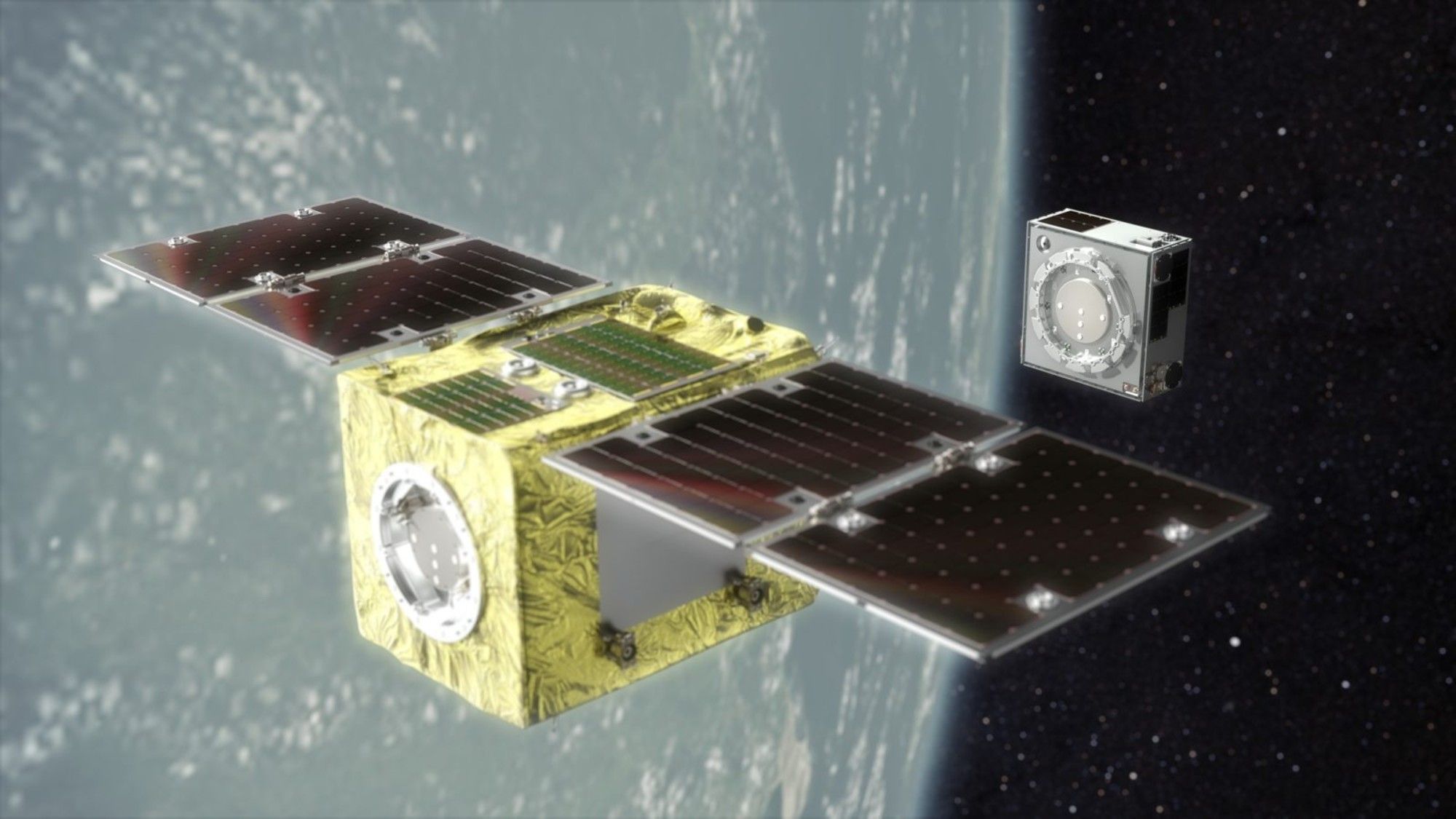
Commercial space debris removal technologies could soon transition from custodial orbital duties to front-line defense roles, providing escort and protection services for high-value satellites vulnerable to hostile maneuvers. Tokyo-based orbital servicing firm Astroscale has proposed that spacecraft architectures originally designed to inspect, capture, and deorbit space junk can be adapted rapidly to field dedicated "bodyguard" platforms. The concept emerges as defense agencies in the United States and allied nations confront an increasingly contested orbital environment, marked by provocative maneuvers from adversary inspection satellites and growing concern over counter-space capabilities fielded by Russia and China.
Key facts
What happened
According to reporting by Space.com, space-servicing enterprise Astroscale has put forward an operational vision in which systems engineered to grapple derelict space hardware are repurposed to shield operational government and commercial satellites. The company argues that the flight-proven software, sensor suites, and guidance packages used to safely approach uncooperative debris can be modified to create protective platforms capable of shadowing high-value orbital assets and deterring hostile interference.
This proposed pivot builds directly upon technical milestones achieved during Astroscale's Active Debris Removal by Astroscale-Japan (ADRAS-J) mission, launched in February 2024. Contracted by the Japan Aerospace Exploration Agency (JAXA), the ADRAS-J spacecraft executed precise rendezvous and proximity operations with an upper-stage H-IIA rocket body that had drifted abandoned in low Earth orbit since 2009. The servicer approached within tens of meters of the tumbling, non-communicative booster, capturing high-resolution imagery and demonstrating autonomous navigation without the aid of docking transponders or cooperative target telemetry.
In Astroscale's assessment, those identical navigation, sensor fusion, and propulsion capabilities could allow purpose-built escort satellites to maintain continuous station-keeping alongside critical communication, navigation, or surveillance constellations. If an adversarial spacecraft were to execute an aggressive rendezvous or approach within an intercept trajectory, an escort platform could maneuver between the target and the asset, document the encounter with optical sensors, or potentially employ non-destructive counter-measures to disrupt the aggressor's mission.
Why it matters
The militarization of rendezvous and proximity operations represents a fundamental shift in how nations defend their infrastructure above the atmosphere. For decades, satellites have operated as defenseless, predictable targets bound to fixed orbital mechanics. Because conventional satellites possess limited propellant strictly reserved for station-keeping and end-of-life disposal, forced evasion maneuvers can prematurely end an asset's multi-million-dollar operational lifespan. By deploying independent escort craft to absorb the tactical burden of close-range deterrence, operators can safeguard their core strategic hardware without depleting its onboard fuel reserves.
Economically, leveraging commercial off-the-shelf servicing buses offers defense procurement agencies an alternative to lengthy military development cycles. Aerospace primes traditionally require nearly a decade to develop and launch classified defense satellites. In contrast, commercial firms in the active debris removal (ADR) and on-orbit servicing, assembly, and manufacturing (ISAM) sectors have iteratively tested dynamic flight software and low-cost sensor suites on rapid schedules. Tapping into these existing commercial production lines allows military commands to scale defensive orbital presence faster and at significantly lower cost.
Strategically, the deployment of defensive escorts creates an urgent need for clarified rules of engagement in space. An escort satellite with close-approach and grappling capabilities is inherently dual-use: a platform built to physically deflect, push, or shield against an approaching spacecraft can just as easily be perceived by adversaries as an offensive anti-satellite weapon. Without transparent operational norms, the sudden deployment of bodyguard fleets could accelerate an orbital security dilemma, prompting rival powers to launch counter-escorts and heightening the risk of miscalculation during geopolitical crises.
The background
Concerns regarding orbital interference have intensified over the past decade as major spacefaring nations developed sophisticated counter-space capabilities. Historically, anti-satellite (ASAT) developments focused on ground-launched kinetic interceptors, demonstrated by China in 2007 and Russia in November 2021, when a Russian missile destroyed the defunct Cosmos 1408 satellite, generating thousands of pieces of trackable debris. However, modern counter-space strategy has increasingly shifted away from kinetic strikes toward co-orbital systems—spacecraft capable of stalking, inspecting, jamming, or physically interacting with target satellites without producing massive debris fields.
Russia has repeatedly launched spacecraft that conduct unusual proximity operations in both low Earth orbit and the geostationary belt. In 2022, the Russian military satellite Cosmos 2558 was deployed into the exact orbital plane of a classified United States intelligence satellite, USA 326, maintaining a close trailing orbit that Western officials characterized as irresponsible and provocative. Similarly, Russian satellites such as Luch (Olymp-K) have spent years repositioning themselves in geostationary orbit, drifting systematically between Western commercial and military communications satellites to gather signals intelligence.
The United States has also accelerated its own proximity-operations programs. The U.S. Space Force operates the Geosynchronous Space Situational Awareness Program (GSSAP), a constellation of maneuverable satellites patrolling the geostationary arc to inspect foreign spacecraft. In 2023, the U.S. Space Force and the National Reconnaissance Office launched the Silent Barker mission to provide comprehensive tracking of objects operating in geosynchronous orbit. While Western doctrine has emphasized space domain awareness and resilience, the concept of active "bodyguard" satellites shifts the posture from observation toward defensive physical presence.
International space law remains ill-equipped to regulate such encounters. The Outer Space Treaty of 1967 guarantees the freedom of all states to explore and use outer space, prohibiting national claims of sovereignty and banning weapons of mass destruction from orbit. However, it does not explicitly define what constitutes an impermissible physical approach, nor does it establish legal buffer zones around operating satellites. Attempts to codify responsible behaviors through United Nations working groups have stalled, leaving operators without clear legal mechanisms to distinguish between benign inspection and hostile stalking.
Reaction
While Western defense ministries have not formally announced commercial procurement contracts for defensive escort platforms, space commanders have routinely voiced support for commercial integration into national security architectures. Officials within the U.S. Space Systems Command have repeatedly stated that commercial space domain awareness and on-orbit servicing capabilities must be integrated into operational battle management to counter fast-moving adversary developments.
Industry analysts and space sustainability advocates have responded to the militarization of servicing technology with guarded concern. Organizations dedicated to space safety note that active debris removal technology is vital for preventing cascading orbital collisions, commonly known as the Kessler syndrome. If these custodial technologies become heavily associated with offensive or defensive military operations, international cooperation on debris remediation could collapse, as non-aligned nations may view commercial clean-up missions with deep suspicion.
Adversary nations, particularly Russia and China, are expected to criticize Western efforts to deploy escort platforms in multilateral forums such as the Conference on Disarmament in Geneva. Moscow and Beijing have historically advocated for the Treaty on the Prevention of the Placement of Weapons in Outer Space (PPWT), arguing that Western space architectures seek orbital dominance while resisting legally binding constraints on ground-based counter-space weapons.
What we don't know yet
Significant operational and technical questions remain unresolved regarding how escort satellites would function during an active confrontation. The reporting does not disclose whether Astroscale's conceptual bodyguard craft would rely strictly on non-destructive methods—such as visual shadowing, electronic screening, or maneuvering into a physical blocking path—or whether they could incorporate reversible disabling tools such as dazzlers or directional jammers.
It is also unclear how a commercial escort would legally navigate sovereign rules of engagement. Under existing military command structures, authorizing a kinetic block or close maneuver against an adversary state's sovereign satellite carries profound escalation risks. Defense departments have not clarified whether private contractors would operate these escort vehicles under commercial flags or whether ownership and operational command would transfer entirely to military uniforms upon orbital insertion. Furthermore, questions persist regarding how an escort platform would sustain operations across high delta-v maneuvers without rapidly exhausting its own propellant supply.
What to watch
The trajectory of orbital escort development will be shaped by upcoming national security contract awards and international test flights. Observers should monitor upcoming solicitations from the U.S. Space Force, particularly within the Space Safari and Tactically Responsive Space (TacRS) programs, which seek rapid, off-the-shelf orbital response capabilities. Any shift in programmatic language prioritizing active escort missions over passive space domain awareness will signal that defense agencies are ready to operationalize commercial servicing buses.
Another critical indicator will be Astroscale's follow-on missions, including the ADRAS-J2 mission, which aims to demonstrate physical capture and removal of an orbital target. The success of advanced capture mechanisms will confirm whether proximity technologies have matured to the point where reliable physical intervention in orbit is technically feasible.
Diplomatically, developments within the United Nations Open-Ended Working Group on reducing space threats will serve as a bellwether for whether international consensus can be reached on orbital safety zones. Observers will be watching for whether member states advance proposals defining minimum approach distances, which could either validate the defensive legal rationale for escort craft or effectively outlaw close-proximity escort maneuvers altogether.
This account is based on original reporting published by Space.com.
How this story was produced
This report was written by The Global Wire newsroom from reporting first published by Space com. We verify the core facts against the original report, write our own account, and add the background and consequences a short wire item leaves out. Drafting is AI-assisted inside an editor-supervised pipeline, and every story is checked for accuracy of attribution, structure and duplication before it appears — full detail in our AI and funding disclosure.
Spotted an error? Tell us at corrections@horizonglobalnews.com and read our corrections policy or editorial standards.






Reader comments
Loading comments…