

RAI Unveils AthenaZero Robot Demonstrating High-Speed Throwing, Catching, and Batting
The AthenaZero system from RAI uses low-inertia mechanics and real-time control to perform complex baseball tasks, advancing dynamic manipulation capabilities in physical artificial intelligence.
By The Global Wire Newsroom · Reported from Kaif Shaikh
Link preview · horizonglobalnews.com
RAI Unveils AthenaZero Robot Demonstrating High-Speed Throwing, Catching, and Batting
The AthenaZero system from RAI uses low-inertia mechanics and real-time control to perform complex baseball tasks, advancing dynamic manipulation capabilities in physical artificial intelligence.
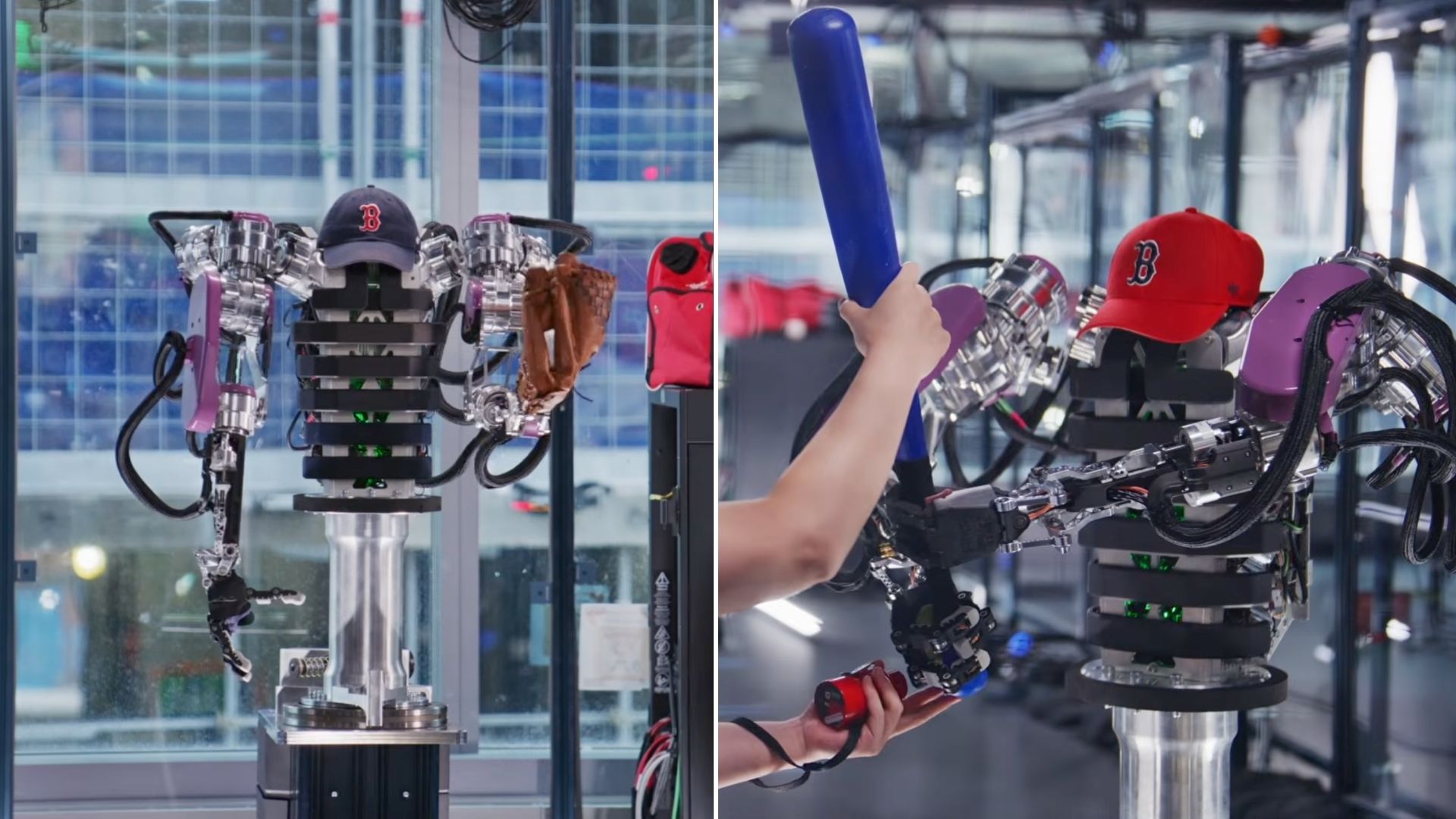
A newly unveiled robotic platform named AthenaZero has demonstrated high-speed athletic capabilities, executing coordinated throwing, catching, and batting movements in a baseball-themed demonstration. Developed by the robotics research entity RAI, the system utilizes a specialized low-inertia mechanical design paired with high-bandwidth control algorithms to manage dynamic physical interactions with fast-moving objects. The demonstration addresses a long-standing hurdle in physical artificial intelligence: enabling machines to calculate trajectories, position end-effectors, and exert precise impact forces within fractions of a second. According to reporting by Kaif Shaikh, AthenaZero's fluid execution across multiple distinct ball-handling tasks underscores key advancements in multi-joint dynamic coordination and real-time sensory-motor feedback.
Key facts
What happened
In a controlled laboratory demonstration detailed by reporter Kaif Shaikh, RAI put its AthenaZero robotic system through a series of demanding dynamic manipulation tests modeled after fundamental baseball mechanics: throwing, catching, and hitting a moving ball. Each of these three actions presents distinct computational and mechanical challenges that historically required separate, specialized hardware or rigid pre-programmed setups.
During the throwing phase, AthenaZero coordinated multiple joint actuators to generate rotational torque, accelerating the ball along a controlled trajectory before timing the exact millisecond of release. To achieve accuracy and distance, the control software synchronized the robot's mechanical structure, distributing energy through the kinematic chain to mimic the whip-like mechanics of human throwers.
In the catching phase, the platform engaged real-time trajectory prediction. As a ball approached, vision sensors tracked its flight path, feeding positional data to the control unit. The system calculated the intercept point and commanded the manipulator to position its end-effector in the ball's path, simultaneously executing dynamic deceleration to cushion the impact and absorb kinetic energy without bouncing or losing grip.
For the hitting segment, AthenaZero demonstrated spatial-temporal alignment by swinging an implement to make contact with an incoming ball. Hitting requires sub-millisecond precision: the system must predict where the projectile will be at a specific instant in space, match the velocity and angle of the swinging limb or bat to that intercept point, and execute a high-force strike.
Central to all three actions is AthenaZero's low-inertia mechanical design. By reducing the effective mass and rotational inertia of its moving limbs—often achieved by placing heavy drive motors closer to the base or main torso and utilizing lightweight linkages—the robot can achieve high angular acceleration. This physical architecture allows the system's control algorithms to make rapid, micro-level course corrections during a movement without inducing structural vibration or mechanical destabilization.
Why it matters
The demonstration of fluid throwing, catching, and hitting by AthenaZero represents a notable milestone in the transition of robotics from static, predictable environments to dynamic, unstructured real-world domains. Historically, industrial robots have excelled at high-speed repetitive tasks—such as spot welding, painting, or pick-and-place operations—where the environment is strictly fixed and the target object does not move independently. However, traditional machines rely on rigid, high-inertia arms that are heavy, slow to react to unexpected environmental changes, and potentially dangerous near human operators.
By demonstrating high-speed reactive manipulation using a low-inertia design, RAI addresses two core bottlenecks in modern robotics: system latency and physical bandwidth. High-speed ball sports serve as an ideal proving ground for physical artificial intelligence because they strip away the luxury of slow deliberation. In a baseball swing or catch, the time between object detection and impact is measured in milliseconds. The control loop must perform vision processing, state estimation, trajectory integration, motion planning, and joint torque generation continuously at high frequencies.
Beyond athletic demonstrations, the underlying technology has broad implications for industrial automation, logistics, search and rescue, and collaborative human-robot environments. In advanced logistics and manufacturing, robots equipped with dynamic manipulation skills can catch falling or tossed items, reorient moving parts on high-speed conveyor belts, or sort irregularly shaped materials on the fly without stopping the production line. In emergency response scenarios, low-inertia dynamic manipulators could clear debris or intercept falling hazards in chaotic conditions where fixed motion plans fail. Furthermore, low-inertia hardware inherently improves physical safety: carrying less moving mass means transferring significantly lower kinetic energy during an accidental collision, making human-robot co-working safer.
The background
The challenge of dynamic manipulation—handling objects in motion under strict time constraints—has been a central focus of academic and industrial robotics research for over four decades. In the late 20th century, early experiments in dynamic control focused primarily on single-degree-of-freedom tasks, such as juggling or balancing a pole on a cart, using high-speed industrial linear drives and simple optical sensors.
As computer vision and real-time embedded computing advanced in the 2000s and 2010s, specialized academic labs began tackling complex ball sports. The University of Tokyo's Ishikawa Watanabe Laboratory developed high-speed vision systems capable of tracking ping-pong balls and baseballs at 1,000 frames per second, paired with high-speed micro-actuated arms that could hit or pitch balls with remarkable consistency. Similarly, researchers at EPFL in Switzerland developed dynamic catching arms equipped with quick-response torque control, demonstrating the ability to catch flying objects with complex geometries, such as rackets or half-filled bottles, by predicting their complex inertial trajectories.
In parallel, the hardware paradigm of robotics underwent a major shift toward low-inertia, torque-controlled actuators. Pioneered in part by research projects like the MIT Biomimetic Robotics Lab's Cheetah series and ETH Zurich's legged platforms, engineers increasingly adopted quasi-direct-drive motors or series elastic actuators. These designs move heavy gearboxes and motor masses closer to the central chassis, transmitting power through light belts, linkages, or tendons. This dramatically reduces moving mass at the extremity, lowering mechanical impedance and allowing the system to back-drive smoothly, absorb shocks, and accelerate rapidly without damaging internal gear teeth.
RAI's development of AthenaZero builds directly upon these historical trajectories, attempting to unify high-speed optical sensing, low-inertia actuator mechanics, and full-body dynamic trajectory optimization into a single platform capable of multi-modal athletic tasks. Where past systems were typically purpose-built for a single function—such as a stationary arm fixed to a wall designed solely to swing a paddle—AthenaZero represents a multi-functional system designed to execute throwing, catching, and striking within unified hardware and software architecture.
Reaction
Following the release of the demonstration reported by Kaif Shaikh, the academic and industrial robotics communities are evaluating the platform's implications for control systems and physical AI architecture. While RAI has presented visual evidence of AthenaZero's fluid movements, technical observers typically look for peer-reviewed performance data to validate long-term reliability and robustness.
Robotics engineers and control researchers will be looking for specific technical papers detailing the control paradigms used in AthenaZero. In particular, experts are keen to examine whether the system relies on traditional model predictive control, deep reinforcement learning trained in simulation, or a hybrid architecture that combines neural policy networks with physics-based optimal control.
Industry analysts are expected to contextualize AthenaZero against competing high-speed dynamic platforms developed by prominent humanoid and manipulation companies. Field experts typically evaluate such announcements based on key metrics including closed-loop tracking bandwidth, impact resistance during high-speed contact, and success rates across non-standard trajectory distributions.
What we don't know yet
Despite the impressive nature of the baseball demonstration, several key technical details remain undisclosed in the initial reporting. The available information does not specify the precise physical form factor of AthenaZero—specifically whether the machine operates as a full humanoid platform, a mobile torso, or a stationary multi-axis gantry arm system.
Furthermore, critical quantitative benchmarks have not been published. The report does not disclose the maximum velocity of the balls thrown or pitched during the testing, the success rate across multiple consecutive attempts, or the degree of variability in the ball flight paths. It is also unclear whether the vision system relies entirely on onboard camera hardware or utilizes an offboard multi-camera motion capture array embedded in the test room environment.
Finally, the underlying computational requirements and power consumption metrics remain unknown. It is not yet clear if AthenaZero computes its trajectory plans on internal edge hardware or relies on tethered external computing clusters, nor whether the low-inertia design allows for extended battery-powered untethered operation.
What to watch
In the coming months, watchers of the sector should monitor upcoming major robotics conferences—such as the IEEE International Conference on Robotics and Automation (ICRA), the International Conference on Intelligent Robots and Systems (IROS), or the Robotics: Science and Systems (RSS) symposium—where RAI may publish peer-reviewed technical papers detailing AthenaZero's mechanical architecture, sensing pipeline, and neural control code.
Observers should also look for follow-up testing protocols that evaluate the platform under less controlled conditions. Key indicators of progress will include tests involving unpredictable pitch trajectories, varying ball sizes and masses, adverse lighting conditions, and outdoor environments subject to wind and atmospheric turbulence.
Additionally, industry watchers should track whether RAI moves to commercialize the underlying low-inertia actuator technology or dynamic control software. Any licensing agreements, industrial partnerships, or technology transfers into commercial warehouse automation, collaborative manufacturing, or defense logistics will serve as concrete indicators of the platform's practical maturity beyond laboratory demonstrations.
This account is based on original reporting by Kaif Shaikh.
How this story was produced
This report was written by The Global Wire newsroom from reporting first published by Kaif Shaikh. We verify the core facts against the original report, write our own account, and add the background and consequences a short wire item leaves out. Drafting is AI-assisted inside an editor-supervised pipeline, and every story is checked for accuracy of attribution, structure and duplication before it appears — full detail in our AI and funding disclosure.
Spotted an error? Tell us at corrections@horizonglobalnews.com and read our corrections policy or editorial standards.





Reader comments
Loading comments…