

Mexico City Marks Day of the Dead Season as Annual Catrina Procession Fills Avenues
Participants painted as skeletons and dressed in elaborate attire marched through the Mexican capital, opening a week of Dia de los Muertos observances.
By The Global Wire Newsroom · Reported from Alexis Caraco
Link preview · horizonglobalnews.com
Mexico City Marks Day of the Dead Season as Annual Catrina Procession Fills Avenues
Participants painted as skeletons and dressed in elaborate attire marched through the Mexican capital, opening a week of Dia de los Muertos observances.
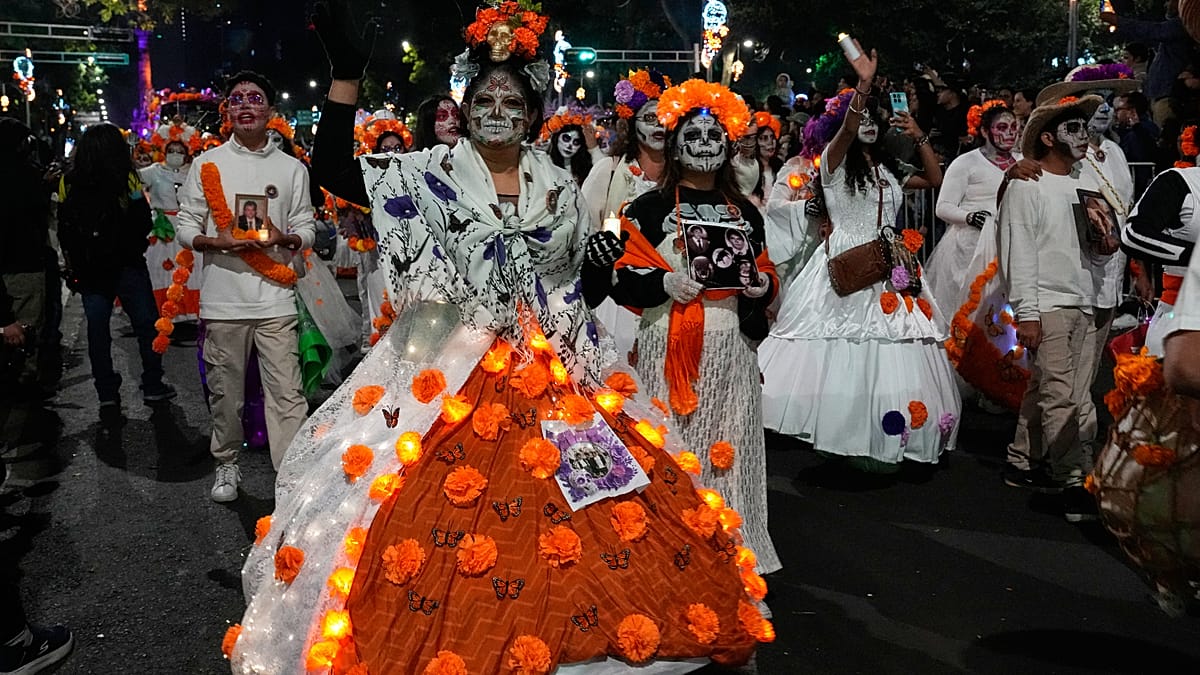
Tens of thousands of participants and spectators gathered along the primary thoroughfares of Mexico City on late October 2026 to celebrate the annual Catrinas Parade, an elaborate public procession that serves as one of the hallmark curtain-raisers for the country's national Day of the Dead observances. According to video reporting broadcast by Alexis Caraco, performers and members of the public donned intricate skull face paint, vibrant garments, and sweeping floral and feather headdresses, converting the capital's central avenues into an open-air celebration of mortality, remembrance, and Mexican folk iconography ahead of the November holiday.
Key facts
What happened
According to video coverage published by Alexis Caraco, crowds dressed in ornate costumes and skeletal visage paint took over Mexico City's streets for the annual Catrinas Parade. The visual dispatch showed participants navigating city boulevards adorned with multi-tiered floral arrangements, traditional gowns, ruffled collars, broad-brimmed hats, and stylized suits reminiscent of late nineteenth- and early twentieth-century aristocratic dress.
Marchers displayed varied regional styles from across the Mexican republic, blending traditional indigenous textile motifs with the distinctive black-and-white calavera makeup that has come to define modern Mexican commemorations of the dead. Dancers, organized civil groups, families, and solo performers processed through barricaded streets lined with spectators holding cameras and mobile phones. As captured in the footage, the mood of the gathering remained celebratory, emphasizing musical performance, theatrical performance art, and civic pride rather than solemnity.
While the supplied dispatch did not specify the precise street-by-street timetable or official crowd tallies for this specific iteration, gatherings of this scale in Mexico City conventionally assemble along Paseo de la Reforma, the capital's premier boulevard, before advancing past the Alameda Central and along Avenida Juarez toward the central square, or Zocalo. The municipal government routinely deploys civil protection officers, transit police, and municipal sanitarians along the corridor to manage pedestrian flow and public safety.
Why it matters
The annual Catrina procession is far more than a decorative civic showcase; it is a central pillar of the municipal economy and a visible manifestation of Mexico’s evolving public cultural policy. Over the past decade, Mexico City has systematically transformed Day of the Dead from a predominantly home-bound, cemetery-focused family ritual into an expansive metropolitan festival that commands global attention. This transition directly impacts municipal commerce, lodging, transport networks, and informal trade.
For municipal authorities and local business chambers, the autumn festivities provide a concentrated burst of economic activity. In typical years, Mexico City's tourism secretariat projects hotel occupancy rates exceeding 75 to 80 percent across central zones such as Cuauhtemoc, Juarez, Roma, Condesa, and the historic downtown core during the final week of October and the first week of November. Thousands of local vendors, artisans, face painters, tailors, and restaurateurs rely heavily on the revenue generated by the influx of visitors who travel specifically to observe the Catrina procession and its sister parades.
Beyond domestic commerce, the event plays an influential role in Mexico's global cultural diplomacy. By broadcasting images of vibrant, joyful engagement with the concept of mortality, Mexico reinforces its distinct cultural identity on the international stage. The parade also reflects the ongoing institutional negotiation over how living heritage is preserved: balancing genuine popular devotion, historical indigenous and colonial customs, and the contemporary commercialization of national folklore.
The background
The central visual figure of the parade—the Catrina—has a rich and politically subversive history in Mexican print culture. The character originated around 1910 under the hand of Aguascalientes-born printmaker and satirist Jose Guadalupe Posada. Originally christened "La Calavera Garbancera," Posada’s etching depicted an elegant skeleton clad only in a European-style French bonnet. The piece was intended as biting political satire aimed at indigenous and mixed-race Mexicans who sought to deny their native heritage by adopting European aristocratic pretenses during the Porfiriato, the three-decade authoritarian rule of President Porfirio Diaz.
Decades later, renowned muralist Diego Rivera revived and codified Posada's figure in his 1947 masterwork, "Dream of a Sunday Afternoon in the Alameda Central" (Sueno de una tarde dominical en la Alameda Central). Rivera gave the skeleton a full-length, elegant Victorian gown, draped a feathered serpent shawl around her neck, and immortalized her as "La Catrina"—a colloquial term used in early twentieth-century Mexico to describe a dandy or an impeccably dressed member of the high bourgeoisie. Rivera portrayed himself as a young boy walking beside her, holding her hand, while Posada stood at her other side, thereby cementing the skeletal figure into the permanent pantheon of modern Mexican national iconography.
Historically, traditional Dia de los Muertos observances in Mexico—held across November 1 and November 2, coinciding with the Catholic liturgical holidays of All Saints' Day and All Souls' Day—did not include massive downtown street parades. Families observed the dates privately by erecting ofrendas (home altars) decorated with yellow cempasuchil (marigold) flowers, pan de muerto (bread of the dead), copal incense, candles, sugar skulls, and the favorite foods of deceased ancestors. Families in communities such as Mixquic in southeastern Mexico City or the island of Janitzio in Michoacan spent the night in local cemeteries, cleaning graves and praying in vigil.
The widespread public street parade phenomenon in central Mexico City is a modern innovation. In 2014, community organizers and cultural activists launched the "Mega Procesion de las Catrinas" to celebrate Posada's imagery on the capital's public boulevards. The profile of such street processions grew exponentially after the 2015 Hollywood film "Spectre," which opened with a fictional James Bond chase sequence through an extravagant, made-for-cinema Day of the Dead parade in Mexico City. Recognizing the massive international appetite for the imagery, the Mexican Ministry of Tourism and the Mexico City government established an official civic parade tradition the following year. Since then, the Catrina procession and the municipal Day of the Dead parade have become institutional fixtures of the autumn cultural calendar, layered atop traditions that UNESCO inscribed onto its Representative List of the Intangible Cultural Heritage of Humanity in 2008.
Reaction
While official reactions to this particular event were not detailed in the dispatch from Alexis Caraco, municipal and cultural authorities routinely emphasize the event's importance to national unity and community identity. Mexico City's Ministry of Culture and Secretariat of Tourism routinely issue formal statements following such processions, praising civic participation and celebrating the peaceful reappropriation of urban spaces by thousands of costumed citizens.
Cultural commentators and community elders often express a nuanced view of the expanding festival season. While there is broad enthusiasm for the artistic brilliance and public solidarity seen in the Catrinas Parade, academic ethnographers and traditionalists in Mexico have at times cautioned that high-production commercial parades risk flattening regional customs into a singular, commercialized spectacle. Nonetheless, public reception among residents and tourists remains overwhelmingly enthusiastic, with thousands turning out annually to showcase weeks of handmade craftsmanship, makeup artistry, and familial cooperation.
What we don't know yet
The brief video reporting provided by Alexis Caraco captures the visual grandeur of the procession but leaves several operational, administrative, and economic details unspecified. Official crowd size estimates—which are typically compiled by the Mexico City Secretariat of Citizen Security (SSC) and the municipal government—were not recorded in the initial dispatch. It is therefore impossible to confirm whether this year's turnout exceeded, matched, or fell short of historical attendance benchmarks, which have reached hundreds of thousands of people in previous years.
Furthermore, the dispatch does not detail the total number of registered contingents, the specific municipal agencies coordinating the event, or the precise route length utilized for this edition. Specific economic data concerning hotel occupancy, municipal revenue generation, and incidental retail sales tied directly to this procession remain unreleased until local commerce bodies publish their post-holiday retrospectives in mid-November.
What to watch
In the days following the Catrina procession, attention will turn toward the core calendar dates of Dia de los Muertos on November 1 and November 2. Observers should track announcements from the Mexico City government regarding complementary events, including the Grand Day of the Dead Parade (Gran Desfile de Dia de Muertos), the installation of the monumental community ofrenda in the central Zocalo, and nighttime cultural activities along the canals of Xochimilco.
Researchers and commercial bodies will also monitor data releases from the Mexico City Chamber of Commerce, Services, and Tourism (CANACO) and the national Ministry of Tourism to gauge the fiscal yield of the 2026 holiday season. Internationally, observers will watch how cultural institutions continue to frame the balance between municipal tourism promotion and the preservation of sacred, intimate funerary traditions practiced in indigenous and rural communities across central and southern Mexico.
This article is based on video reporting and visual coverage published by Alexis Caraco.
How this story was produced
This report was written by The Global Wire newsroom from reporting first published by Alexis Caraco. We verify the core facts against the original report, write our own account, and add the background and consequences a short wire item leaves out. Drafting is AI-assisted inside an editor-supervised pipeline, and every story is checked for accuracy of attribution, structure and duplication before it appears — full detail in our AI and funding disclosure.
Spotted an error? Tell us at corrections@horizonglobalnews.com and read our corrections policy or editorial standards.





Reader comments
Loading comments…