

Ukrainian Military Video Shows Frontline Casualty Evacuated by Unmanned Heavy-Lift Drone
Footage released by Ukrainian forces depicts what is described as the first frontline medical evacuation of an injured soldier carried out entirely by an uncrewed aerial vehicle.
By The Global Wire Newsroom · Reported from Alexandra Snow
Link preview · horizonglobalnews.com
Ukrainian Military Video Shows Frontline Casualty Evacuated by Unmanned Heavy-Lift Drone
Footage released by Ukrainian forces depicts what is described as the first frontline medical evacuation of an injured soldier carried out entirely by an uncrewed aerial vehicle.
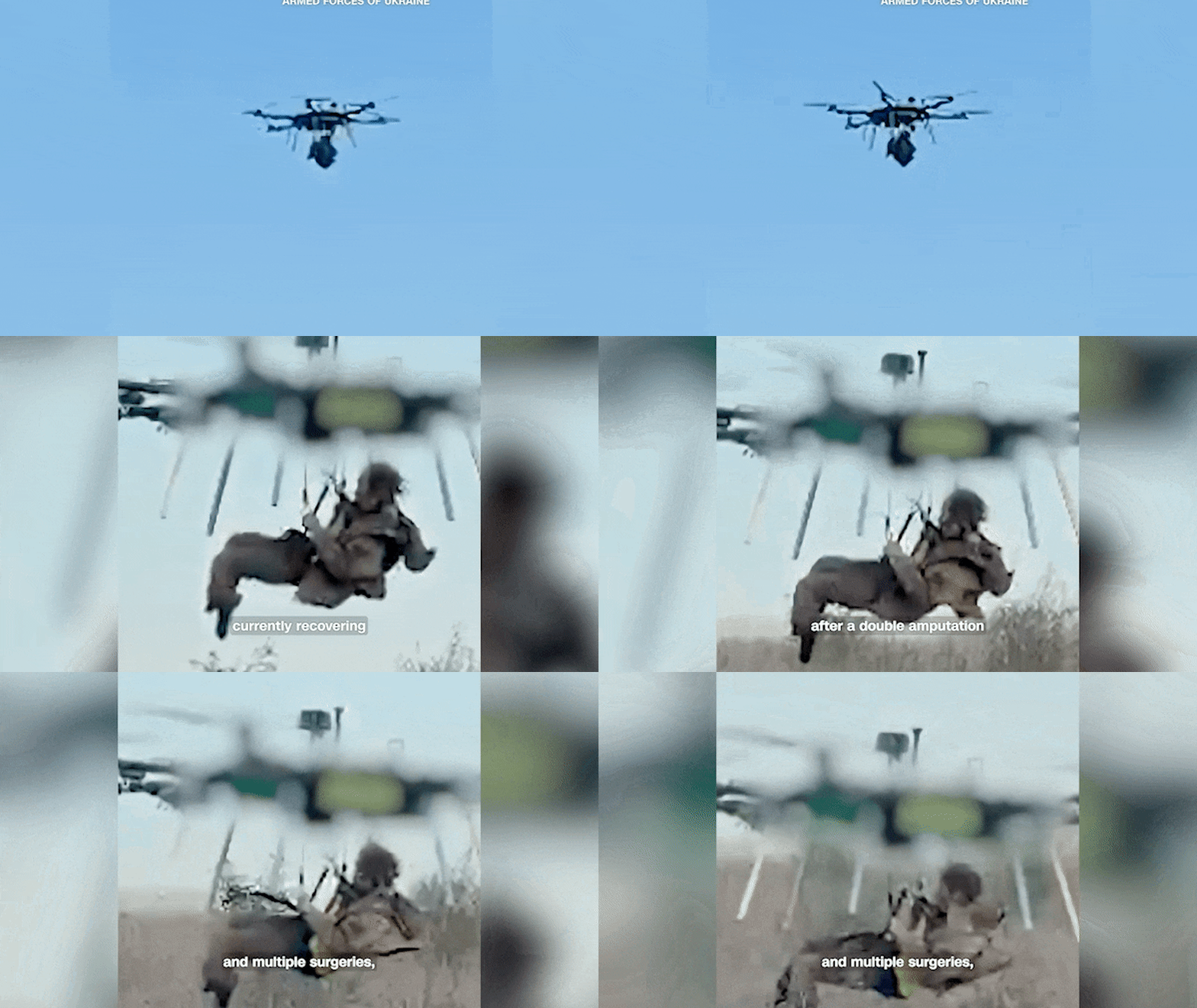
Ukrainian armed forces have released video footage documenting the battlefield evacuation of a wounded service member using an uncrewed aerial vehicle, marking what observers describe as the first recorded operational case of an autonomous or remotely operated drone airlifting human casualties directly from active combat positions. The recording shows an uncrewed platform descending into an operational zone, where an individual wearing standard military fatigues secures himself to a deployed cable mechanism before the aircraft ascends and transports him away from the engagement area, according to reporting by Alexandra Snow.
Key facts
What happened
According to the footage made public by the Ukrainian military, the mission took place in a combat sector where conventional evacuation options appeared unavailable or excessively hazardous. In the sequence, an uncrewed multi-rotor aircraft hovers downward toward a clearing amid frontline terrain. The aircraft lowers a cable attachment or harness line to the ground, maintaining steady flight despite the downwash generated by its multi-rotor propulsion assembly.
A soldier dressed in standard combat gear approaches the line, fastens himself securely into the hoisting harness, and signals or waits as tension is applied to the cable. Once the individual is secured, the uncrewed platform increases motor output and lifts the soldier cleanly off the terrain, rising above tree cover and field obstacles before transiting horizontally across the airspace toward rear defensive positions.
The released recording captures the continuous extraction from descent to ascent, though specific geographical coordinates, operational dates, and the precise military unit responsible for the deployment were not immediately disclosed in the video dissemination. The footage demonstrates that the aerial platform possessed sufficient stability, thrust-to-weight margin, and control precision to counterbalance the shifting mass of an adult human equipped with tactical gear—a load that typically totals between 80 and 110 kilograms.
Why it matters
The tactical extraction of injured personnel constitutes one of the most hazardous undertakings in modern warfare, directly influencing soldier survival rates and unit morale. In high-intensity combat, military medical doctrine relies heavily on the concept of the "golden hour"—the vital 60-minute window following traumatic injury during which immediate surgical intervention or stabilization dramatically lowers mortality. Across eastern and southern Ukraine, the presence of dense drone surveillance and precision strike networks has rendered traditional evacuation vehicles, including lightly armored tracked carriers and wheeled field ambulances, exceptionally vulnerable targets.
By substituting an uncrewed aerial vehicle for crewed vehicles or manual four-person stretcher teams, ground forces eliminate the risk to auxiliary medical personnel during extraction maneuvers. Traditional stretcher evacuations across open, zero-line terrain often require between two and six soldiers who must navigate shell craters, barbed wire, and unexploded ordnance while moving at walking speed, exposing entire rescue teams to enemy surveillance and subsequent artillery or loitering munition strikes.
Furthermore, the successful deployment of human-rated uncrewed logistics demonstrates that heavy multicopter technology has reached a threshold of mechanical reliability and software stability capable of managing life-critical tasks. Beyond personnel recovery, systems capable of lifting an adult soldier can be dynamically reassigned to deliver bulk ammunition, transport replacement electronic warfare batteries, or deploy high-capacity sensors across terrain impassable to wheeled or tracked platforms.
The background
Since the beginning of Russia's full-scale invasion in February 2022, the Ukrainian battlespace has evolved into the most drone-saturated theater in military history. Both Ukrainian and Russian forces deployed thousands of commercial off-the-shelf quadcopters alongside bespoke industrial models for reconnaissance, artillery spotting, and strike operations. Over time, Ukrainian defense organizations and domestic volunteer initiatives fostered a rapidly expanding cottage industry of heavy-lift agricultural and industrial multicopters, colloquially referred to by frontline troops and commentators under terms such as the "Baba Yaga" class.
These large-format platforms, often powered by six or eight electric rotors with lithium-polymer battery packs or hybrid power units, were initially adapted to carry heavy anti-tank munitions, mortar shells, and automated drop mechanisms during night missions. As Ukrainian technical teams expanded motor efficiency, carbon-fiber chassis manufacturing, and anti-jamming communication links, the payload capacities of these uncrewed platforms steadily climbed from 15 kilograms to upwards of 50 to 100 kilograms.
Concurrently, Western armed forces have long studied unmanned casualty evacuation (CASEVAC). The United States Marine Corps, the U.S. Army Medical Research and Development Command, and several European allied militaries have run trials on autonomous evacuation platforms since the mid-2010s. Prototype programs evaluated vertical takeoff and landing (VTOL) craft, uncrewed utility helicopters, and autonomous ground vehicles. However, Western military trials largely remained confined to controlled test ranges and simulated training environments, constrained by strict aviation safety certifications, risk-aversion protocols, and doubts regarding in-flight patient safety in uncrewed environments.
Ukraine's protracted front line, stretching over 1,000 kilometers, created an operational necessity that compressed peacetime developmental timelines. As forward trenches became isolated pockets surrounded by mine belts and monitored continuously by thermal-optic surveillance drones, standard ground routes were severed. In response, Ukrainian engineering units turned to available heavy-lift platforms to bridge tactical transit gaps, shifting the technology from experimental logistics to direct human recovery.
Reaction
Official and military analytical responses have focused on the technical ingenuity of the maneuver while acknowledging the extreme conditions that prompted its use. Military observers and tactical medicine specialists tracking the conflict have noted that while uncrewed extraction carries inherent physical risks for the patient—such as hypothermia, suspension trauma, and lack of in-transit medical stabilization—it represents an acceptable alternative in areas where ground recovery has become impossible.
Ukrainian defense officials have consistently highlighted technological asymmetry and autonomous systems as critical tools to compensate for Russian numerical advantages in personnel and conventional tube artillery. The Ministry of Defense of Ukraine and the general staff regularly publish operational milestones to demonstrate the efficacy of state-backed procurement initiatives, including the domestic drone manufacturing efforts organized under programs like the Brave1 defense tech cluster.
International defense technology analysts and NATO operational planners are expected to examine the event closely. Defense research institutions, such as Britain's Royal United Services Institute (RUSI) and the International Institute for Strategic Studies (IISS), routinely scrutinize frontline Ukrainian innovations to revise Western doctrine regarding tactical logistics, combat search and rescue (CSAR), and medical evacuation protocols under contested anti-access and area-denial (A2/AD) conditions.
What we don't know yet
Despite the release of the video, several technical and operational questions remain unresolved. The Ukrainian military did not reveal the precise identity of the drone platform utilized in the extraction, leaving it unclear whether the aircraft was a standard production model, an adapted heavy agricultural multicopter, or an experimental prototype built specifically for casualty recovery.
Additionally, the geographical sector where the mission occurred was withheld for operational security reasons. It is unknown whether the flight took place along the Donbas front, the northeastern Kharkiv border, or in the southern operational theater. Crucially, the video does not provide information regarding the medical status or identity of the extracted soldier, nor does it confirm how far the drone transported him before delivering him to a ground ambulance or combat medical post. The technical mechanisms used for pilot control—specifically whether the platform operated under autonomous waypoint navigation or direct manual piloting through low-frequency, jam-resistant radio links—likewise remain unconfirmed.
What to watch
Over the coming months, defense monitors will track whether this extraction represents an isolated improvisation by an inventive frontline unit or the formal initiation of a standardized unmanned casualty evacuation doctrine within the Ukrainian armed forces. Observers will look for indications that the Ukrainian General Staff or international donors begin funding dedicated medical winch attachments and safety cages tailored for existing heavy multicopters.
Attention will also turn to how Russian electronic warfare units and counter-unmanned aerial systems (C-UAS) adapt to larger aerial platforms operating in low-altitude corridors. Heavy-lift drones present significantly larger radar and visual cross-sections than small reconnaissance drones, making them more detectable by short-range air defense systems, heavy machine guns, and specialized interceptor drones.
Furthermore, Western military procurement programs are likely to evaluate the combat validation of drone-based evacuation during upcoming defense acquisitions reviews. Defense ministries across NATO, currently reassessing force modernization plans for high-intensity European warfare, will assess whether uncrewed aerial medical extraction should transition from long-term research pipelines into immediate tactical field trials.
This report is based on video materials and combat reporting published by Alexandra Snow.
How this story was produced
This report was written by The Global Wire newsroom from reporting first published by Alexandra Snow. We verify the core facts against the original report, write our own account, and add the background and consequences a short wire item leaves out. Drafting is AI-assisted inside an editor-supervised pipeline, and every story is checked for accuracy of attribution, structure and duplication before it appears — full detail in our AI and funding disclosure.
Spotted an error? Tell us at corrections@horizonglobalnews.com and read our corrections policy or editorial standards.





Reader comments
Loading comments…