

Renewed Paris Clashes Follow Nationwide Demonstrations Over Inflation and Schools
Fresh unrest erupted at Place de la République after weekend protests against living costs and school conditions led to 1,800 arrests and widespread looting across France.
By The Global Wire Newsroom · Reported from en.mercopress.com
Link preview · horizonglobalnews.com
Renewed Paris Clashes Follow Nationwide Demonstrations Over Inflation and Schools
Fresh unrest erupted at Place de la République after weekend protests against living costs and school conditions led to 1,800 arrests and widespread looting across France.
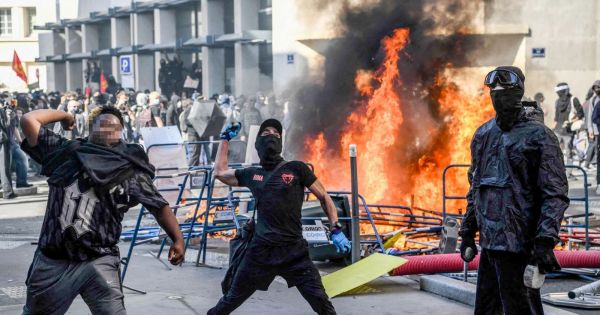
Fresh confrontations between security personnel and demonstrators broke out in central Paris on Sunday around the historic Place de la République, following a massive national day of action over living costs and classroom conditions that resulted in at least 1,800 arrests and widespread property damage nationwide. The secondary wave of unrest arrived less than twenty-four hours after street rallies mobilized thousands in major urban centers across France, descending into retail looting and running skirmishes along commercial corridors on Saturday. The recurrent street friction underlines the deepening volatility facing French municipal authorities and law enforcement, as household financial strains merge with long-standing grievances over underfunded public services.
Key facts
What happened
According to reporting by MercoPress, the wave of unrest developed from a coordinated national day of demonstrations called to challenge rapid consumer price inflation and the deterioration of resources inside French public schools. What began on Saturday as organized marches through regional administrative centers and Paris quickly fragmented into volatile confrontations between tactical police units and breakaway groups of demonstrators.
By Saturday evening, retail avenues in Paris and several regional hubs experienced extensive property destruction. Hundreds of commercial establishments had their display windows smashed, with widespread looting reported across high-street outlets and consumer shops. French internal security agencies responded with aggressive dispersal tactics, mobilizing specialized crowd-control units, tear gas deployments, and mobile interception brigades. By the end of Saturday's operations, the Ministry of the Interior recorded a national tally of no fewer than 1,800 detentions.
Rather than subsiding after Saturday's widespread detentions, street agitation flared again on Sunday afternoon in Paris. Crowds reconvened around the Place de la République, a traditional focal point for left-leaning political mobilizations and public assemblies on the boundary of the 3rd, 10th, and 11th arrondissements. Clashes broke out anew as groups threw projectiles and erected temporary barricades, prompting riot squads to deploy tear gas and cordon off surrounding metro stations and boulevards to contain the disorder before nightfall.
Why it matters
The recurrence of street clashes and the scale of the 1,800 arrests reflect a severe escalation in French domestic instability, posing immediate operational and political challenges for the central government. When demonstrations transition from scheduled labor union processions into widespread looting and multi-day street skirmishes, they strain both the physical capacity of the French national police force and the resilience of urban commercial corridors. For small business owners and retail operators, the looting of hundreds of stores translates to extensive direct financial losses, soaring commercial insurance premiums, and prolonged closures during an already challenging operating climate.
Beyond the immediate economic fallout, the events signal a dangerous convergence of broader working-class economic stress with sector-specific grievances. In France, public education has long served as a bedrock of state identity and republican integration. When teacher dissatisfaction and complaints about degraded classroom facilities intersect with household panic over high energy bills, food inflation, and diminishing purchasing power, the resulting protest coalitions become exceptionally difficult for the state to satisfy through isolated, incremental policy adjustments. The magnitude of the detention figures indicates that public order commands have adopted a zero-tolerance containment posture, an approach that risks further radicalizing demonstrators and alienating moderate civic organizations.
The background
Street mobilizations and civil unrest have functioned as an integral mechanism of French political negotiation for decades, frequently pushing back executive overreach when formal legislative avenues appear unresponsive. The French state is organized around a highly centralized executive branch governed under the Fifth Republic framework, which concentrates significant authority in the presidency and the cabinet. In recent years, this concentration of power has repeatedly clashed with grassroots movements protesting socio-economic insecurity, such as the yellow vest (Gilets Jaunes) demonstrations that began in 2018 over fuel duties and subsequently expanded into broader anti-government agitation.
More recently, national union confederations, including the General Confederation of Labour (CGT) and the French Democratic Confederation of Labour (CFDT), mounted months of coordinated industrial action against statutory pension age increases in 2023, while suburban unrest erupted in mid-2023 over policing practices. Throughout these cycles, law enforcement tactics—spearheaded by the Compagnies Républicaines de Sécurité (CRS) and the National Gendarmerie—have faced scrutiny from international human rights bodies regarding crowd control methodologies, particularly the use of rubber projectile launchers, stun grenades, and aggressive containment cordons known as kettling.
The specific convergence seen in this latest mobilization reflects acute vulnerabilities inside the French public education infrastructure. For successive academic terms, French educational unions have sounded alarms over structural teacher shortages, declining real wages, dilapidated campus facilities, and swelling classroom rosters, especially in underprivileged suburban departments such as Seine-Saint-Denis. When these professional grievances combine with national inflation pressures—which have constrained consumer budgets across Europe through elevated grocery and utility tariffs—the threshold for civic eruption lowers drastically. Place de la République has consistently served as the geographical fulcrum for such expressions, from the 2016 Nuit Debout assemblies to modern civic demonstrations.
Reaction
While official ministerial communiqués detailing the exact breakdown of charges have not yet been fully cataloged in initial dispatches, the scale of property destruction and arrests typically prompts swift condemnation from executive leadership. The French Interior Minister is expected to address the National Assembly to defend the operational decisions of law enforcement commanders and provide formal damage assessments compiled by regional prefectures.
Business advocacy federations, notably the Movement of the Enterprises of France (MEDEF) and regional commerce associations, routinely demand emergency municipal compensation and enhanced perimeter policing following retail looting sprees of this magnitude. Meanwhile, educational labor federations and progressive parliamentary factions generally move to distance their core socio-economic demands from peripheral street vandalism, arguing that excessive police mobilization and socioeconomic neglect by the state create the volatile conditions under which destructive elements flourish. Judicial officials across French jurisdictions, including the Paris prosecutor's office, will face heavy processing demands to formalize charges, hold fast-track hearings (comparutions immédiates), and establish bail terms for the hundreds detained.
What we don't know yet
Critical pieces of operational and legal information remain unresolved in the initial reports. The reporting by MercoPress confirms 1,800 arrests across France and the looting of hundreds of businesses, but it does not specify how many of those detained have been formally remanded into judicial custody (garde à vue) versus processed and released without immediate charge. Furthermore, official statistics regarding casualties—including injuries suffered by demonstrators, retail workers, or law enforcement officers—have not been detailed.
It is also unclear to what extent the property destruction was driven by organized autonomous networks, such as black bloc collectives known for infiltrating peaceful marches to target commercial infrastructure, or if the looting represented decentralized, spontaneous actions by youth from peripheral suburbs. Finally, the exact financial toll on retail real estate and municipal infrastructure across Paris and regional cities has not yet been calculated by insurers or local chambers of commerce.
What to watch
The trajectory of the crisis will depend on several concrete developments in the coming days. Observers should watch for announcements from national trade union coalitions regarding whether further strike dates or coordinated walkouts will be declared, particularly across the education sector and municipal transit systems. Statements from the Ministry of National Education regarding emergency budget appropriations or salary adjustments could serve as a bellwether for whether the government intends to negotiate with teachers or rely solely on public-order deterrence.
In addition, judicial dockets in Paris and other urban tribunal courts should be tracked closely to determine the sentencing severity handed down during fast-track court proceedings, which will offer insight into how harshly the state intends to penalize the weekend's participants. Lastly, security arrangements ahead of upcoming weekend gatherings around Place de la République and other central plazas will indicate whether authorities intend to introduce emergency exclusion zones or restrictions on assembly to prevent a third consecutive cycle of street unrest.
This report is based on coverage and details originally reported by MercoPress.
How this story was produced
This report was written by The Global Wire newsroom from reporting first published by en.mercopress.com. We verify the core facts against the original report, write our own account, and add the background and consequences a short wire item leaves out. Drafting is AI-assisted inside an editor-supervised pipeline, and every story is checked for accuracy of attribution, structure and duplication before it appears — full detail in our AI and funding disclosure.
Spotted an error? Tell us at corrections@horizonglobalnews.com and read our corrections policy or editorial standards.



Reader comments
Loading comments…