

Nawaqanitawase Weighs International Future Ahead of 2027 Rugby World Cup
Dual-code back Mark Nawaqanitawase has cast doubt over his international allegiance, leaving Wallabies officials uncertain as eligibility rules open a pathway to Fiji.
By The Global Wire Newsroom · Reported from Christy Doran
Link preview · horizonglobalnews.com
Nawaqanitawase Weighs International Future Ahead of 2027 Rugby World Cup
Dual-code back Mark Nawaqanitawase has cast doubt over his international allegiance, leaving Wallabies officials uncertain as eligibility rules open a pathway to Fiji.
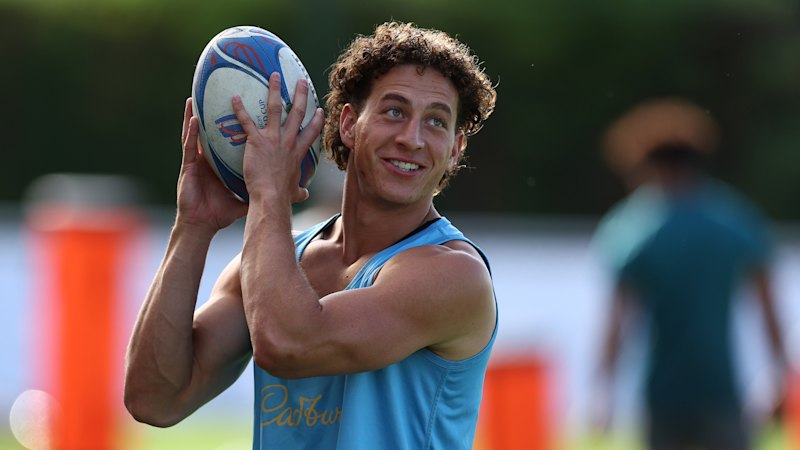
SYDNEY — Dual-code back Mark Nawaqanitawase has revealed he remains undecided about his international allegiance ahead of the 2027 Rugby World Cup, contradicting expectations within Australian rugby hierarchy that he would commit to the Wallabies. Speaking one year out from the tournament, the 26-year-old indicated that multiple factors remain under consideration before making a binding choice on which country to represent on the global stage.
Key facts
What happened
The uncertainty surrounding Nawaqanitawase's international future emerged publicly following comments in which he candidly pushed back against assumptions that his return to Australian gold was guaranteed. Wallabies coaching staff and Rugby Australia officials had operated under the working premise that the athletic wing and fullback would anchor the Australian backline during the 2027 global tournament on home soil.
Instead, Nawaqanitawase made clear that his decision remains entirely unresolved. When asked about his international pathway, he noted that competing priorities and familial considerations have complicated the choice, emphasizing that no final determination has been reached.
The revelation exposes a disconnect between Rugby Australia’s long-term planning and the athlete's personal timeline. Nawaqanitawase's emergence as an indecisive figure in international rugby comes as team selectors across both hemispheres finalize long-range squads for the quadrennial tournament. For Australian team management, who viewed the outside back as a central piece of their home campaign, the player's hesitation introduces unexpected turbulence into backline projections.
Why it matters
The decision carries immediate competitive, financial, and promotional consequences for international rugby in the southern hemisphere. At a competitive level, elite outside backs who combine aerial capability, top-end speed, and defensive versatility are rare commodities. For Australia, losing a proven international strike weapon to a direct Pacific rival would constitute a major setback. The Wallabies have spent recent seasons rebuilding squad depth and re-establishing high-performance consistency following an unprecedented pool-stage exit at the 2023 tournament. Losing an established test performer during what should be his physical peak would weaken Australia's tactical options on the wing and at fullback.
For Fiji, securing a player of Nawaqanitawase's caliber would represent another major milestone in the Pacific nation's push to convert its world-class talent pool into consistent tier-one test success. The Flying Fijians reached the World Cup quarterfinals in 2023 and defeated Australia in pool play, demonstrating that access to elite athletes through updated eligibility mechanisms can permanently rebalance international results. A commitment from Nawaqanitawase would reinforce Fiji's status as a top-tier contender capable of recruiting top talent directly from established traditional powers.
Beyond the field, the commercial ramifications are substantial. The 2027 Rugby World Cup in Australia represents a critical financial lifeline for Rugby Australia, which has navigated severe balance-sheet stress and heavy debt burdens following years of declining broadcast revenue and domestic attendance. High-profile, crossover stars who can attract general sports audiences are essential to driving domestic ticket sales, sponsorship activations, and broadcast ratings. If a marquee domestic name opts to represent a rival nation at Australia's home tournament, it would highlight ongoing systemic vulnerabilities in Rugby Australia’s player retention models.
The background
Nawaqanitawase rose to prominence in Australian rugby union through the New South Wales Waratahs system, making his Super Rugby debut in early 2020. Blessed with a 1.92-meter frame and exceptional aerial skills honed during an athletic upbringing in Sydney, he quickly developed into one of the country's most dangerous attacking threats. His domestic form earned him a senior Wallabies debut under then-coach Dave Rennie during the 2022 end-of-year European tour, where he delivered a breakout two-try performance against Wales at Cardiff's Principality Stadium.
He remained a core figure throughout 2023, earning selection under Eddie Jones for the Rugby World Cup in France. During that campaign, Nawaqanitawase started every pool match, scoring tries against Georgia and Wales even as Australia endured a historically disappointing tournament. In total, he amassed 11 caps and five tries in Australian test colors before transitioning codes at the conclusion of his contract to pursue opportunities in the National Rugby League with the Sydney Roosters.
His eligibility to switch national allegiances rests on a landmark regulatory change enacted by World Rugby's Council in November 2021, which took effect in January 2022. Under the amended Regulation 8, an internationally capped player may transfer allegiance to a second national union provided two strict criteria are met: the player must possess a genuine heritage connection through birth, parent, or grandparent in the second country, and they must observe a mandatory 36-month stand-down period during which they make zero international appearances for their original nation.
Nawaqanitawase qualifies for Fiji through his father, Sevuloni Nawaqanitawase, a native of the Pacific island nation. Because his final appearance for the Wallabies occurred during the pool stage of the 2023 World Cup in early autumn of that year, the mandatory three-year stand-down window elapses prior to the kickoff of the 2027 tournament. Consequently, under World Rugby rules, Nawaqanitawase will hold complete regulatory freedom to register for Fiji once the three-year hiatus concludes. The eligibility revision was originally designed to invigorate Pacific Island nations by allowing diaspora athletes previously tied to tier-one nations to represent their ancestral homelands, and Nawaqanitawase represents one of the most high-profile potential beneficiaries of the rule.
Reaction
While formal administrative statements have not yet been issued, key governing bodies and team management are expected to address the matter in upcoming squad briefings and commercial updates. Rugby Australia executive leadership and Wallabies coaching staff will face immediate pressure to clarify the nature of their ongoing dialogue with the player and verify whether any formal contract offers or incentives have been tabled.
Fiji Rugby Union officials and Flying Fijians coaching leadership are also expected to monitor the developments closely. Pacific rugby figures have consistently advocated for eligible heritage players to embrace their ancestral roots, often emphasizing cultural connection and the unique camaraderie of the Fijian squad environment. Domestic supporters in both Australia and Fiji have already engaged in intense debate across regional sports platforms, with Australian supporters expressing dismay at the potential loss of a homegrown talent, while Fijian fans have welcomed the prospect of adding another dynamic runner to an already explosive back division.
What we don't know yet
Several critical elements of Nawaqanitawase's decision-making process remain undisclosed. The primary unknown is whether the player has held direct, formal discussions with Fiji Rugby Union selectors or whether his hesitance reflects a broader uncertainty regarding his long-term sporting career across rugby league and rugby union codes. The financial terms and contractual structures available to him across competing codes and unions have not been made public, leaving it unclear whether compensation, domestic club commitments, or personal lifestyle preferences are driving his deliberation.
Furthermore, it is not yet established whether Wallabies head coach Joe Schmidt has delivered a specific contractual or sporting pitch to lock the player into Australia's 2027 campaign. Because formal squad selection remains distant, the degree to which Nawaqanitawase's comments represent an opening salvo in contract negotiations, an authentic cultural dilemma, or an expression of code-hopping indecision cannot yet be independently confirmed.
What to watch
The coming months will provide several tangible markers that will clarify Nawaqanitawase's ultimate direction. The most immediate checkpoint involves his domestic club contractual status, as commitments to Australian rugby union franchises or competing rugby league outfits will directly dictate his availability for international test windows. Under Rugby Australia's current contracting policy, participation in the national team generally requires alignment with a domestic Super Rugby Pacific franchise or an approved national contract.
Observers should also watch for the official expiration of his 36-month stand-down window under World Rugby Regulation 8, which will formally open the door for a switch of association. Concrete announcements regarding the Wallabies' extended preparation squads for the 2027 home season and the release of Fiji's international test fixtures will force both unions to declare their formal interest. Until Nawaqanitawase formally registers his allegiance with World Rugby or accepts a multi-year national contract, his international future will remain one of the most scrutinized questions leading into the 2027 tournament.
Reporting by Christy Doran first detailed Nawaqanitawase's unresolved international status and the conflicting expectations within Australian rugby.
How this story was produced
This report was written by The Global Wire newsroom from reporting first published by Christy Doran. We verify the core facts against the original report, write our own account, and add the background and consequences a short wire item leaves out. Drafting is AI-assisted inside an editor-supervised pipeline, and every story is checked for accuracy of attribution, structure and duplication before it appears — full detail in our AI and funding disclosure.
Spotted an error? Tell us at corrections@horizonglobalnews.com and read our corrections policy or editorial standards.


Reader comments
Loading comments…