

Albanian Prime Minister Warns Protesters After Clashes Leave Roughly 300 Injured
The government pledged bonuses and pay rises for police as escalating street confrontations drew sharp warnings from the prime minister.
By The Global Wire Newsroom · Reported from Agence France Presse
Link preview · horizonglobalnews.com
Albanian Prime Minister Warns Protesters After Clashes Leave Roughly 300 Injured
The government pledged bonuses and pay rises for police as escalating street confrontations drew sharp warnings from the prime minister.
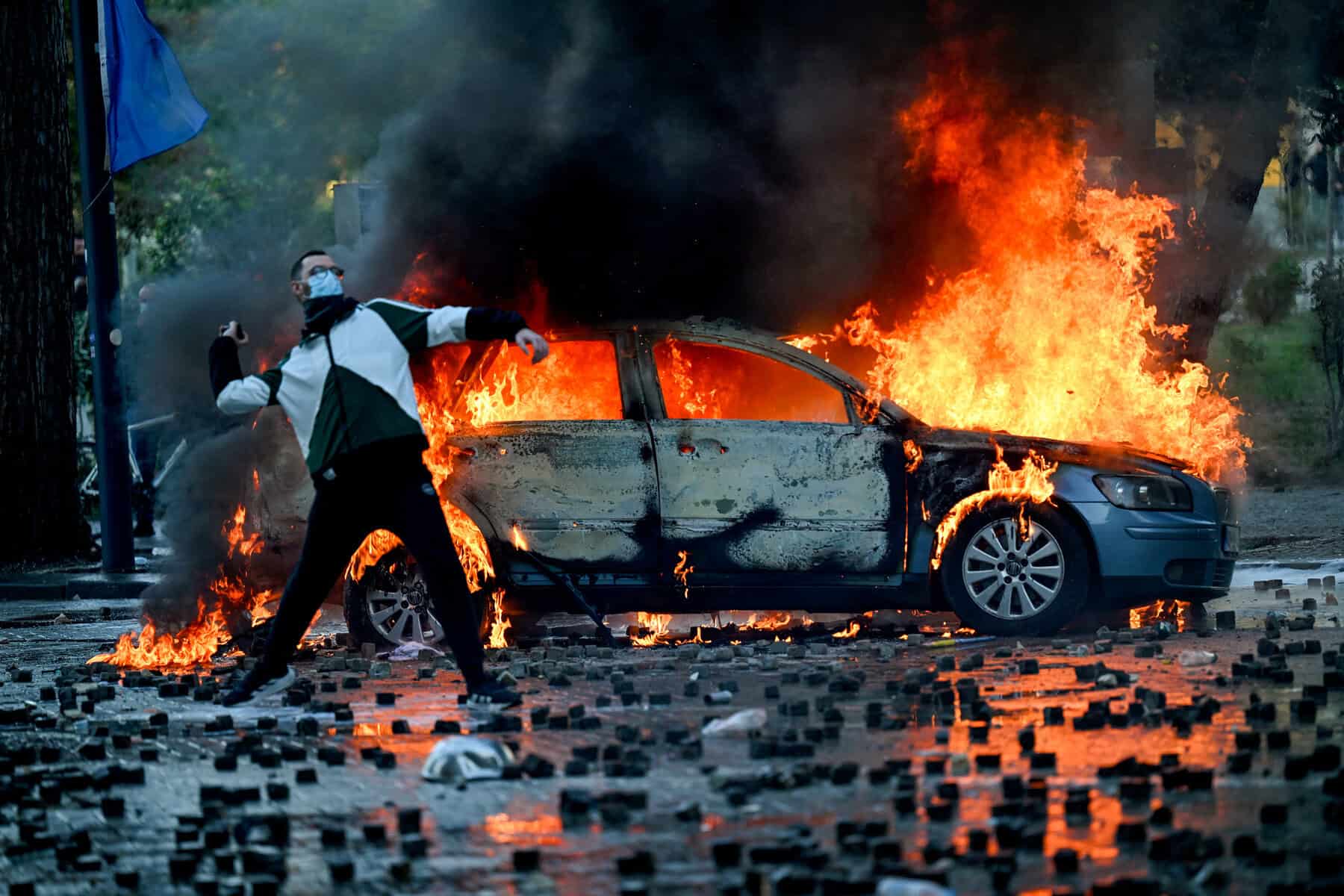
Violent street confrontations in Albania have left approximately 300 people injured, prompting the prime minister to declare that demonstrators crossed an intolerable line and driving the government to promise financial incentives for deployed police personnel, according to reporting by Agence France-Presse. The escalation marks one of the most intense flare-ups of civil friction in the Balkan nation in recent years, testing civil order in the capital and putting heavy strain on state security forces as political antagonism between the government and its opponents sharpens.
Key facts
What happened
According to reporting by Agence France-Presse, demonstrations over recent days deteriorated into direct physical confrontation between crowds and security units, yielding a casualty count of around 300 individuals. The injuries, sustained by both demonstrators and law enforcement officers, followed clashes characterized by intense street-level pressure on police perimeters, the use of riot-control measures, and reciprocal violence.
Faced with swelling disorder, the prime minister intervened publicly, stating that participants in the unrest had crossed an impermissible boundary. The denunciation was accompanied by a direct appeal to the state's security apparatus. To bolster operational resolve and reward personnel subjected to physical risk, the executive branch announced that officers on the frontline would receive emergency compensation payments alongside structural pay raises.
Government installations in central administrative districts have regularly served as focal points during Albanian public demonstrations. Law enforcement contingents tasked with securing institutional perimeters typically encounter concentrated groups attempting to breach barriers, using thrown projectiles, pyrotechnics, or improvised weapons. The magnitude of roughly 300 injured persons underscores the intensity of the latest engagements, requiring widespread medical intervention and the deployment of substantial reserves from the state police forces.
Why it matters
The casualty figure of around 300 people represents a significant shock to Albania’s public health infrastructure and domestic security posture. For citizens living and working in major metropolitan corridors, escalating unrest disrupts transit, shuttered commercial enterprises, and threatens personal safety. Furthermore, when street demonstrations produce casualties on this scale, the boundary between peaceful assembly and institutional crisis dissolves rapidly, putting the executive and judicial branches under scrutiny from both domestic watchdogs and foreign observers.
From a governance and fiscal perspective, the immediate pledge of bonus compensation and permanent salary hikes for police personnel carries tangible budget implications. Allocating unbudgeted funds to law enforcement during an active confrontation signals deep concern within the executive that police morale and discipline could fray under sustained public hostility. When governments rely on monetary incentives to maintain security cordons, critics frequently interpret the measure as a sign of institutional vulnerability, while supporters view it as necessary hazard compensation for public servants facing physical harm.
Beyond domestic borders, stability in Albania holds substantial geopolitical weight. As a NATO member state since 2009 and an official candidate for accession to the European Union, the country is evaluated rigorously on its adherence to democratic standards, freedom of assembly, and proportional use of police force. European institutions in Brussels closely monitor how candidate governments handle civil dissent and rule-of-law challenges. A protracted cycle of street violence, heavy-handed policing, and retaliatory unrest could complicate integration timelines, damage investor sentiment, and dampen international confidence in the state's institutional maturity.
The background
Albania's post-communist political history has been marked by acute polarization, primarily contested between the center-left Socialist Party (Partia Socialiste e Shqipërisë) and the center-right Democratic Party (Partia Demokratike e Shqipërisë). Since the collapse of the totalitarian regime in the early 1990s and the traumatic financial pyramid crisis of 1997—which led to widespread looting of armories and civil anarchy—electoral contests and governance in Albania have frequently spilt into public squares.
Prime Minister Edi Rama took office in 2013 and has secured successive parliamentary mandates, steering sweeping judicial reforms overseen by the European Union and the United States. These reforms included the creation of the Special Structure Against Corruption and Organized Crime, known locally by the acronym SPAK. While international partners have lauded SPAK for indicting high-ranking officials across party lines, the opposition has repeatedly accused the governing party of weaponizing state institutions, capturing the judiciary, and engaging in electoral clientelism.
Over the past decade, opposition coalitions have periodically staged sustained boycotts of parliament, local elections, and judicial processes, often mobilizing thousands of supporters on Tirana’s central boulevard, Dëshmorët e Kombit. Protests in front of the Prime Minister’s Office, the Parliament building, and the Tirana Municipality have recurrently featured clashes involving tear gas, water cannons, smoke bombs, and barricades. Law enforcement oversight falls under the State Police (Policia e Shtetit), whose operational capacity and crowd-control methods have drawn recurrent evaluations from international human rights bodies.
Simultaneously, Albania has faced severe socio-economic headwinds, including youth emigration, persistent cost-of-living pressures, and public frustration with perceived cronyism. When opposition political grievances overlap with broader civilian disillusionment, small demonstrations can rapidly expand into broader anti-government movements, increasing the likelihood of violent encounters between agitated crowds and security cordons.
Reaction
The prime minister's declaration that demonstrators crossed an impermissible line established a combative official tone, signaling that authorities intend to pursue legal accountability against individuals deemed responsible for violence. The accompanying announcement of financial remuneration for frontline police personnel was intended to project firm administrative backing for the ranks of the interior ministry.
While the wire account does not quote formal responses from opposition leaders, human rights monitors, or international embassies, reactions from these stakeholders follow a well-established pattern during Albanian political crises. Opposition figures typically condemn government warnings as authoritarian rhetoric designed to suppress legitimate popular dissent, often accusing police forces of using excessive force or acting as partisan enforcers. Civil society organizations and independent legal observers are expected to scrutinize whether detentions comply with constitutional safeguards and whether the response of riot units remained proportionate.
Diplomatic missions from the European Union and the United States, which maintain an active presence in Tirana, routinely issue statements urging restraint on both sides. In previous confrontations, Western diplomats have consistently affirmed the right to peaceful protest while condemning violent acts against public buildings and law enforcement officers, urging political adversaries to resolve grievances inside the assembly rather than through street warfare.
What we don't know yet
Several critical operational details remain unaddressed in available accounts. The precise composition of the roughly 300 injured individuals has not been publicly broken down: it is not yet established how many casualties occurred among police ranks versus civilian protesters, nor is the clinical severity of the injuries fully detailed. The number of hospitalizations, severe traumas, and outpatient treatments remains unverified.
Additionally, the specific flashpoints, underlying catalysts, or immediate triggers that turned the demonstration into violent clashes are not specified in the wire summary. Whether the confrontations were sparked by specific judicial rulings, legislative disputes, economic grievances, or police cordoning tactics remains unclear. Furthermore, the administrative and budgetary details of the promised police wage enhancements—including the exact amount of the frontline bonuses, the timeline for structural salary revisions, and the legislative mechanisms required to authorize them—have not been detailed.
What to watch
In the coming days and weeks, observers will be tracking several key markers to gauge whether the unrest stabilizes or intensifies:
This account is based on original reporting by Agence France-Presse.
How this story was produced
This report was written by The Global Wire newsroom from reporting first published by Agence France Presse. We verify the core facts against the original report, write our own account, and add the background and consequences a short wire item leaves out. Drafting is AI-assisted inside an editor-supervised pipeline, and every story is checked for accuracy of attribution, structure and duplication before it appears — full detail in our AI and funding disclosure.
Spotted an error? Tell us at corrections@horizonglobalnews.com and read our corrections policy or editorial standards.


Reader comments
Loading comments…