

Myanmar Military Ruler Min Aung Hlaing Schedules Diplomatic Trips to Vietnam and Cambodia
Senior General Min Aung Hlaing is scheduled to visit Hanoi and Phnom Penh in September, seeking regional engagement amid Myanmar's civil conflict and diplomatic isolation.
By The Global Wire Newsroom · Reported from thestar.com.my
Link preview · horizonglobalnews.com
Myanmar Military Ruler Min Aung Hlaing Schedules Diplomatic Trips to Vietnam and Cambodia
Senior General Min Aung Hlaing is scheduled to visit Hanoi and Phnom Penh in September, seeking regional engagement amid Myanmar's civil conflict and diplomatic isolation.
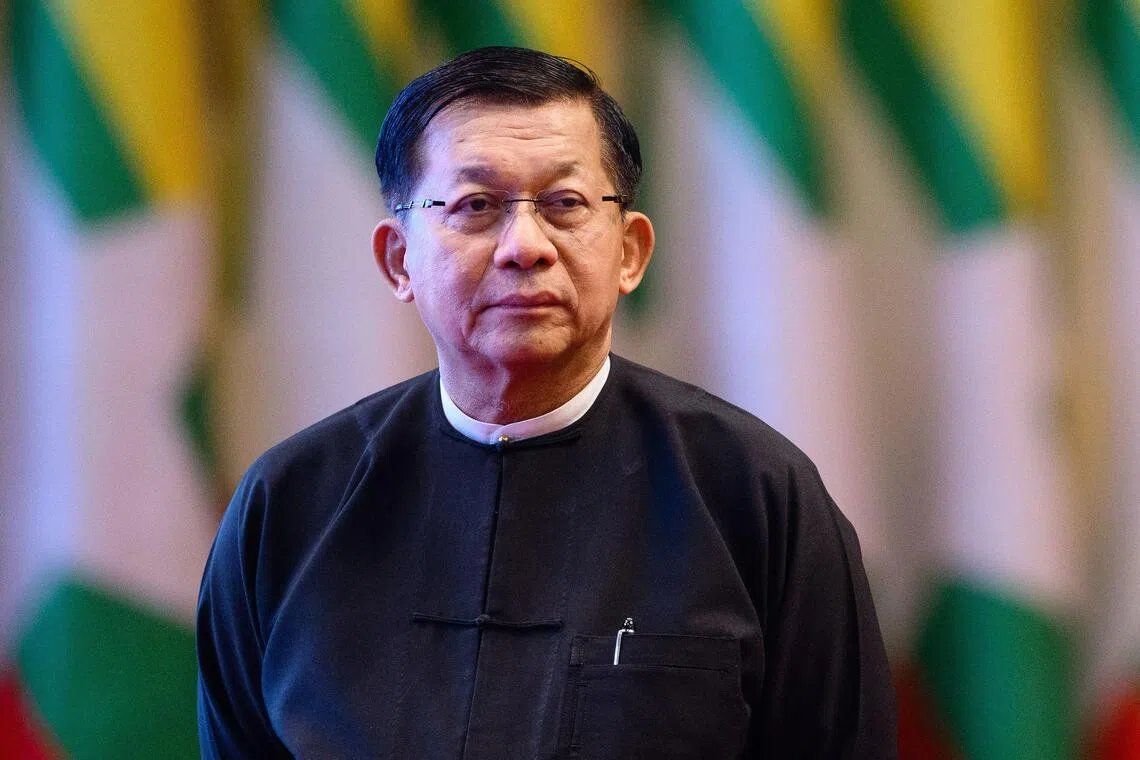
Myanmar’s military ruler, Senior General Min Aung Hlaing, is scheduled to make official visits to Vietnam and Cambodia during the first half of September 2026, according to regional diplomatic sources. The planned diplomatic tour represents a significant effort by the general, who recently assumed the formal duties of president, to expand bilateral ties within mainland Southeast Asia at a time when his administration remains largely excluded from high-level multilateral platforms. According to reporting by The Star, Min Aung Hlaing is expected to arrive in Vietnam on Sept. 4 for a three-day visit concluding Sept. 6, before traveling to Cambodia for a two-day itinerary spanning Sept. 11 to Sept. 12.
Key facts
What happened
The scheduled visits by Min Aung Hlaing to Hanoi and Phnom Penh were disclosed by diplomatic sources based in Bangkok, as published by The Star. The planned itinerary opens with a visit to Vietnam from Sept. 4 through Sept. 6, where the Myanmar military leader is anticipated to hold discussions with senior Vietnamese government and ruling party officials. Following a short return or interim stop, Min Aung Hlaing is scheduled to arrive in Cambodia on Sept. 11 for bilateral talks scheduled through Sept. 12.
The upcoming diplomatic tour follows a prolonged period during which Min Aung Hlaing's international travel was largely confined to non-Western partner nations, notably Russia and China, alongside limited international gatherings where his attendance was permitted. By securing bilateral state-level invitations from fellow ASEAN member states, the administration in Naypyidaw aims to re-establish routine diplomatic interactions with neighboring governments in mainland Southeast Asia.
While neither the government of Vietnam nor the Kingdom of Cambodia has publicly released full official schedules or detailed agenda descriptions for the early September meetings, bilateral talks are expected to center on regional security cooperation, border management, economic ties, and the broader political crisis in Myanmar.
Why it matters
The willingness of Vietnam and Cambodia to host Min Aung Hlaing highlights a persistent strategic rift within the 10-member Association of Southeast Asian Nations regarding how to handle the ruling junta in Naypyidaw. Since the military seized power in 2021, ASEAN has struggled to maintain a unified posture. While maritime members such as Indonesia, Malaysia, Singapore, and the Philippines have consistently advocated for enforcing strict diplomatic sanctions and withholding political recognition from the junta, neighboring mainland nations—including Thailand, Vietnam, Laos, and Cambodia—have frequently favored pragmatic, direct engagement.
For Min Aung Hlaing, these visits offer crucial domestic and international symbolic value. By appearing alongside recognized heads of state and government in Hanoi and Phnom Penh, the military leadership seeks to project an image of normalization and legal legitimacy. This political messaging is particularly aimed at counteracting the efforts of the opposition National Unity Government (NUG), an alliance of ousted democratic lawmakers and anti-junta groups that operates internationally to secure official recognition as Myanmar’s legitimate authority.
Economically and strategically, Vietnam and Cambodia share tangible interests with Myanmar that complicate isolation efforts. Vietnam maintains significant investments in Myanmar, particularly in telecommunications, banking, and agriculture, which Hanoi seeks to safeguard despite widespread political instability. Cambodia, under both long-serving former Prime Minister Hun Sen and his successor Prime Minister Hun Manet, has historically maintained that total exclusion of the military administration impedes regional conflict resolution. However, bilateral hosting of the junta leader risks undermining ASEAN's collective bargaining power, further diluting the bloc's official policy of conditioning high-level engagement on concrete political reforms and a cessation of military violence.
The background
Myanmar was plunged into deep political and civil crisis on Feb. 1, 2021, when the Tatmadaw, led by Senior General Min Aung Hlaing, overthrew the democratically elected government of the National League for Democracy (NLD) led by Nobel laureate Aung San Suu Kyi. The military formed the State Administration Council (SAC) to govern the nation, alleging widespread voter fraud during the November 2020 general election—claims rejected by domestic and international election observers.
In response to the coup, widespread peaceful protests were met with severe military crackdowns, triggering the rapid emergence of armed resistance groups known as People's Defence Forces (PDFs). These forces aligned with long-standing ethnic armed organizations (EAOs) along Myanmar’s borderlands, escalating the country into a full-scale civil conflict. The military's territorial control has eroded substantially following major armed offensives by resistance coalitions, including Operation 1027 launched in late 2023, which resulted in the loss of key border trade hubs and military posts along the Chinese border.
Internationally, ASEAN convened an emergency leaders' summit in Jakarta in April 2021, attended by Min Aung Hlaing himself. The meeting produced the Five-Point Consensus, a peace framework that called for an immediate cessation of violence, constructive dialogue among all parties, the appointment of a special ASEAN envoy, provision of humanitarian assistance, and a visit by the envoy to Myanmar to meet all stakeholders.
However, as the junta repeatedly failed to implement the consensus commitments, ASEAN leaders took the unprecedented step in late 2021 of barring non-political representatives from Myanmar from attending official summits and ministerial council meetings. This policy was maintained through successive ASEAN chairmanships held by Cambodia (2022), Indonesia (2023), Laos (2024), and Malaysia (2025).
Despite the consensus ban on summit participation, bilateral channels between Naypyidaw and individual neighboring states have remained open. In January 2022, then-Cambodian Prime Minister Hun Sen became the first foreign leader to visit Myanmar post-coup, attempting a controversial direct diplomatic initiative that drew sharp criticism from human rights groups and several fellow ASEAN nations. Min Aung Hlaing's title transition to president—assuming executive functions after former acting president Myint Swe was placed on medical leave—reflects an effort by the military leadership to formalize state governance ahead of proposed, though widely disputed, future national elections.
Reaction
The reported travel plans have drawn scrutiny from regional diplomatic watchers, international human rights organizations, and Myanmar's opposition movement. Opponents of the military junta, including representatives of the National Unity Government, routinely condemn state visits hosted for Min Aung Hlaing, arguing that official receptions provide diplomatic cover to a military regime accused by United Nations investigators of extensive war crimes and human rights violations against civilians.
Within ASEAN, formal public statements from individual member capitals regarding the upcoming trips have not been issued. However, the visits are expected to heighten internal debate at upcoming regional diplomatic forums. Maritime ASEAN nations, particularly Malaysia and Indonesia, have repeatedly emphasized that member states should adhere strictly to the spirit of the Five-Point Consensus and refrain from unilateral actions that could be interpreted as conferring formal legitimacy on the junta.
Human rights advocates and international civil society groups are expected to renew calls on the governments of Vietnam and Cambodia to cancel the visits, urge an immediate end to military airstrikes, and press for the unconditional release of political prisoners, including Aung San Suu Kyi and former President Win Myint.
What we don't know yet
Several critical elements of the scheduled diplomatic mission remain undisclosed or unconfirmed by official government channels. It is not yet clear precisely which state officials Min Aung Hlaing will meet during his stops in Hanoi and Phnom Penh. Specifically, details remain unannounced regarding whether he will receive formal audiences with Cambodian Prime Minister Hun Manet, King Norodom Sihamoni, or senior leaders of the ruling Communist Party of Vietnam.
Additionally, the specific diplomatic deliverables, economic agreements, or security memorandums intended for negotiation during the Sept. 4–6 and Sept. 11–12 trips have not been made public. Gaps also remain regarding whether these visits signify a coordinated diplomatic initiative by mainland ASEAN states or represent separate bilateral engagements conducted independently of the broader ASEAN chair framework. Finally, the extent to which host nations will address the implementation of the Five-Point Consensus during private discussions remains unknown.
What to watch
In the coming days, observers will monitor official state media organs in Myanmar, Vietnam, and Cambodia for formal announcements confirming meeting agendas, protocol levels, and delegation compositions. Key indicators will include whether official joint press briefings or signed bilateral communiqués accompany the visits in Hanoi and Phnom Penh.
Diplomats will also closely track reactions from fellow ASEAN member states in the lead-up to annual regional summits, evaluating whether the bilateral hosting of Min Aung Hlaing prompts formal pushback or policy recalibrations from states advocating strict non-engagement. Furthermore, developments on the ground in Myanmar will be critical; anti-junta resistance groups and the National Unity Government may coordinate diplomatic counter-protests or intensify military operations to counter the junta's narrative of regional stability and control.
This report is based on reporting originally published by The Star.
How this story was produced
This report was written by The Global Wire newsroom from reporting first published by thestar.com.my. We verify the core facts against the original report, write our own account, and add the background and consequences a short wire item leaves out. Drafting is AI-assisted inside an editor-supervised pipeline, and every story is checked for accuracy of attribution, structure and duplication before it appears — full detail in our AI and funding disclosure.
Spotted an error? Tell us at corrections@horizonglobalnews.com and read our corrections policy or editorial standards.




Reader comments
Loading comments…