

Agile Bicycle Robot Uses Internal Moving Mass and AI to Execute Flips and Jumps
Researchers have developed a two-wheeled robotic platform that combines deep reinforcement learning with an internal shifting mass to execute jumps, wheelies, and mid-air acrobatic maneuvers.
By The Global Wire Newsroom · Reported from Jijo Malayil
Link preview · horizonglobalnews.com
Agile Bicycle Robot Uses Internal Moving Mass and AI to Execute Flips and Jumps
Researchers have developed a two-wheeled robotic platform that combines deep reinforcement learning with an internal shifting mass to execute jumps, wheelies, and mid-air acrobatic maneuvers.
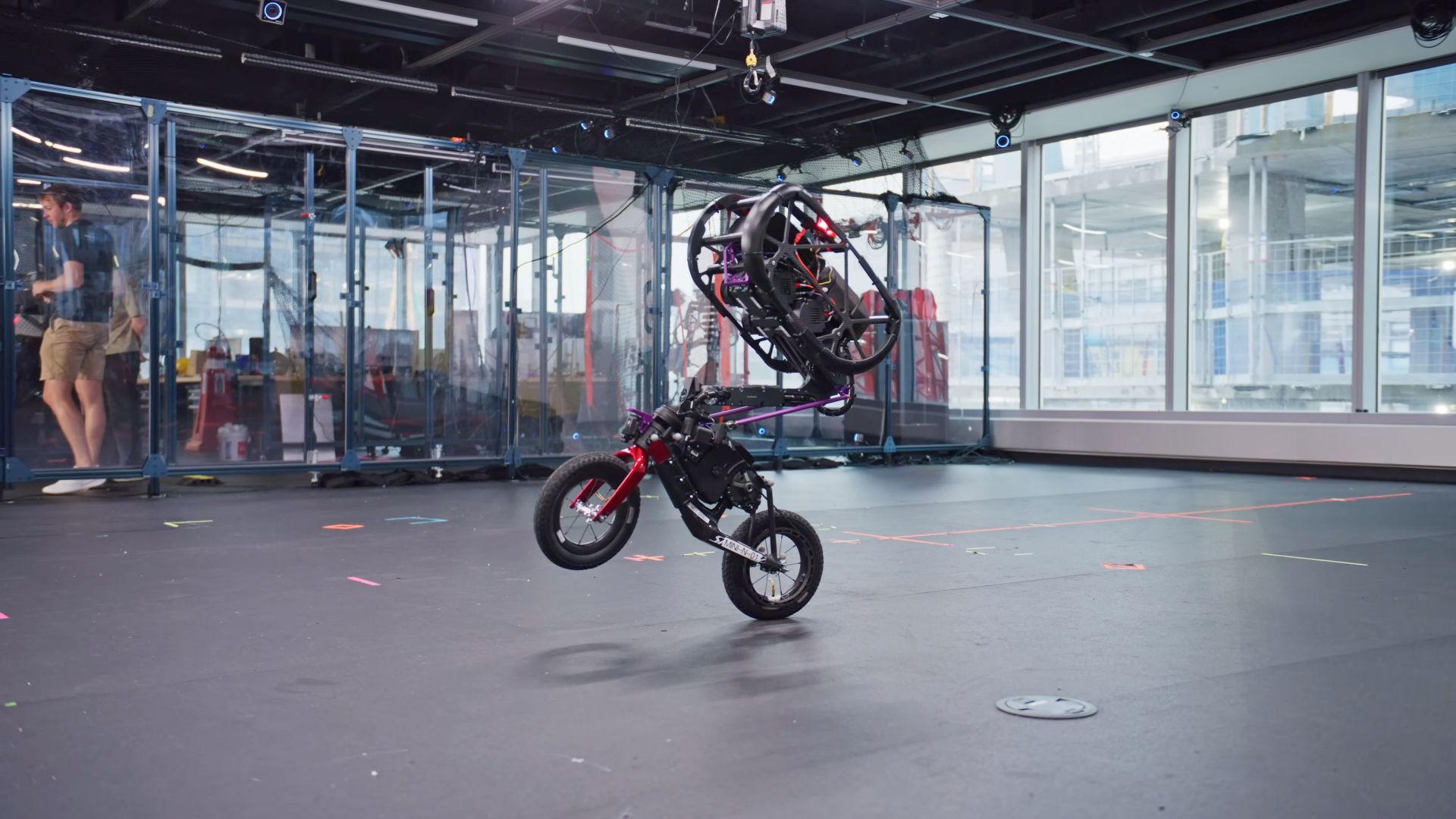
Robotics researchers have introduced a bicycle-inspired mobile robot capable of executing advanced dynamic maneuvers, including lateral hopping, front flips, and sustained single-wheel balance. As reported by Jijo Malayil, the two-wheeled autonomous system relies on artificial intelligence trained through reinforcement learning paired with an internal moving mass weight mechanism. This combined architecture enables the robot to alter its center of gravity dynamically, allowing it to execute high-impact aerial stunts and rapidly recover its equilibrium upon impact with the ground.
Key facts
What happened
In standard two-wheeled ground vehicles, stability is typically maintained through forward momentum, front-wheel steering adjustments, or external gyroscopic flywheels. The newly demonstrated platform expands on these classical mechanics by integrating an active internal shifting weight alongside a specialized control framework driven by deep reinforcement learning.
According to reporting by Jijo Malayil, the robot executes aggressive maneuvers by using its internal moving mass to instantly bias its center of gravity. When initiating a front flip or a lateral hop, the robot coordinates motor torques across its wheels while simultaneously sliding or shifting the internal mass. This action generates sufficient angular momentum to launch the vehicle off the surface or pitch it forward into an acrobatic flip.
During airborne phases—where traditional steering inputs have no effect due to the loss of tire contact with the ground—the moving mass continues to exert control torque through conservation of angular momentum. Upon landing, the neural-network-based control policy immediately processes onboard sensor telemetry to reposition the internal mass and apply corrective wheel torque, preventing the robot from tipping over or skidding out.
In addition to full airborne jumps and front flips, the control system allows the robot to balance on its rear wheel to perform prolonged wheelies, as well as hop sideways to translate across surfaces without pivoting its chassis. The machine manages these tasks autonomously without human pilot intervention, relying on real-time onboard computation to execute the complex motor sequences required for each trick.
Why it matters
Unmanned ground vehicles (UGVs) faced with obstacles generally rely on multi-legged locomotion, such as quadrupedal systems, or heavy tracked chassis to cross rough terrain. However, legged and tracked robots incur significant mechanical complexity, higher manufacturing costs, and elevated energy consumption compared to wheeled platforms. Standard wheeled robots, conversely, are traditionally constrained to smooth, continuous surfaces and struggle with abrupt drops, vertical ledges, or wide gaps.
By demonstrating that a lightweight, two-wheeled bicycle robot can leap over obstacles, jump sideways, and recover from full mid-air inversions, researchers offer a potential path toward energy-efficient, high-agility ground robotics. A two-wheeled system possesses a minimal ground footprint, reducing rolling resistance during baseline transport on flat surfaces. Integrating hopping and flipping capabilities bridges the performance gap between power-efficient wheeled transport and terrain-adaptable legged systems.
Furthermore, the success of this system highlights advancements in sim-to-real transfer within reinforcement learning. Training artificial neural networks in high-speed physics simulators allows algorithms to experience millions of control failure scenarios without risking physical hardware. Demonstrating that complex multi-body mechanics—involving non-linear shifting masses and impact dynamics—can be learned in simulation and successfully deployed onto real-world hardware represents a notable validation of modern robotic control methodologies.
Potential real-world applications for agile two-wheeled platforms include search-and-rescue operations in collapsed structures where space is constrained, industrial inspection within narrow pipe racks, and last-mile urban logistics where curb-hopping and step-climbing are required.
The background
Two-wheeled self-balancing technology has evolved through distinct phases over the past several decades. Early dynamic self-balancing systems gained commercial prominence in 2001 with the release of the Segway Human Transporter, which relied on inverted pendulum mechanics, solid-state gyroscopes, and tilt sensors to maintain upright stability. In 2005, Japanese electronics firm Murata Manufacturing showcased "Murata Boy," a robotic bicycle that used an internal reaction wheel inside its frame to maintain equilibrium while stationary or moving at low speeds.
Subsequent research platforms explored control moment gyroscopic flywheels, reaction wheels, and high-torque direct-drive motors. Academic projects, such as those conducted at ETH Zurich with the "Cubli" project, demonstrated that reaction wheels could jump and balance cubic structures on single corners by abruptly decelerating spinning flywheels. Later hybrid designs, including Boston Dynamics' Handle robot introduced in 2017, combined legs with powered wheels to navigate stairs and jump over obstacles using complex hydraulic and electric actuation.
Classical control theory for bicycles relies heavily on the Whipple bicycle model, a mathematical formulation that describes how steering geometry, speed, mass distribution, and gyroscopic forces interact. Under traditional controls, maintaining balance requires steering the front wheel into the direction of an unwanted lean to generate centrifugal force that restores upright positioning.
However, when a two-wheeled machine is airborne or operating at low forward velocities during extreme pitch angles, steering inputs become ineffective. To overcome this limit, roboticists turned to internal moving mass actuation (MMA) and control moment gyroscopes (CMGs). When paired with modern deep reinforcement learning algorithms hosted in environments like NVIDIA Isaac Gym or MuJoCo, algorithms can discover complex actuation timings—such as shifting internal weights in counter-intuitive patterns—that human control engineers would struggle to model manually.
Reaction
The academic and industrial robotics communities broadly monitor developments in highly dynamic underactuated systems, as these platforms push the limits of power density and controller adaptability. Robotics engineers generally evaluate moving-mass architectures against alternative balancing techniques, such as reaction wheels or control moment gyroscopes, weighing trade-offs in power consumption, weight distribution, and control bandwidth.
While reaction wheels offer continuous torque generation, they often require high-speed motors that consume significant electrical power and add dead weight when unpowered. Moving mass systems, by contrast, utilize mechanical leverage and linear displacement, which can produce rapid shifting of center-of-gravity vectors using compact linear actuators.
Formally peer-reviewed feedback from broader technical conferences—such as the IEEE International Conference on Robotics and Automation (ICRA) or the International Conference on Intelligent Robots and Systems (IROS)—typically focuses on the safety, repeatability, and endurance limits of such reinforcement learning policies. Field operators and commercial deployment teams are expected to scrutinize how well these AI-driven balancing models adapt to varying environmental conditions without losing control integrity.
What we don't know yet
Several technical specifics regarding the physical construct and performance limits of the bicycle robot remain unconfirmed in available reports. Key unknown factors include:
Understanding these variables is critical for evaluating whether the concept can transition from a laboratory demonstration to practical commercial or industrial hardware.
What to watch
Moving forward, several key milestones will clarify the trajectory and viability of this robotic platform:
This account is based on original reporting published by Jijo Malayil on October 14, 2026.
How this story was produced
This report was written by The Global Wire newsroom from reporting first published by Jijo Malayil. We verify the core facts against the original report, write our own account, and add the background and consequences a short wire item leaves out. Drafting is AI-assisted inside an editor-supervised pipeline, and every story is checked for accuracy of attribution, structure and duplication before it appears — full detail in our AI and funding disclosure.
Spotted an error? Tell us at corrections@horizonglobalnews.com and read our corrections policy or editorial standards.




Reader comments
Loading comments…