

India Unveils Trio of Domestic AI Foundation Models to Bolster Sovereign Technology
The Ministry of Electronics and IT launched Eka-1, Dhir 2B, and Dhir 5B, built by homegrown startups Soket Labs and ZenteiQ, to expand India's domestic artificial intelligence ecosystem.
By The Global Wire Newsroom · Reported from ET Online
Link preview · horizonglobalnews.com
India Unveils Trio of Domestic AI Foundation Models to Bolster Sovereign Technology
The Ministry of Electronics and IT launched Eka-1, Dhir 2B, and Dhir 5B, built by homegrown startups Soket Labs and ZenteiQ, to expand India's domestic artificial intelligence ecosystem.
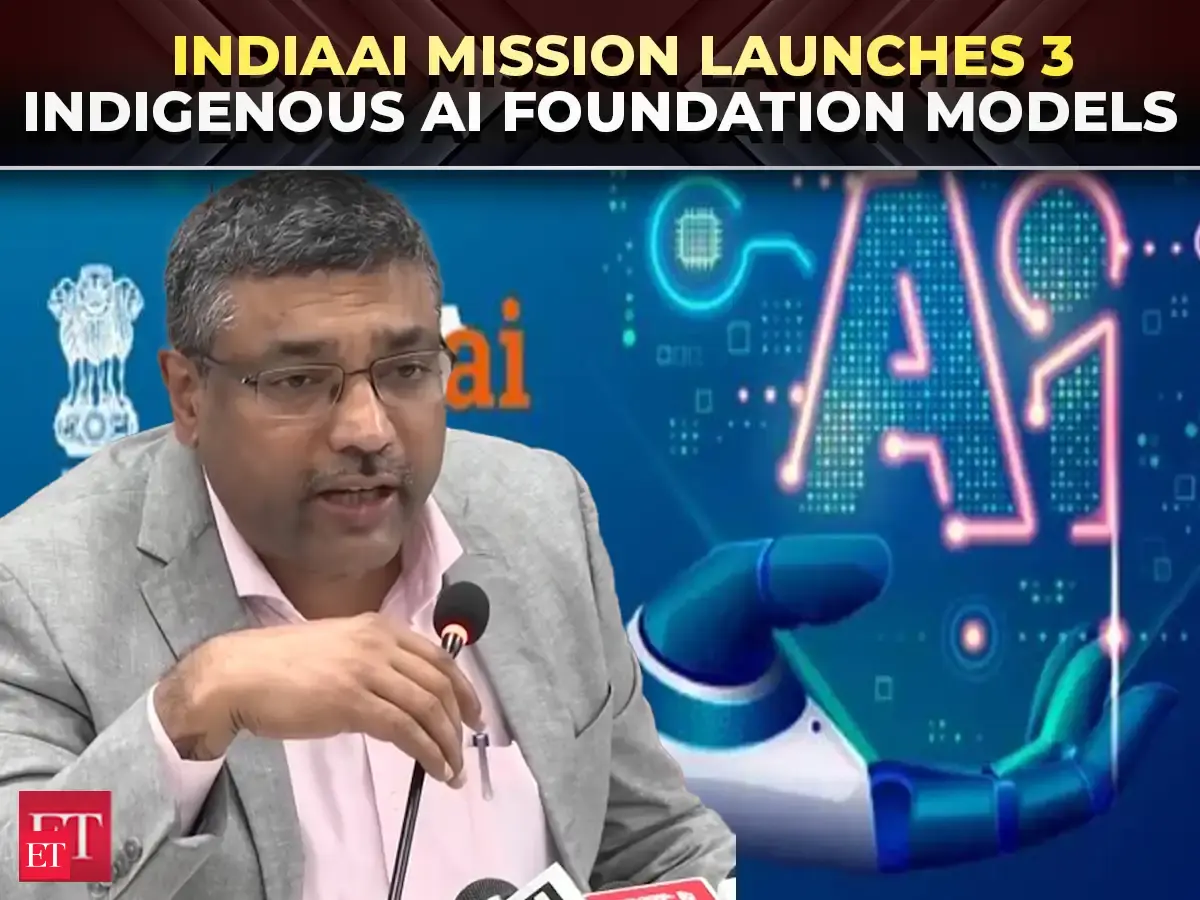
NEW DELHI — India's Ministry of Electronics and Information Technology on Thursday oversaw the formal rollout of three home-grown artificial intelligence foundation models, marking an official push to establish domestic sovereign capabilities in core machine-learning architecture. The newly introduced systems include Eka-1, created by Soket Labs, alongside Dhir 2B and Dhir 5B, developed by ZenteiQ. Unveiled during an official ministry event attended by senior policymakers and industry representatives, the public release of the models reflects an escalating effort by New Delhi to reduce strategic reliance on imported Western and Chinese computing frameworks while tailoring foundational software to India's multilingual and institutional requirements.
Key facts
What happened
During a dedicated presentation hosted by the Ministry of Electronics and Information Technology, government officials and technologists assembled to inaugurate three generative foundation architectures built entirely by domestic engineering teams. Ministry Secretary S. Krishnan led the proceedings, formally introducing Eka-1 from Soket Labs as well as the Dhir 2B and Dhir 5B family of models from ZenteiQ. Krishnan emphasized that making foundational weights and architectures publicly accessible serves as a structural baseline for independent software engineering across the subcontinent.
The models themselves occupy distinct segments within the broader machine learning landscape. Soket Labs designed Eka-1 to address foundational tasks, while ZenteiQ's Dhir series addresses lower-parameter computing environments. The numerical designations for Dhir 2B and Dhir 5B signify parameter scales of approximately two billion and five billion variables, a tier intentionally tuned for edge computing, low-latency deployments, and cost-constrained inference environments rather than the massive, hundred-billion-parameter clusters maintained by hyperscale American technology corporations.
Throughout the rollout, ministry officials outlined how the public debut of these systems bridges academic research and commercial deployment. Rather than relying entirely on application-layer wrappers built on top of external application programming interfaces, the ministry highlighted the strategic necessity of cultivating native architectures where training corpuses, tokenization mechanics, and alignment protocols remain under domestic oversight.
Why it matters
The introduction of domestic base models carries broad ramifications for enterprise digitization, data sovereignty, and the allocation of national technological capital. For decades, emerging economies have operated predominantly as consumers of foreign-built software architectures. In the domain of artificial intelligence, relying entirely on proprietary systems maintained outside national boundaries creates systemic vulnerabilities regarding platform access, recurring licensing expenditure, foreign exchange flight, and abrupt service modifications governed by overseas regulatory jurisdictions.
By establishing functional foundation models engineered by Soket Labs and ZenteiQ, local developers gain access to tools that can be customized for specific domestic use cases without routing proprietary information through offshore data centers. Smaller footprint models like Dhir 2B and Dhir 5B are particularly relevant for decentralized enterprise environments, such as regional banking institutions, municipal governance bodies, and localized healthcare clinics. These organizations frequently operate under stringent budgetary limitations and fragmented telecommunications networks, making massive models economically unviable and technically impractical to host.
Furthermore, the linguistic profile of the Indian subcontinent presents computational complexities that global foundation models historically neglect. India recognizes 22 official regional languages written across 13 unique scripts, with hundreds of non-scheduled dialects spoken across rural districts. Mainstream foundation models trained overwhelmingly on English-dominated digital archives struggle with accurate tokenization, phonetic transliteration, and semantic context when parsing Indic vernaculars. Native models constructed by local teams provide a baseline designed to minimize semantic loss and computational overhead for Indian languages, enabling more equitable citizen access to digital services.
The background
India has spent several years formulating a comprehensive national policy to transition from an IT outsourcing hub into a primary developer of frontier technologies. In March 2024, the Union Cabinet sanctioned the comprehensive IndiaAI Mission with a multi-year budgetary allocation of 10,372 crore Indian rupees, equivalent to approximately 1.25 billion dollars. A central pillar of that expenditure targeted the procurement and aggregation of high-performance computing infrastructure, with government plans aiming to deploy a shared public pool of at least 10,000 graphics processing units to democratize access for startups and academic labs.
Historically, the capital intensity required to train large foundation models from scratch has concentrated frontier development within a handful of deep-pocketed tech giants based in the United States and China. Frontier training runs routinely require millions of dollars in compute time, proprietary high-bandwidth memory chips, and vast petabyte-scale data pipelines. Consequently, smaller nations and private enterprises faced steep economic barriers to entry, often resigning themselves to fine-tuning foreign base models such as Meta's LLaMA series or licensing closed APIs from OpenAI and Google.
To counter this technological asymmetry, Indian authorities introduced initiatives like the Digital India Bhashini Division, tasked with assembling multilingual speech and text datasets across all scheduled regional languages. Concurrently, academic institutions such as the Indian Institutes of Technology, alongside early-stage venture studios, began experimenting with national models such as BharatGPT, Hanooman, and Krutrim. The official debut of Eka-1 alongside the Dhir family represents an institutional continuation of this push, transitioning national objectives from theoretical frameworks and private demonstrations into officially backed releases.
Reaction
Industry organizations, software developers, and academic institutions in New Delhi and Bengaluru are closely monitoring the official reception of the new models. While official responses during the launch event were anchored by Secretary S. Krishnan, broader developer networks across India's technology hubs have expressed keen interest in the licensing terms, architectural documentation, and API availability governing Eka-1 and the Dhir models.
Public sector bodies, including the National Informatics Centre and various state-level administrative departments, are expected to review the models as potential candidates for internal administrative automation, citizen grievance redressal portals, and regional-language document summarization. Independent enterprise software developers are similarly reviewing whether the operational costs of the two-billion and five-billion parameter models provide a sustainable alternative to established open-weight weights distributed by international consortia.
Representatives from civil society and digital rights organizations are anticipated to scrutinize the transparency of the underlying training corpuses, seeking formal disclosures regarding data copyright compliance, linguistic representativeness, and the methodologies employed to scrub bias during the reinforcement learning and alignment phases.
What we don't know yet
Significant technical and commercial details concerning the three models remain unverified in the initial public announcements. The Ministry of Electronics and Information Technology and the participating startups have not yet published exhaustive technical white papers specifying the exact composition of the training datasets, the total token counts ingested during pre-training, or the precise hardware infrastructure utilized to train Eka-1 and the Dhir series.
Additionally, standard benchmark evaluations measuring performance against comparable open-weight systems—such as Meta's LLaMA 3.2 family, Mistral AI's compact architectures, or Microsoft's Phi models—have not yet been independently verified across standard reasoning, mathematics, coding, and multi-turn conversational rubrics. It remains uncertain whether the software weights will be published under fully permissive open-source licenses, such as Apache 2.0 or MIT, or distributed through restricted research licenses that limit unrestricted commercial usage. The commercial pricing structure for enterprise API access, hosting arrangements on sovereign cloud networks, and developer documentation standards also remain unaddressed.
What to watch
The immediate trajectory of these models will depend heavily on the rollout of comprehensive developer portals and technical white papers over the coming weeks. The open-source machine learning community will look to verify whether Soket Labs and ZenteiQ upload the model checkpoints to public repositories such as Hugging Face, allowing global researchers to evaluate the architectures against standard benchmark suites like MMLU, GSM8K, and specialized Indic language evaluations.
Observers should also monitor whether the Ministry of Electronics and Information Technology integrates Eka-1 and the Dhir models into live public-sector applications, such as the Unified Mobile Application for New-age Governance or state-level land records platforms. The broader integration of these models with the IndiaAI computing cluster, particularly through government-subsidized compute credits for local startups building on these foundations, will serve as a practical indicator of their long-term viability against entrenched international alternatives.
This report is based on original reporting published by ET Online.
How this story was produced
This report was written by The Global Wire newsroom from reporting first published by ET Online. We verify the core facts against the original report, write our own account, and add the background and consequences a short wire item leaves out. Drafting is AI-assisted inside an editor-supervised pipeline, and every story is checked for accuracy of attribution, structure and duplication before it appears — full detail in our AI and funding disclosure.
Spotted an error? Tell us at corrections@horizonglobalnews.com and read our corrections policy or editorial standards.






Reader comments
Loading comments…