

India Completes 480-Metre Sabarmati Bridge for Mumbai-Ahmedabad High-Speed Rail
Engineers finish a key 36-metre-high river span in Ahmedabad using balanced cantilever construction for India's flagship bullet train corridor.
By The Global Wire Newsroom · Reported from ET Online
Link preview · horizonglobalnews.com
India Completes 480-Metre Sabarmati Bridge for Mumbai-Ahmedabad High-Speed Rail
Engineers finish a key 36-metre-high river span in Ahmedabad using balanced cantilever construction for India's flagship bullet train corridor.
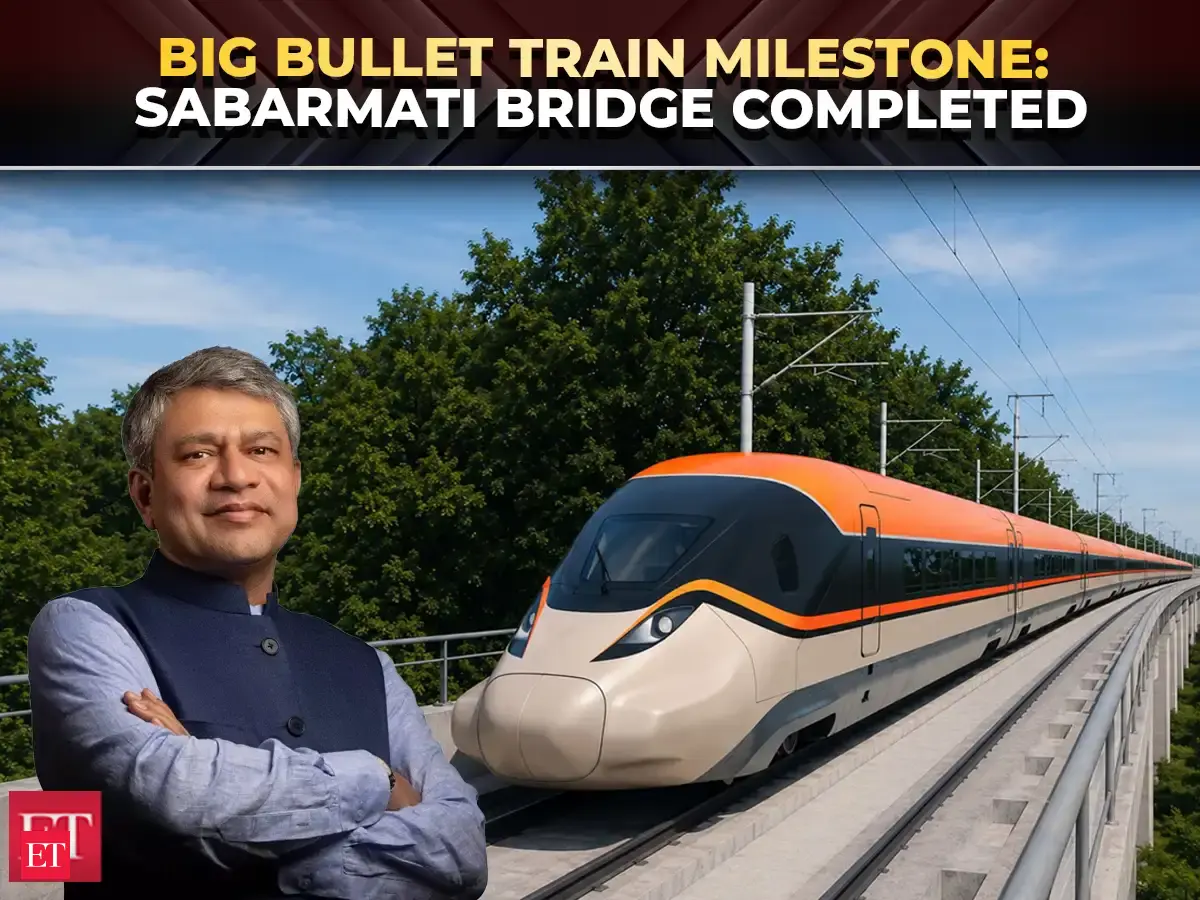
AHMEDABAD, India — Construction crews have successfully completed the 480-metre-long bridge over the Sabarmati River in Ahmedabad, achieving a major civil engineering landmark for India’s flagship Mumbai-Ahmedabad High-Speed Rail corridor, according to reporting by ET Online on October 8, 2026. The structure, which stands 36 metres above the riverbed, relies on eight massive circular piers and was erected using the balanced cantilever construction methodology. The bridge forms a crucial link in the northern section of the 508-kilometre high-speed rail line designed to connect India’s commercial capital of Mumbai with the industrial center of Ahmedabad at operating speeds reaching 320 kilometres per hour.
Key facts
What happened
The completion of the Sabarmati River bridge represents one of the most complex river-crossing engineering tasks along the northern stretch of the Mumbai-Ahmedabad bullet train corridor. According to reporting by ET Online, the structure spans 480 metres and elevates the high-speed track bed 36 metres above the river floor, providing necessary vertical clearance for seasonal water fluctuations and urban infrastructure below.
To span the wide riverbed without obstructing water flow or requiring temporary support towers inside the active channel, project engineers adopted the Balanced Cantilever Method. This specialized civil engineering technique involves building concrete box girder segments outward from central pier supports in synchronized pairs on opposite sides. By maintaining symmetrical weight distribution around each of the eight circular piers, workers can construct long structural spans suspended over open water or deep terrain until adjacent segments meet and are post-tensioned together at mid-span.
The eight circular concrete piers were constructed to withstand high hydrodynamic forces during monsoon floods while bearing the heavy dead weight of the concrete superstructure and the dynamic loads of high-speed passenger trains traveling overhead. With the main concrete superstructure of the Sabarmati bridge now physically joined, civil engineering crews can transition to the subsequent phases of rail corridor installation, including track bed preparation, system integration, and electrical overhead equipment installation across the span.
Why it matters
The successful erection of the Sabarmati River bridge is a fundamental milestone for the operational viability of the high-speed rail network in Gujarat. The bridge serves as a critical entryway into Ahmedabad, positioning the line to link directly into the Sabarmati multimodal transport hub, which is designed to connect bullet train passengers with existing Indian Railways lines and local bus rapid transit systems.
Once fully operational, the 508-kilometre Mumbai-Ahmedabad High-Speed Rail corridor is projected to reduce travel time between India’s financial center and Gujarat’s main business hub from the current six-to-eight-hour conventional train journey to approximately two hours for fast express services. The project aims to dramatically transform regional commerce, enabling same-day business travel and spurring economic integration along the industrial belt spanning western Maharashtra and Gujarat.
Furthermore, mastering complex civil engineering challenges—such as constructing long-span river crossings using the balanced cantilever technique—enhances domestic technical capacity within India’s infrastructure construction sector. The successful completion of major river bridges along the alignment establishes tested construction protocols for future high-speed rail projects planned across the Indian subcontinent.
The background
The Mumbai-Ahmedabad High-Speed Rail (MAHSR) project, often referred to as India’s first bullet train line, was officially launched following a bilateral agreement between India and Japan in December 2015. Under the agreement, Japan agreed to provide advanced Shinkansen technology alongside substantial financial support. The Japan International Cooperation Agency (JICA) committed to funding approximately 80 percent of the estimated project cost through a soft loan carrying an interest rate of 0.1 percent, with a 50-year repayment tenure and a 15-year grace period.
To execute the project, the Union Ministry of Railways jointly established the National High Speed Rail Corporation Limited (NHSRCL) in 2016 alongside the state governments of Gujarat and Maharashtra. The full corridor spans 508.17 kilometres, comprising 348 kilometres in Gujarat, 156 kilometres in Maharashtra, and 4 kilometres in the Union Territory of Dadra and Nagar Haveli. The route features 12 proposed stations: Mumbai Bandra-Kurla Complex (BKC), Thane, Virar, Boisar, Vapi, Bilimora, Surat, Bharuch, Vadodara, Anand, Ahmedabad, and Sabarmati.
While the original target completion date was set for 2023, the project encountered significant delays due to land acquisition disputes—particularly in Maharashtra—alongside environmental permitting requirements and operational slowdowns during the COVID-19 pandemic. Consequently, project authorities shifted to a phased operational strategy, prioritizing the construction of the Gujarat segment where civil works progressed at a faster pace.
The alignment requires dozens of major river crossings across western India, including major bridges over the Narmada, Tapi, Mahi, and Sabarmati rivers. The technical parameters of the line are modeled on Japan’s E5 Series Shinkansen system, designed for operational speeds of up to 320 km/h with a maximum design speed of 350 km/h, utilizing ballastless track systems engineered for high-velocity stability and reduced maintenance requirements.
Reaction
Following the milestone reported by ET Online, project execution teams and transport infrastructure specialists highlighted the completion as evidence of accelerated civil work progress along the Gujarat portion of the alignment. Infrastructure analysts have noted that the completion of major river bridges is essential for maintaining momentum toward operational testing on the northern corridor.
While public sector project managers and government representatives have praised the engineering milestone, regional business groups in Gujarat and Maharashtra continue to press for definitive timelines regarding full corridor integration. Environmental experts and urban planners are also closely monitoring how the elevated structures perform during seasonal monsoon flooding cycles along the Sabarmati river basin.
What we don't know yet
Despite the structural completion of the Sabarmati bridge, several key operational parameters remain unconfirmed in public disclosures. The exact schedule for laying track slabs, installing catenary power lines, and mounting signal control systems across this specific river segment has not been detailed by project administrators.
Additionally, while civil engineering progress in Gujarat has moved rapidly, the overall timeline for opening the complete end-to-end corridor from Mumbai to Sabarmati remains subject to adjustments due to ongoing construction work on the underground and undersea tunnel sections entering Mumbai’s Bandra-Kurla Complex station. Final revised project cost estimates, accounting for currency fluctuations, material inflation, and past delay-related overheads, have also not been fully updated in the latest public reports.
What to watch
The next immediate phase for the Sabarmati bridge section involves the placement of track beds and the installation of specialized Japanese ballastless track system components. Observers will also monitor progress at the neighboring Sabarmati multimodal hub to evaluate how integration between high-speed rail platforms, local metro transit, and conventional rail lines is progressing.
On a broader scale, track-laying operations along the Surat-to-Bilimora stretch—designated as the initial trial run section—remain a key benchmark for the overall program. Observers will also track the delivery schedule of Japanese Shinkansen E5 trainsets, initial dynamic test runs, and civil construction updates on the remaining river crossings across the Maharashtra segment.
This report incorporates information originally reported by ET Online.
How this story was produced
This report was written by The Global Wire newsroom from reporting first published by ET Online. We verify the core facts against the original report, write our own account, and add the background and consequences a short wire item leaves out. Drafting is AI-assisted inside an editor-supervised pipeline, and every story is checked for accuracy of attribution, structure and duplication before it appears — full detail in our AI and funding disclosure.
Spotted an error? Tell us at corrections@horizonglobalnews.com and read our corrections policy or editorial standards.





Reader comments
Loading comments…