

Capitals Defenseman Vincent Desharnais Sidelined Up to Six Weeks After Surgery
Washington Capitals blueliner Vincent Desharnais faces a four-to-six-week recovery window following an appendectomy, forcing immediate adjustments to the club's defensive rotation.
By The Global Wire Newsroom · Reported from ESPN
Link preview · horizonglobalnews.com
Capitals Defenseman Vincent Desharnais Sidelined Up to Six Weeks After Surgery
Washington Capitals blueliner Vincent Desharnais faces a four-to-six-week recovery window following an appendectomy, forcing immediate adjustments to the club's defensive rotation.
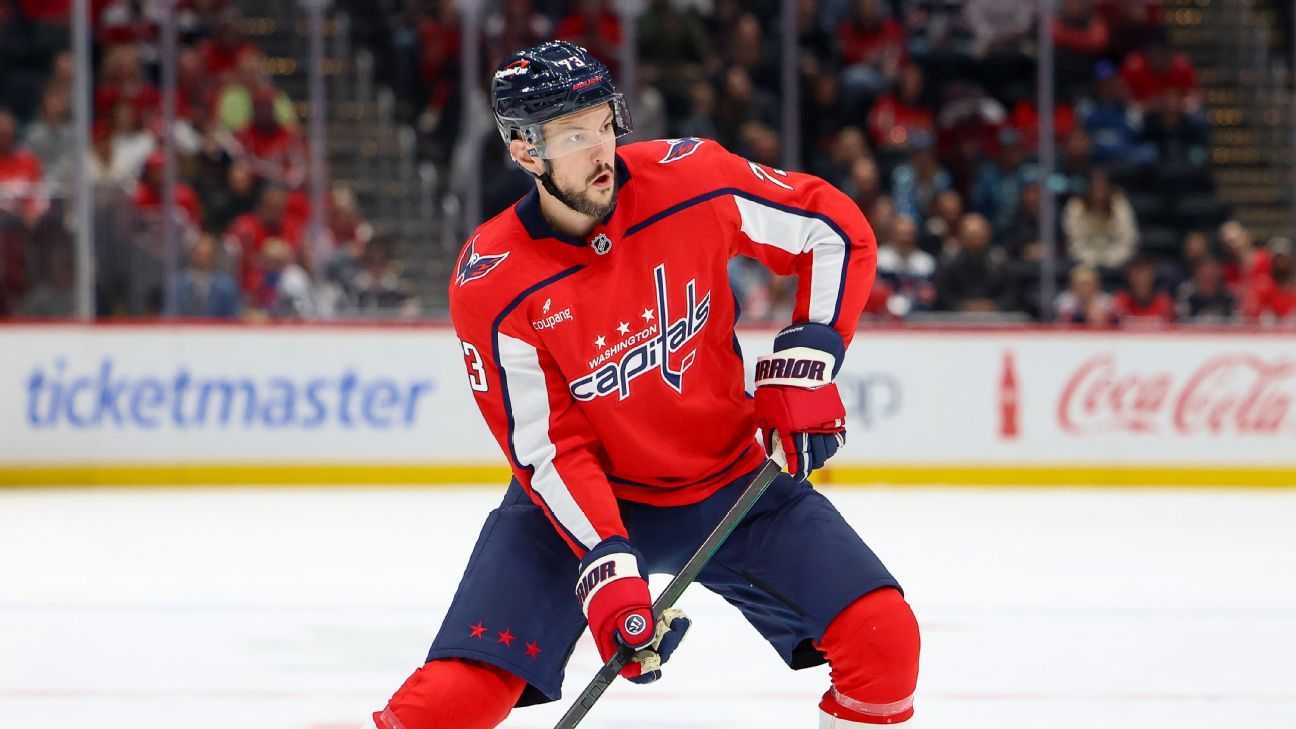
The Washington Capitals will be without veteran defenseman Vincent Desharnais for the next four to six weeks following a surgical procedure to remove his appendix, the National Hockey League club announced on Thursday. The unexpected medical intervention sidelines the blueliner through late November or early December, creating an immediate vacancy on the Capitals' defensive unit during the opening weeks of the regular season schedule. Desharnais underwent the procedure on Thursday, October 22, 2026, prompting Washington's hockey operations staff to adjust their blue-line pairings and examine corresponding roster mechanisms under league salary cap rules.
Key facts
What happened
According to reporting by ESPN, the Capitals confirmed that Desharnais required an emergency appendectomy on Thursday after medical personnel determined that surgical intervention was necessary. The organization did not specify whether the 29-year-old blueliner experienced symptoms during team activities or at home, but acute appendicitis typically presents with rapid onset lower-quadrant abdominal discomfort, fever, and localized tenderness, necessitating prompt surgical excision to prevent perforation or broader internal infection.
Following the completion of the procedure, club medical staff established a baseline recovery timeline of four to six weeks. This duration aligns with clinical standards for elite athletes participating in full-contact sports, allowing adequate time for the abdominal wall and muscular tissue to heal sufficiently before absorbing physical contact. Desharnais was immediately ruled out of upcoming team fixtures as he began postoperative rest and monitoring under the direction of Washington's medical personnel.
The team's front office and coaching staff were notified of the surgical outcome on Thursday, initiating procedural discussions regarding injured-reserve status and blue-line deployments ahead of Washington's upcoming slate of regular season games. Desharnais had been expected to serve as a steadying, physical stay-at-home presence on the bottom half of the Capitals' defense pairings.
Why it matters
The loss of Desharnais introduces immediate structural pressure on Washington's defensive corps, particularly in specialized defensive assignments and penalty-killing units where large, physical blueliners are heavily utilized. At six feet, seven inches tall and over 225 pounds, Desharnais brings a distinct physical profile characterized by reach, shot-blocking capability, and crease-clearing strength. Replacing those specific attributes cannot be accomplished through simple aggregate minutes, requiring head coach Spencer Carbery and the coaching staff to either elevate depth defensemen into higher-leverage roles or distribute expanded short-handed responsibilities across existing top-four personnel like John Carlson and Martin Fehervary.
Beyond on-ice tactical adjustments, Desharnais's absence triggers notable administrative and financial implications under the NHL's Collective Bargaining Agreement. Under league roster regulations, teams must maintain an active roster of no more than 23 players under the upper salary cap ceiling. If Washington places Desharnais on standard Injured Reserve (IR), the club frees up an active roster spot to recall a replacement from its primary development affiliate, the Hershey Bears of the American Hockey League (AHL), though his salary continues to count against the payroll ceiling.
However, because the projected four-to-six-week recovery spans approximately 12 to 18 regular season contests, Desharnais exceeds the threshold for Long-Term Injured Reserve (LTIR), which mandates an absence of at least 10 regular season games and 24 calendar days. Utilizing LTIR would allow the Capitals to access relief exceeding the cap ceiling, providing general manager Chris Patrick with flexibility if additional injury complications emerge across the roster during November.
The background
Appendectomies, while routine in modern general surgery, represent significant disruptions when sustained by professional ice hockey players due to the intense core engagement and severe physical collisions inherent to the sport. In the general population, non-strenuous daily activities can frequently resume within one to two weeks following a standard laparoscopic appendectomy. For contact-sport athletes, however, premature exertion risks abdominal hernia formation, wound dehiscence, and severe muscular strain. Recent NHL history includes comparable situations where players underwent in-season appendectomies—such as forward Jamie Benn and defenseman Connor Murphy in prior seasons—with each requiring approximately three to five weeks before regaining the conditioning required for competitive game speed.
Desharnais entered the league through an unconventional developmental path, establishing himself as a reliable defensive specialist through perseverance in minor league circuits. Selected in the seventh round (183rd overall) of the 2016 NHL Entry Draft by the Edmonton Oilers out of Providence College, Desharnais spent several developmental campaigns split between the ECHL's Wichita Thunder and the AHL's Bakersfield Condors before earning his NHL debut in January 2023 at age 26. His ascent into regular NHL duty was built upon disciplined positioning, exceptional stick reach, and physical containment along the end boards.
After completing his tenure in Western Canada with Edmonton and Vancouver, Desharnais joined the Capitals to provide dependable depth and veteran leadership to a retooling defense. The Washington organization entered the 2026–27 campaign aiming to balance veteran continuity with younger organizational prospects, making early-season stability along the blue line essential for maintaining competitiveness within a tightly contested Metropolitan Division.
Reaction
The Capitals limited their formal public statement to the medical facts of Desharnais's diagnosis and the projected timeline for his rehabilitation, adhering to standard sports organizational protocol regarding personal health records. While official statements from front office executives or player representatives were not included in the initial disclosure reported by ESPN, team leadership typically addresses medical developments during scheduled morning skates and media availabilities preceding upcoming fixtures.
Capitals coaching staff are expected to clarify internal pairing adjustments during their next media briefings, detailing how minutes will be reallocated among available depth defensemen like Alexander Alexeyev or Dylan McIlrath. Representatives from the National Hockey League Players' Association (NHLPA) routinely monitor such cases to guarantee that players are not pressured into accelerated timelines before obtaining formal independent medical clearance.
What we don't know yet
Several practical and medical details remain undisclosed following the initial announcement. The team has not clarified whether Desharnais underwent a standard minimally invasive laparoscopic procedure or an open laparotomy, a distinction that carries measurable implications for soft-tissue recovery and abdominal wall reconstruction. Laparoscopic surgeries typically involve smaller incisions and quicker initial healing, whereas open surgeries can extend the rehabilitation timetable toward the outer boundary of the six-week estimate.
Furthermore, the Capitals have not yet confirmed the exact corresponding roster transaction. It remains unannounced whether Desharnais will be designated for standard Injured Reserve or if the team will officially designate him for Long-Term Injured Reserve to maximize cap flexibility. The specific identity of the defenseman recalled from Hershey or elevated from the press box to assume his vacant spot in the lineup also remains unconfirmed by the organization.
What to watch
The most immediate indicator of Washington's roster strategy will appear on the NHL's official media transaction ledger, where the Capitals must file formal paperwork regarding Desharnais's injury designation and any corresponding recall from the Hershey Bears before their next regular season contest. Observers should track whether the front office summons a young prospect to evaluate development or opts for a seasoned veteran with prior NHL experience to stabilize the third defensive pairing.
Over the coming month, Desharnais's progress through standard rehabilitation milestones will signal where his return falls along the four-to-six-week spectrum. Key indicators include his resumption of light off-ice aerobic conditioning, followed by individual solo skating sessions, participation in non-contact team practices wearing a no-contact jersey, and ultimately clearance for full-contact scrimmages. If his rehabilitation proceeds without secondary complications, Desharnais could realistically target a return to Washington's active lineup between late November and early December.
This report is based on information initially confirmed and published by ESPN.
How this story was produced
This report was written by The Global Wire newsroom from reporting first published by ESPN. We verify the core facts against the original report, write our own account, and add the background and consequences a short wire item leaves out. Drafting is AI-assisted inside an editor-supervised pipeline, and every story is checked for accuracy of attribution, structure and duplication before it appears — full detail in our AI and funding disclosure.
Spotted an error? Tell us at corrections@horizonglobalnews.com and read our corrections policy or editorial standards.

Reader comments
Loading comments…