

Asian Security Bloc CICA Pushes to Transform Diplomatic Dialogue Into Policy Action
Member states of the Conference on Interaction and Confidence-Building Measures in Asia convened to advance regional security, trade, and the body's institutional evolution.
By The Global Wire Newsroom · Reported from euronews.com
Link preview · horizonglobalnews.com
Asian Security Bloc CICA Pushes to Transform Diplomatic Dialogue Into Policy Action
Member states of the Conference on Interaction and Confidence-Building Measures in Asia convened to advance regional security, trade, and the body's institutional evolution.
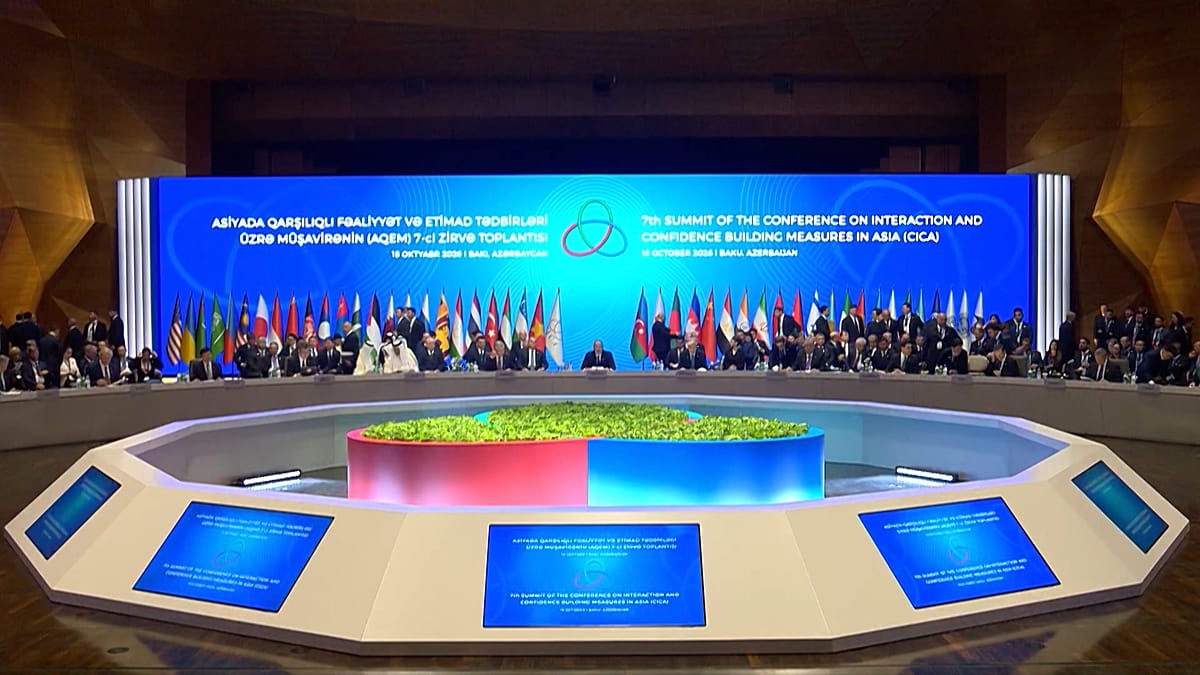
Member nations of the Conference on Interaction and Confidence-Building Measures in Asia gathered this week to assess shared security priorities, expand cross-border economic cooperation, and advance the group's long-planned institutional transition from a consultative forum into a fully functioning international organization, according to reporting by Euronews. Convening amid sharpening geopolitical rivalries across Eurasia, delegates focused on translating decades of voluntary confidence-building dialogue into structured, binding operational mechanisms capable of managing regional friction, climate vulnerability, and commercial connectivity across the world's most populous continent.
Key facts
What happened
Delegates from member states across Asia assembled to evaluate CICA's diplomatic agenda and determine the pace of its ongoing institutional overhaul, according to reporting by Euronews. The sessions focused on bridging the divide between high-level diplomatic communique declarations and the practical realities of policy execution on the ground. Representatives examined operational initiatives across five core dimensions: economic cooperation, environmental stewardship, human dimension initiatives, emerging security challenges, and military-political confidence building.
During the working sessions, participating delegations discussed how best to modernize the forum's operational machinery. Established as a voluntary platform designed to foster communication rather than enforce mandates, the grouping has repeatedly faced administrative bottlenecks when attempting to address rapid regional crises. Delegations evaluated mechanisms to accelerate the implementation of trade facilitation projects, harmonize customs protocols along overland transit routes, and establish permanent coordination committees dedicated to non-traditional security threats such as cybercrime, cross-border water shortages, and climate disasters.
Discussions also addressed internal procedural governance, specifically the consensus-based decision-making model that governs the body. While consensus safeguards the sovereign interests of diverse participants, it has historically slowed the drafting of joint resolutions and limited decisive institutional intervention during regional disputes. Working groups reviewed structural draft proposals intended to strengthen the executive powers of the CICA Secretariat, based in Astana, Kazakhstan, while retaining the foundational principle that no measure can be imposed without unanimous assent.
Why it matters
Asia lacks a single, overarching security architecture comparable to the Organization for Security and Co-operation in Europe (OSCE) or the collective treaty frameworks found in post-war Europe. As a result, the region relies on an overlapping patchwork of bilateral treaties, sub-regional pacts like the Association of Southeast Asian Nations (ASEAN), and security compacts such as the Shanghai Cooperation Organisation (SCO). CICA represents the only pan-Asian platform that gathers virtually all major Eurasian powers under one roof, providing a rare venue where strategic adversaries sit at the same negotiating table.
For global markets and international commerce, the operational viability of this forum carries direct consequences. Eurasia contains the vital maritime straits and overland transport arteries—including the Trans-Caspian International Transport Route, or Middle Corridor—that sustain global energy shipments and consumer supply chains between Europe and East Asia. If CICA can successfully institute practical confidence-building measures across customs checkpoints, regulatory boundaries, and logistics hubs, it can lower the systemic cost of trade finance and transit risks across Central Asia, South Asia, and the Middle East.
Furthermore, the effort to move from passive dialogue to functional cooperation tests whether multipolar diplomacy can survive in an era of acute fragmentation. For citizens and businesses operating across Eurasia, non-traditional security threats like shared river basin management, cross-border dust storms, and seismic crisis responses demand coordinated state intervention. If the organization fails to establish functional working mechanisms for these shared challenges, individual member states will increasingly default to unilateral actions, heightening the risk of localized disputes over water, energy, and territorial boundaries.
The background
The origins of CICA trace back to October 5, 1992, when Kazakhstan's first president, Nursultan Nazarbayev, formally proposed establishing a pan-Asian security platform during an address to the United Nations General Assembly. At the time, the dissolution of the Soviet Union had left Central Asia and surrounding regions vulnerable to political instability, civil conflict, and shifting balance-of-power dynamics. Inspired in part by the 1975 Helsinki Final Act that stabilized Cold War Europe through incremental trust-building steps, the Asian initiative sought to introduce predictable dialogue between states with fundamentally divergent political systems.
Progress in the early years was deliberate and cautious. It took nearly seven years for participating nations to agree on basic founding tenets, culminating in the adoption of the Declaration on the Principles Guiding Relations between the CICA Member States at the first ministerial meeting in Almaty in September 1999. In June 2002, the inaugural CICA Summit brought heads of state and government together to sign the Almaty Act, establishing the body's permanent charter. The document codified respect for state sovereignty, territorial integrity, peaceful settlement of disputes, and non-interference in internal affairs as non-negotiable guiding principles.
Over the subsequent two decades, CICA expanded its membership to include 28 sovereign states spanning East Asia, Southeast Asia, South Asia, Central Asia, and the Middle East, with an additional nine countries and five multinational bodies participating as observers. However, the organization's expansive geographic scope—stretching from the Mediterranean Sea to the Pacific Ocean—also introduced sharp geopolitical divides. Member states include India and Pakistan, China and Vietnam, as well as Iran, Israel, and Turkey. Managing relations among such disparate actors required an extraordinarily delicate diplomatic balance.
A watershed moment occurred at the Sixth CICA Summit held in Astana in October 2022, marking the forum's 30th anniversary. Member states officially adopted the Astana Statement on the Transformation of CICA, launching a formal process to upgrade the grouping into a full-fledged international regional organization. That decision initiated ongoing legal, institutional, and administrative reforms designed to grant the Secretariat greater administrative authority, establish permanent functional councils, and elevate Asia's collective voice in broader multilateral forums.
Reaction
Official state delegations have maintained a disciplined public posture, emphasizing the necessity of preserving consensus while urging steady institutional upgrades. Central Asian governments, particularly Kazakhstan as the founding host and long-time administrative anchor of the secretariat, have consistently championed the transformation agenda. Regional diplomats have stressed in multilateral forums that Eurasian landlocked economies require institutionalized security and open trade channels to avoid becoming isolated economic corridors caught between competing global powers.
Outside analysts and international security observers, however, have expressed tempered expectations regarding how swiftly the bloc can convert rhetoric into binding operational programs. Western diplomatic observers have historically viewed CICA with a degree of skepticism, noting that its reliance on absolute consensus often restricts high-level summit declarations to broad, non-binding generalities. Independent regional think tanks frequently point out that with members holding directly opposing security postures on core flashpoints—such as the Indo-Pakistani border, the South China Sea, and Middle Eastern conflicts—any attempt to introduce mandatory military verification mechanisms or collective dispute arbitrations faces immediate resistance from national capitals safeguarding sovereign autonomy.
What we don't know yet
While Euronews reported on the broad mandate of member states gathering to discuss regional security and institutional strengthening, several key operational specifics remain undisclosed. The reporting does not provide the precise draft text under consideration for CICA's institutional charter, nor does it specify the anticipated timeline for finalizing the formal conversion into an international organization. The operational cost of this bureaucratic transition and how the expanded organizational budget will be apportioned across member state contributions are also unstated.
Critically, the available information leaves open the question of how member states intend to reconcile the consensus rule with the stated ambition of taking "practical action." It is not yet clear whether the reform framework will introduce qualified majority voting for administrative or humanitarian protocols, or if all substantive decisions will remain subject to single-state vetoes. Furthermore, the extent to which major powers like China, India, and Russia align on specific economic and transit integration measures within CICA—as opposed to prioritizing rival institutions such as the SCO or bilateral agreements—remains an unresolved dynamic that directly dictates the forum's future influence.
What to watch
The immediate indicators of progress will emerge from upcoming senior officials' committee meetings and ministerial gatherings, where working groups are scheduled to negotiate the technical amendments to CICA's legal framework. Analysts will be scrutinizing whether member governments can reach formal agreement on the organizational charter ahead of the next scheduled heads-of-state summit. Ratification of that charter by individual national parliaments will provide the ultimate litmus test of state-level commitment to the grouping's elevated legal status.
Beyond institutional paperwork, observers should monitor whether CICA establishes tangible cross-border mechanisms in low-controversy fields before attempting broader security interventions. The launch of concrete joint initiatives—such as unified digital transit manifests for Eurasian railways, cross-border disaster response task forces, or standardized technical protocols for regional water management—will serve as the primary evidence of whether the organization is truly moving from rhetorical confidence-building toward actionable multilateral governance.
This report is based on original reporting by Euronews.
How this story was produced
This report was written by The Global Wire newsroom from reporting first published by euronews.com. We verify the core facts against the original report, write our own account, and add the background and consequences a short wire item leaves out. Drafting is AI-assisted inside an editor-supervised pipeline, and every story is checked for accuracy of attribution, structure and duplication before it appears — full detail in our AI and funding disclosure.
Spotted an error? Tell us at corrections@horizonglobalnews.com and read our corrections policy or editorial standards.





Reader comments
Loading comments…