

Sikorsky Unveils Containerized Launch System for Nomad 100 VTOL Drones
Sikorsky has integrated four Nomad 100 vertical takeoff drones and support equipment into a standard 20-foot shipping container designed for rapid expeditionary deployment.
By The Global Wire Newsroom · Reported from David Szondy
Link preview · horizonglobalnews.com
Sikorsky Unveils Containerized Launch System for Nomad 100 VTOL Drones
Sikorsky has integrated four Nomad 100 vertical takeoff drones and support equipment into a standard 20-foot shipping container designed for rapid expeditionary deployment.
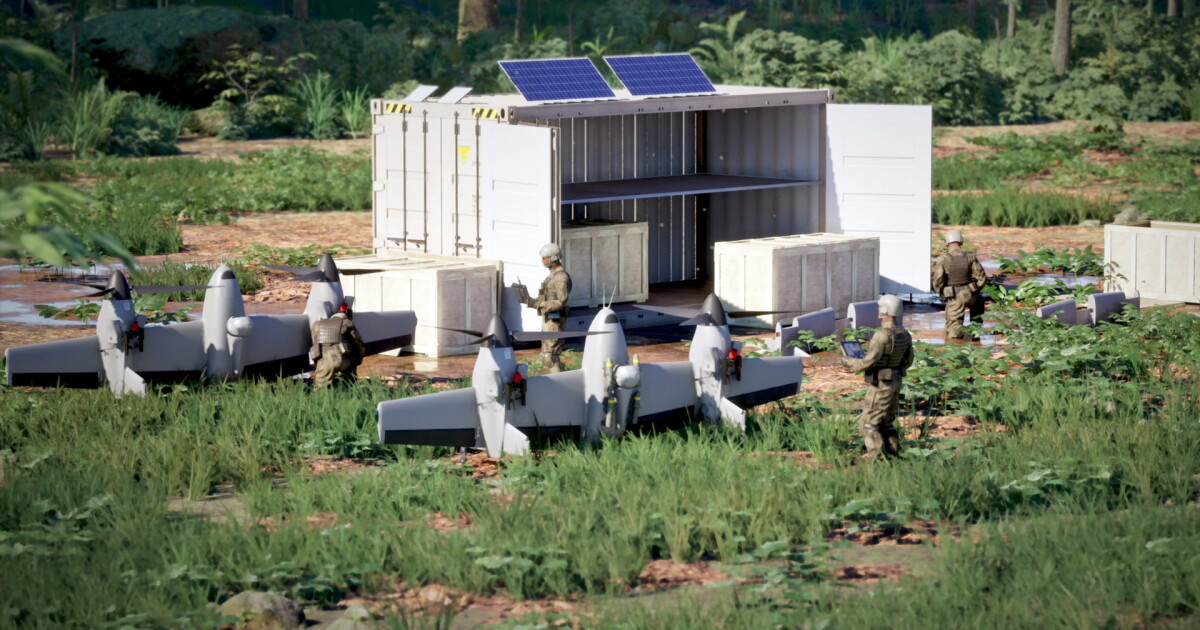
STRATFORD, Conn. — Aviation manufacturer Sikorsky has introduced a self-contained expeditionary deployment system that packages multiple vertical takeoff and landing drones inside a standard commercial shipping container. The configuration, designated the Fast Pack, fits four Nomad 100 autonomous aircraft alongside their requisite maintenance tools, power supplies, and launch gear into a standard 20-foot intermodal container, according to reporting by David Szondy. Engineered to provide an expeditionary aviation footprint without requiring fixed runway infrastructure, the setup allows ground crews to unpack, configure, and launch two of the uncrewed aircraft in as little as 15 minutes.
Key facts
What happened
Sikorsky developed the Fast Pack to solve the persistent operational bottleneck of transporting and sustaining tactical uncrewed aircraft in remote operational environments. By utilizing the universal form factor of an International Organization for Standardization (ISO) 20-foot shipping container, the company transformed a standard piece of commercial freight infrastructure into a mobile tactical aviation depot, according to reporting by David Szondy.
Inside the steel container, four Nomad 100 VTOL aircraft are stowed in dedicated modular racks designed to protect delicate airframes, sensors, and avionics from the mechanical shocks and vibration typical of maritime, rail, and rough-road transit. In addition to housing the aircraft, the container functions as a climate-controlled workshop and operations center, containing diagnostic computers, battery charging stations or fuel handling modules, replacement rotors, communications antennas, and maintenance workbenches.
Operational deployment begins immediately upon placing the container on flat, semi-prepared ground. Once the container doors are opened, ground operators can slide the Nomad 100 airframes from their storage cradles along integrated rails. Pre-flight checks and rotor assembly are streamlined through modular interfaces, enabling a small crew to conduct systems checks and launch the first two aircraft within a 15-minute window. The remaining two airframes serve either as rapid follow-on sorties or immediate operational reserves to maintain continuous air coverage over an area of interest.
Why it matters
The integration of tactical aviation assets into standardized freight architecture reflects a fundamental shift in military logistics and expeditionary planning. Modern multi-domain operations increasingly require armed forces to disperse into small, highly mobile detachments rather than concentrating assets on sprawling, fortified air bases that present vulnerable targets to long-range precision ballistic and cruise missiles. For strategic planners, the ability to conceal and move a squadron of surveillance and reconnaissance aircraft inside an unremarkable commercial shipping container significantly complicates adversary targeting cycles.
From a logistical perspective, moving uncrewed aviation units traditionally demands specialized transport cases, specialized support vehicles, and substantial physical footprints that strain tactical airlift capacity. Standard 20-foot ISO containers, by contrast, can be handled by commercial forklifts, standard cranes, flatbed commercial trucks, and military transport aircraft such as the C-130 Hercules or C-17 Globemaster III without requiring bespoke handling equipment. By packaging four aircraft and their sustaining tail into a single unit, field units reduce the number of transport movements required to establish an operational perimeter.
Furthermore, the 15-minute deployment timeline changes how field commanders can utilize tactical VTOL systems during rapid movements. Ground forces frequently operate on unpredictable timelines where pausing for hours to establish satellite uplinks, assemble complex airframes, and calibrate ground control stations is operationally unacceptable. A quarter-hour preparation cycle permits responsive airborne surveillance, reconnaissance, and targeting data generation during brief halts, offering real-time situational awareness directly to company- and battalion-level commanders.
The background
The Nomad 100 and its Fast Pack concept emerge from years of defense industry efforts to balance range, payload, and runway independence. Traditional fixed-wing uncrewed aerial systems deliver superior endurance and higher cruise speeds compared to rotary-wing craft, but they require cleared runways, catapult launchers, or arresting gear. In austere combat theaters—such as heavily forested terrain, urban environments, or dispersed archipelagic islands—finding or maintaining a smooth 1,000-foot runway is frequently impossible.
To overcome this limitation, defense manufacturers turned toward hybrid and dedicated VTOL architectures. Helicopters and tilt-rotor designs provide the ability to take off and land vertically from compact clearings, ship decks, or unprepared fields, but they historically suffered from high mechanical complexity, heavy maintenance burdens, and vulnerability to environmental degradation from sand and dust. Sikorsky, which was acquired by Lockheed Martin in 2015 for $9 billion, has spent decades researching autonomous flight controls, notably through its proprietary MATRIX autonomous flight architecture, to simplify the pilot workload and operational overhead associated with rotary systems.
At the same time, major western military services have rewritten their doctrine to emphasize dispersion. The United States Marine Corps developed Expeditionary Advanced Base Operations (EABO), while the United States Air Force introduced Agile Combat Employment (ACE). Both doctrines require small units to deploy swiftly across remote island chains or austere forward operating locations, conduct localized strikes or surveillance missions, and displace before enemy forces can pinpoint their coordinates. Shipping containerized systems—frequently termed "box-to-sky" or modular weapon systems—have become central to these operational concepts, spanning containerized loitering munition launchers, anti-ship missile batteries, and now autonomous VTOL uncrewed aircraft.
Reaction
While Sikorsky has not publicly released customer purchase agreements or official military endorsements alongside the initial unveiling, defense logistics specialists and expeditionary warfare planners closely track modular containerized platforms. Observers within military procurement circles expect the system to draw attention from special operations forces, marine expeditionary units, and naval surface warfare branches seeking organic air support that does not compete for hangar space aboard small surface combatants.
Defense analysts are expected to evaluate how the Fast Pack performs in environments where GPS navigation and traditional radio frequency links are aggressively jammed. In future defense acquisition symposiums and military trials, oversight bodies such as the U.S. Department of Defense's operational testing offices will examine whether small tactical detachments can maintain the rigorous 15-minute launch pace under adverse weather conditions, nighttime operations, and chemical, biological, or radiological protective postures without external manufacturer assistance.
What we don't know yet
Key technical and operational specifications of the Nomad 100 system remain undisclosed. The public reporting does not specify the maximum flight endurance, payload capacity, operational ceiling, or propulsion type of the Nomad 100 aircraft—specifically whether the platform relies on pure battery-electric propulsion, a hybrid-electric architecture, or heavy-fuel internal combustion engines. This distinction is critical: pure electric systems simplify maintenance but often suffer from limited flight endurance, whereas fuel-burning systems increase flight duration while introducing flammable liquid storage requirements inside the enclosed ISO container.
Additionally, Sikorsky has not disclosed the total financial cost of a single Fast Pack unit, nor whether the system has secured an active program of record with a specific military service branch or international customer. Gaps also remain regarding the container's level of physical hardening; it is not yet clear whether the Fast Pack uses a standard civilian-grade steel container or incorporates ballistic armor, electromagnetic shielding, and chemical filtration to protect the stored aircraft and operating crew from fragmentation or electronic warfare detection.
What to watch
Future developments will hinge on scheduled military field trials and formal procurement demonstrations. Industry observers will monitor whether the U.S. Marine Corps, U.S. Army, or international defense ministries invite the Fast Pack system to upcoming multi-domain military exercises, such as the annual Project Convergence or Pacific-area joint training maneuvers, to validate its deployment speed in tropical and maritime environments.
Attention will also focus on whether Sikorsky introduces variations of the containerized platform tailored for specific payload mission sets. Observers should track announcements regarding whether the Nomad 100 can integrate electronic warfare suites, laser target designators, communications relay packages, or kinetic strike payloads. Finally, regulatory and export approvals from the U.S. State Department and Defense Security Cooperation Agency will determine whether Sikorsky can market the Fast Pack system to allied foreign militaries operating in NATO or Indo-Pacific defense frameworks.
This report is based on original reporting published by David Szondy.
How this story was produced
This report was written by The Global Wire newsroom from reporting first published by David Szondy. We verify the core facts against the original report, write our own account, and add the background and consequences a short wire item leaves out. Drafting is AI-assisted inside an editor-supervised pipeline, and every story is checked for accuracy of attribution, structure and duplication before it appears — full detail in our AI and funding disclosure.
Spotted an error? Tell us at corrections@horizonglobalnews.com and read our corrections policy or editorial standards.





Reader comments
Loading comments…