

San Marino Becomes 76th Nation to Sign Artemis Accords for Civil Space Exploration
The Republic of San Marino has formally joined the U.S.-led space exploration framework during a ceremony held in Rimini, Italy.
By The Global Wire Newsroom · Reported from Elizabeth Shaw
Link preview · horizonglobalnews.com
San Marino Becomes 76th Nation to Sign Artemis Accords for Civil Space Exploration
The Republic of San Marino has formally joined the U.S.-led space exploration framework during a ceremony held in Rimini, Italy.
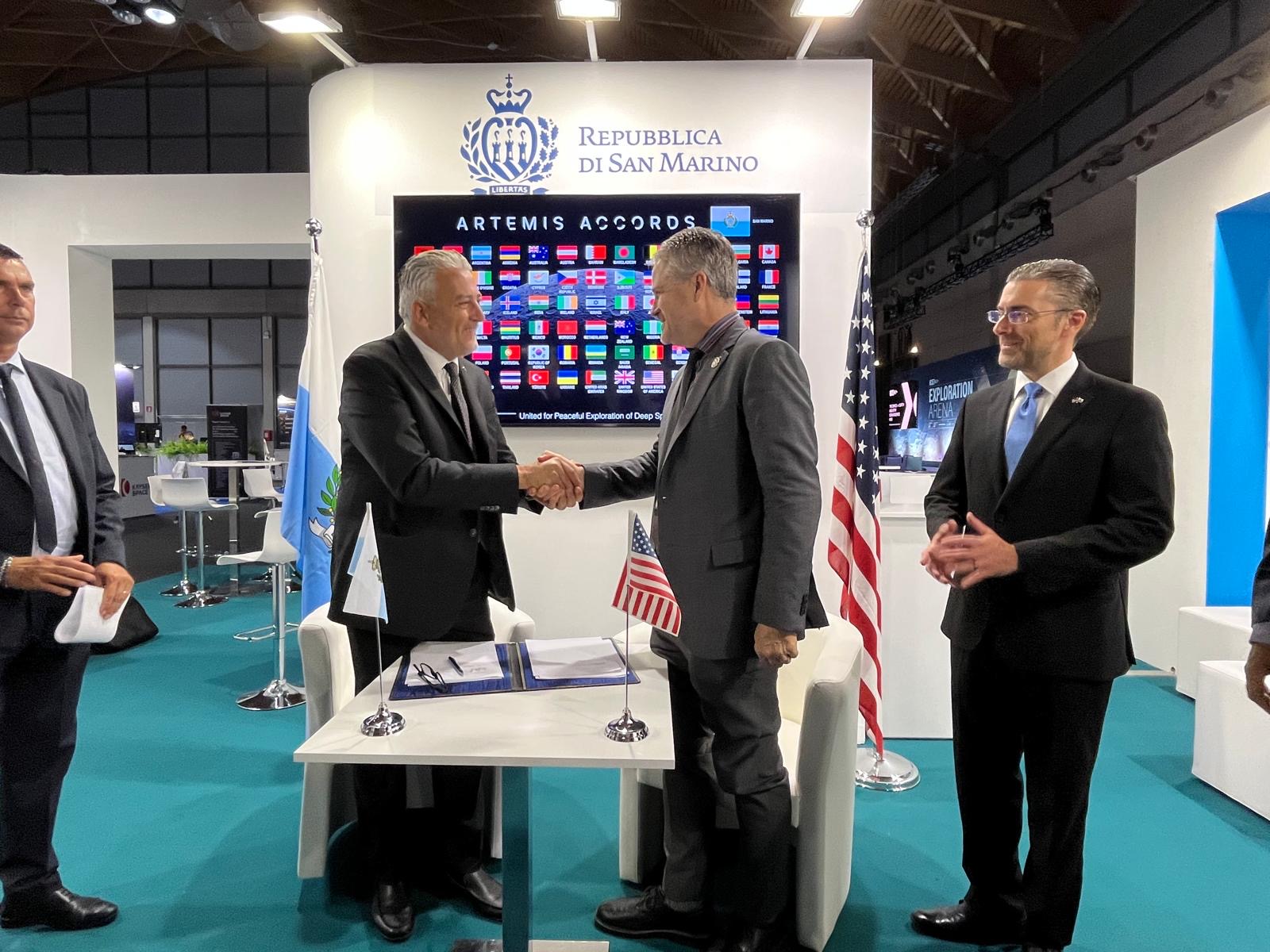
The Republic of San Marino has formally acceded to the Artemis Accords, becoming the 76th country to sign the diplomatic framework governing principles for civil space exploration, according to reporting by Elizabeth Shaw. The signing ceremony took place on Friday, Sept. 25, 2026, in the Italian city of Rimini, held in collaboration with representatives from NASA and the United States Department of State. By signing the agreement, the European microstate commits itself to shared international standards regarding space activity transparency, scientific data sharing, emergency assistance for space personnel, and the peaceful utilization of space resources.
Key facts
What happened
On Friday, Sept. 25, 2026, officials from the Republic of San Marino joined representatives from NASA and the U.S. Department of State in Rimini, Italy, to formally sign the Artemis Accords, according to reporting by Elizabeth Shaw. The ceremony marked San Marino's official entry into the multilateral framework, making it the 76th country to adopt the non-binding guidelines for civil space exploration.
The choice of Rimini, an Italian city situated immediately adjacent to San Marino, served as the geographic location for the signing event. Representatives from the U.S. State Department and NASA worked alongside Sammarinese officials to complete the endorsement.
By signing the document, San Marino aligned its national policies with the operational principles outlined in the Accords. These include commitments to peaceful space exploration, public disclosure of scientific data, emergency assistance to astronauts, preservation of historic space heritage, and the responsible management of space debris. Although San Marino does not currently operate an independent orbital launch program, its accession represents part of a broader diplomatic effort to build global consensus around space governance norms across states of varying geographic sizes and economic capabilities.
Why it matters
San Marino’s accession as the 76th signatory to the Artemis Accords highlights the continuing expansion of international frameworks intended to govern human and robotic exploration beyond Earth's orbit. For space policy experts, the growing number of signatories reflects a concerted effort by the United States and its international partners to establish customary norms for deep-space activities before lunar exploitation and commercial space operations scale up significantly.
The Artemis Accords codify vital operational guidelines. They mandate the open sharing of scientific findings, advocate for common hardware standards to ensure technical interoperability between nations, and establish rules for creating temporary safety zones to prevent mutual interference around lunar bases. By securing commitments from non-traditional spacefaring nations, the framework builds broad diplomatic backing across diverse international jurisdictions.
Furthermore, this expansion occurs within a competitive global context for space governance. While the Artemis framework has attracted 76 nations, alternative models—such as the International Lunar Research Station project led by China and Russia—are also soliciting international partners. The decision of European nations like San Marino to endorse the Artemis Accords reinforces the legal and operational precedents favored by NASA and its partner nations under the 1967 Outer Space Treaty.
For smaller nations, joining the Accords opens diplomatic and technological avenues. Participation provides microstates with opportunities to join international technical working groups, explore potential supply-chain roles for domestic technology firms, and participate in multilateral discussions regarding off-world resources and space traffic management.
The background
To understand the significance of San Marino joining the Artemis Accords, it is necessary to examine the history of the framework, its legal foundations, and the broader context of space diplomacy.
NASA and the U.S. Department of State established the Artemis Accords in October 2020. The initial framework was signed by eight founding countries: Australia, Canada, Italy, Japan, Luxembourg, the United Arab Emirates, the United Kingdom, and the United States. The Accords were designed to support NASA's Artemis campaign, which aims to return astronauts to the Moon, establish a sustainable human presence on the lunar surface, and prepare for future crewed exploration of Mars.
The legal bedrock of the Artemis Accords is the 1967 Outer Space Treaty, formally known as the Treaty on Principles Governing the Activities of States in the Exploration and Use of Outer Space, Including the Moon and Other Celestial Bodies. The Accords do not replace the 1967 treaty; rather, they provide operational mechanisms to implement its broad mandate in modern exploration scenarios. Key provisions in the Accords include:
Between 2020 and late September 2026, the framework expanded from eight to 76 nations. Participating states range from major spacefaring economies to emerging spacefaring nations in Africa, South America, and Asia, as well as European microstates.
San Marino is an enclave surrounded entirely by Italy, covering approximately 61 square kilometers on the Apennine Peninsula. While historically recognized for its ancient republican institutions, San Marino has pursued modern international integration through scientific, digital, and technological initiatives. Given its geography and deep economic ties with Italy—one of the original eight founding members of the Artemis Accords—San Marino's signing aligns with broader European technological and scientific collaboration.
Reaction
Following the ceremony on Friday, Sept. 25, 2026, official reactions focused on institutional announcements, according to reporting by Elizabeth Shaw. NASA and the U.S. Department of State formally welcomed San Marino as the 76th signatory, underscoring the value of expanding international consensus on peaceful space principles.
In comparable accession events, incoming non-spacefaring signatories generally emphasize their commitment to international law, multilateral governance, and scientific advancement. International space policy organizations typically monitor these accessions as indicators of global alignment regarding off-world resource norms.
Detailed statements from Sammarinese government agencies, including its diplomatic services or technical representatives, are expected to outline how the republic plans to engage with Artemis working groups and scientific forums. Non-signatory spacefaring nations, notably China and Russia, have previously criticized the Artemis Accords, arguing that space governance standards should be negotiated exclusively within multilateral United Nations bodies such as the UN Committee on the Peaceful Uses of Outer Space (COPUOS) rather than U.S.-led diplomatic initiatives.
What we don't know yet
Several specific details regarding San Marino’s signing remain unconfirmed based on available reporting:
First, the wire summary does not specify the precise names of the individual delegation leaders representing San Marino, NASA, or the U.S. Department of State at the ceremony in Rimini.
Second, it remains unknown whether San Marino will pursue specific industrial or scientific roles within the Artemis ecosystem, such as developing specialized technology components, hosting ground tracking support, or funding university research partnerships.
Third, the available reporting leaves unstated whether San Marino intends to draft domestic space legislation or create a formal regulatory body to register commercial space entities following its signing of the Accords.
What to watch
In the coming months, several key markers will demonstrate how San Marino’s signing fits into broader space governance developments:
This report incorporates news details originally reported by Elizabeth Shaw on behalf of NASA and the U.S. Department of State.
How this story was produced
This report was written by The Global Wire newsroom from reporting first published by Elizabeth Shaw. We verify the core facts against the original report, write our own account, and add the background and consequences a short wire item leaves out. Drafting is AI-assisted inside an editor-supervised pipeline, and every story is checked for accuracy of attribution, structure and duplication before it appears — full detail in our AI and funding disclosure.
Spotted an error? Tell us at corrections@horizonglobalnews.com and read our corrections policy or editorial standards.



Reader comments
Loading comments…