

Ryanair CEO Michael O’Leary Attacks EU Leadership and Environmental Mandates
Ryanair chief executive Michael O’Leary has denounced European Commission President Ursula von der Leyen and EU lawmakers, alleging environmental rules are inflating passenger flight expenses.
By The Global Wire Newsroom · Reported from Méabh Mc Mahon
Link preview · horizonglobalnews.com
Ryanair CEO Michael O’Leary Attacks EU Leadership and Environmental Mandates
Ryanair chief executive Michael O’Leary has denounced European Commission President Ursula von der Leyen and EU lawmakers, alleging environmental rules are inflating passenger flight expenses.
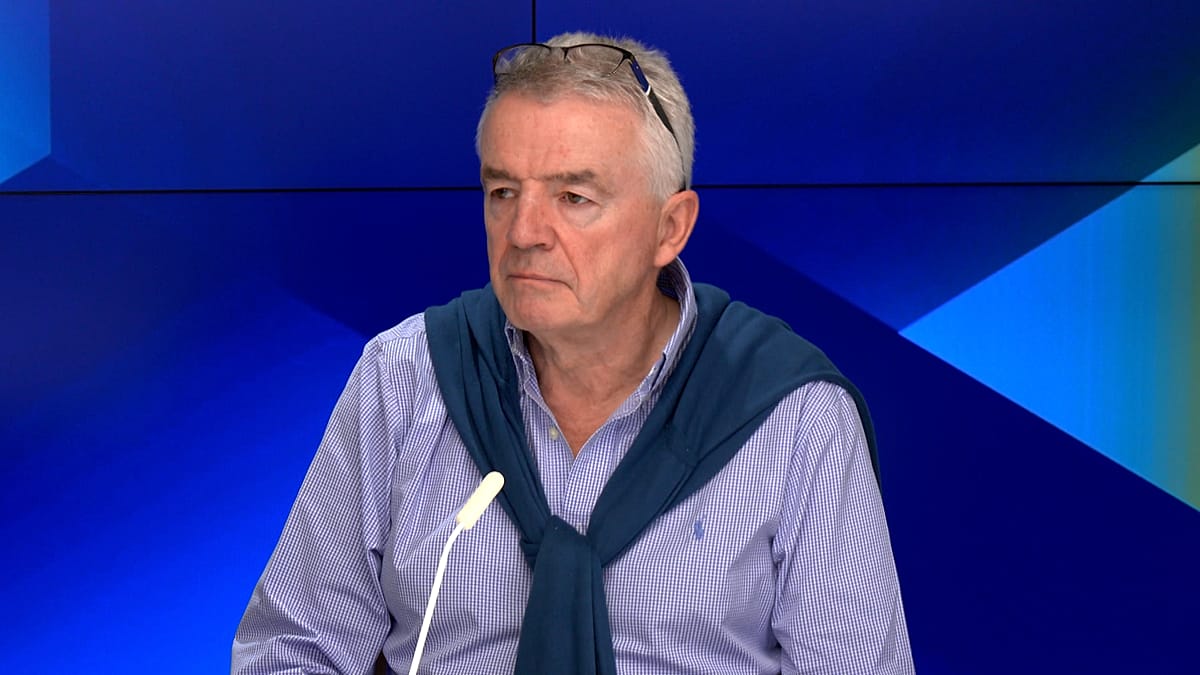
BRUSSELS — Michael O’Leary, the chief executive officer of Irish budget carrier Ryanair, has launched a sharp public attack against European Commission President Ursula von der Leyen and members of the European Parliament, condemning the European Union’s environmental regulatory agenda for imposing what he described as excessive expenses and regulatory friction on commercial aviation. In broadcast remarks, the airline executive characterized von der Leyen as ineffective in her executive role and labeled the European Parliament a “ship of fools,” asserting that Brussels policymakers are driving up the underlying cost of regional passenger air transport through unworkable green mandates.
Key facts
What happened
In recorded comments reported by journalist Méabh Mc Mahon, Ryanair chief executive Michael O’Leary directly targeted the executive and legislative branches of the European Union, focusing his criticism on the bloc’s flagship climate initiatives affecting regional commercial aviation.
O’Leary specifically singled out European Commission President Ursula von der Leyen, dismissing her executive performance as “useless” in the context of commercial aviation policy and broader continental economic oversight. Turning his attention to the European Union’s directly elected legislature, O’Leary referred to the European Parliament as a “ship of fools.” His criticism centered on the argument that directives and regulations drafted in Brussels impose an unreasonable administrative burden on airlines, creating operational friction while failing to deliver pragmatic environmental progress.
Central to O’Leary’s argument is the claim that European green legislation generates compounding complexity and financial strain for carriers. He maintained that these regulatory obligations do not simply remain on corporate balance sheets, but inevitably translate into higher base fares for consumers across the continent. By raising operating expenses through compliance requirements, taxes, and mandates, O’Leary argued, European policymakers are systematically eroding the low-cost travel model that has enabled millions of European citizens to travel affordably across member states over the last three decades.
Why it matters
The confrontation between Europe’s largest airline by passenger volume and the European Union’s top institutional leadership highlights an escalating structural conflict between decarbonization policies and low-fare commercial mobility. The aviation sector accounts for roughly 2 to 3 percent of global greenhouse gas emissions, but its share within the European Union has historically faced heightened scrutiny due to dense regional air corridors and the availability of cross-border rail alternatives.
For consumers, the outcome of this policy debate directly dictates the trajectory of ticket prices. Over the past twenty years, deregulated European aviation allowed low-cost carriers such as Ryanair, easyJet, and Wizz Air to stimulate demand through ultra-low fares, operating point-to-point networks connecting secondary regional airports. However, the economic viability of that model faces pressure under European Union regulatory frameworks that progressively internalize the environmental cost of fossil fuels. When airline executives assert that European regulations are inflating passenger prices, they point toward an operating environment where statutory compliance costs constitute a steadily expanding share of total operating expenditures.
For financial markets and airline investors, the executive's comments reflect growing anxiety over compliance overhead. As airlines manage narrow operating margins, escalating compliance expenses risk depressing passenger volume growth, especially on discretionary leisure routes that form the bedrock of the ultra-low-cost business model. For policymakers, the remarks represent a direct political challenge from an industry heavyweight who commands significant public visibility, testing whether institutional resolve on climate targets will withstand organized corporate resistance and potential consumer backlash against rising travel expenses.
The background
The clash between Ryanair’s leadership and Brussels takes place against the backdrop of the European Union’s comprehensive climate framework, established under the European Green Deal and legislative measures known as the “Fit for 55” package. The overarching initiative legally binds the 27 EU member states to reduce net greenhouse gas emissions by at least 55 percent below 1990 levels by 2030, with the ultimate objective of achieving continental climate neutrality by 2050.
For the commercial aviation sector, this policy architecture operates primarily through two critical regulatory instruments: the revision of the European Union Emissions Trading System (EU ETS) and the ReFuelEU Aviation initiative.
Under the revised EU ETS directive, airlines operating flights within the European Economic Area are subject to a phased elimination of free carbon allowance allocations. Historically, commercial carriers received a substantial proportion of their emissions permits at no cost to safeguard industrial competitiveness. Under reforms adopted by the European Parliament and the Council of the European Union, these complimentary allowances began phasing down in 2024, with full phase-out scheduled for 2026. Consequently, carriers must purchase compliance allowances at prevailing carbon market rates for all emissions generated on intra-European routes, substantially raising the direct cost of burning conventional aviation turbine fuel.
Simultaneously, the ReFuelEU Aviation regulation mandates that aviation fuel suppliers ensure an increasing percentage of sustainable aviation fuels (SAF) are blended into conventional kerosene supplied at EU airports. The quota began with a 2 percent blending mandate in 2025, climbing to 6 percent in 2030, 20 percent in 2035, and reaching 70 percent by 2050. Because synthetic and bio-based sustainable fuels currently trade at a substantial premium—often three to five times higher than conventional fossil kerosene—airline operators face steep increases in fuel procurement bills. Furthermore, carriers routinely criticize the European market for suffering from acute supply deficits in certified sustainable fuels, which limits their ability to meet blending benchmarks economically.
Michael O’Leary has served as chief executive of Ryanair since 1994, transforming the carrier from a minor regional operator into Europe’s largest airline by passenger volume, carrying around 180 million to 200 million passengers annually aboard an expansive fleet of Boeing 737 aircraft. Throughout his tenure, O’Leary has established a long record of aggressive public rhetoric directed at European and national regulators. He has repeatedly confronted national aviation authorities over airport departure taxes, threatened route cancellations in response to localized fees, and engaged in prolonged public feuds with national air traffic control agencies over chronic strike action and airspace bottlenecks. His latest denunciations of von der Leyen and European parliamentarians follow this established pattern of confrontational lobbying.
Reaction
Neither the European Commission nor the leadership of the European Parliament immediately issued formal rejoinders to O’Leary’s specific comments. In comparable past instances involving broad rhetorical critiques from industry figures, spokespersons for the European Commission have reiterated that environmental legislation is formulated through rigorous impact assessments, approved by democratically elected member state governments in the European Council, and endorsed by directly elected members of the European Parliament.
Environmental advocacy groups and sustainable transport organizations have historically pushed back against Ryanair’s regulatory complaints, pointing out that the aviation sector has long enjoyed tax privileges not afforded to other transport modes, including blanket exemptions from value-added tax on international passenger tickets and fuel tax exemptions under the 2003 Energy Taxation Directive. Climate policy advocates routinely argue that budget airlines have expanded capacity without sufficiently financing the true environmental externalities of regional fossil-fuel emissions.
Within the aviation industry itself, reactions remain multifaceted. While rival airline groups frequently share Ryanair’s underlying concerns regarding the high cost and scarcity of sustainable aviation fuels and the financial impact of the ETS phase-out, mainstream legacy network carriers and industry trade associations such as Airlines for Europe (A4E) typically adopt more conventional diplomatic approaches when negotiating policy revisions with European Union commissioners and legislative rapporteurs.
What we don't know yet
The brief initial reporting surrounding O’Leary’s statements leaves several operational and tactical questions open. It remains unclear whether Ryanair intends to pair the executive's rhetorical offensive with formal legal proceedings, such as legal challenges before the Court of Justice of the European Union targeting specific regulatory implementation details, or whether the statements represent standalone public relations rhetoric.
Additionally, the available reporting does not provide specific econometric projections from Ryanair illustrating the precise ticket price increases the airline attributes to individual EU climate files, such as ReFuelEU Aviation versus ETS allowance purchases. It also remains uncertain whether Ryanair plans to alter its capacity allocation, aircraft deployments, or airport bases across EU jurisdictions in direct response to these regulatory costs, or whether it will continue its fleet expansion under ongoing deliveries of Boeing 737 8-200 aircraft while passing compliance costs directly onto consumers.
What to watch
Observers of European transport policy should monitor several key milestones and decision points that will determine whether O’Leary’s criticisms alter the policy trajectory:
This account is based on original reporting and video material published by journalist Méabh Mc Mahon.
How this story was produced
This report was written by The Global Wire newsroom from reporting first published by Méabh Mc Mahon. We verify the core facts against the original report, write our own account, and add the background and consequences a short wire item leaves out. Drafting is AI-assisted inside an editor-supervised pipeline, and every story is checked for accuracy of attribution, structure and duplication before it appears — full detail in our AI and funding disclosure.
Spotted an error? Tell us at corrections@horizonglobalnews.com and read our corrections policy or editorial standards.




Reader comments
Loading comments…