

Paris Enacts Protest Restrictions as Transatlantic Friction Escalates Over Unrest
French authorities have placed security cordons across key areas of Paris, while President Emmanuel Macron rejected outside political commentary on domestic demonstrations.
By The Global Wire Newsroom · Reported from Malay Mail
Link preview · horizonglobalnews.com
Paris Enacts Protest Restrictions as Transatlantic Friction Escalates Over Unrest
French authorities have placed security cordons across key areas of Paris, while President Emmanuel Macron rejected outside political commentary on domestic demonstrations.
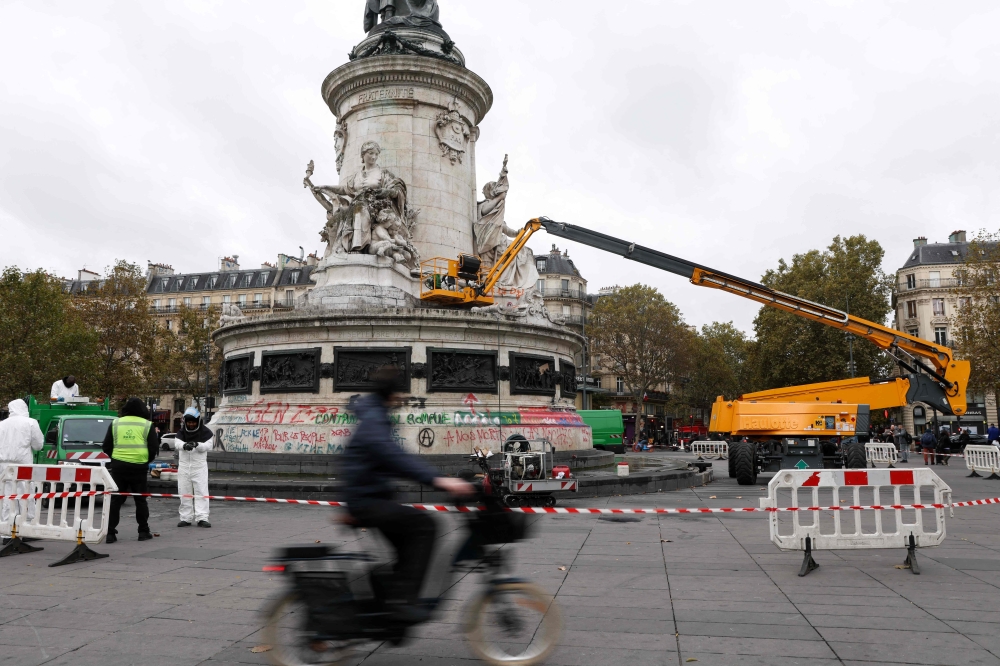
PARIS — Police authorities in Paris issued orders on Thursday barring public demonstrations across designated perimeters of the French capital, responding to consecutive days of street mobilization marked by student blockades and severe public disturbances. The emergency decree came as French President Emmanuel Macron sharply criticized foreign political commentary surrounding the domestic turmoil, warning against attempts by United States political figures, including Donald Trump, to leverage civil unrest in European cities for domestic electoral advantage. The convergence of security crackdowns at home and geopolitical friction abroad highlights the volatile atmosphere gripping the French administration as it attempts to maintain public order amid a broader wave of social dissent.
Key facts
What happened
French law enforcement agencies mobilized extensively across central Paris on Thursday morning after administrative orders prohibited protest assembly along prominent boulevards, major thoroughfares, and government administrative precincts. According to reporting by the Malay Mail, the restrictions were enacted after student mobilizations and affiliated protest actions degenerated into severe disorder earlier in the week, resulting in property damage, blocked school entrances, and direct confrontations with riot control officers.
Prefectural authorities identified recurring flashpoints across the capital, moving preemptively to establish cordons around institutions such as the National Assembly, the Senate, and major academic hubs where previous unrest had concentrated. Under French administrative jurisprudence, departmental prefects possess statutory authority under the Internal Security Code to prohibit assemblies deemed an imminent threat to public order, particularly when local law enforcement resources face strain or intelligence reports indicate the presence of organized agitators intent on violence.
Parallel to the operational policing response, diplomatic friction erupted over remarks from the United States political arena. As street scenes from Paris were circulated by international media and political figures abroad, President Macron addressed the foreign commentary directly. The French head of state condemned attempts to exploit images of internal French instability to advance domestic political narratives, specifically rebuffing Donald Trump for using French street demonstrations to justify hardline political positions in the context of American electoral campaigns. Macron emphasized that domestic public policy and law enforcement responses in France remain strictly sovereign matters governed by the constitutional framework of the French Republic.
Why it matters
The enforcement of protest bans in central Paris carries direct implications for civil liberties, administrative governance, and transatlantic diplomatic engagement. Within France, the prohibition of public demonstrations is an extraordinary measure that routinely draws scrutiny from civil rights groups, legal scholars, and opposition lawmakers. When authorities invoke security decrees to restrict freedom of assembly, it underscores a state assessment that standard policing methods are no longer sufficient to contain disorder. For residents, commuters, and commercial enterprises in Paris, the restrictions trigger significant operational disruptions, including transit station closures, vehicular diversions, and widespread retail precautions against property vandalism.
On the diplomatic front, the clash underscores the recurring friction between European centrist leaders and American populist figures who frequently point to European street unrest as evidence of administrative or societal failure. Macron’s public reprimand highlights a growing resistance among European officials against allowing domestic policy challenges to be weaponized in foreign election cycles. In an interconnected information environment, domestic protests are rapidly absorbed into global media ecosystems, where viral footage is severed from local policy nuances. By pushing back publicly, the French presidency is seeking to protect its institutional standing and assert that European democratic processes and civic disputes cannot be reduced to political theater for an overseas electorate.
The background
Street demonstrations have historically served as a central pillar of French political expression and policy negotiation. Over several decades, university campuses and secondary schools across France have functioned as primary incubators for broader social movements, frequently coordinating with organized labor unions to challenge administrative reforms. Historical precedents include the massive student-worker mobilizations of May 1968, the 1986 student strikes against university entry reforms, and the widespread 2006 demonstrations against the First Employment Contract, each of which demonstrated the capacity of student movements to disrupt national governance.
Under French constitutional law and the European Convention on Human Rights, freedom of assembly is guaranteed as a fundamental right. However, French statute requires protest organizers to submit advance administrative declarations detailing march routes, participant estimates, and internal security measures to local prefectures at least three days prior to an event. If the prefecture assesses that a gathering poses a disproportionate threat to public safety, public health, or property, it holds the power to ban the assembly outright or mandate alternate routes. Unauthorized gatherings face dispersal orders, and participants may be subject to administrative fines or criminal proceedings under Article R644-4 of the French Penal Code.
Relations between President Macron and Donald Trump have historically oscillated between formal camaraderie and sharp public disputes over security, international accords, and domestic governance. During Trump's tenure in the White House, the two leaders frequently clashed over multilateral frameworks, including the Paris Climate Accord and the Joint Comprehensive Plan of Action regarding Iran's nuclear program. Trump repeatedly referenced civil unrest in France, notably during the height of the 2018 Yellow Vest protests, arguing that domestic French demonstrations demonstrated the unpopularity of green energy taxation. The French government consistently maintained that domestic protests should not be instrumentalized by outside leaders, a stance reiterated in this latest exchange.
Reaction
The implementation of demonstration bans drew immediate scrutiny across the French political spectrum and among international observers. Student unions and independent civil liberties organizations criticized the decree as an overreach of executive authority, arguing that blanket bans infringe upon the constitutional right to assemble peacefully and risk aggravating tensions rather than diffusing them. Union representatives emphasized that youth grievances regarding educational conditions, economic precarity, and administrative policies require substantive political dialogue rather than preemptive security measures.
Conversely, police labor unions and conservative municipal figures welcomed the intervention, arguing that recent demonstrations had been compromised by radical elements and black bloc tactics designed to provoke confrontations with law enforcement. Municipal officials in affected arrondissements pointed to damaged urban infrastructure, scorched barricades, and commercial disruptions as justification for emergency measures. On the diplomatic level, French foreign affairs officials echoed Macron's position, asserting that foreign political leaders must respect the boundaries of national sovereignty and cease framing French civil affairs through the lens of external partisan battles.
What we don't know yet
Significant gaps remain regarding the precise operational scope and duration of the Parisian security decrees. Available reporting does not detail the exact geographic boundaries of all banned zones, nor does it specify the precise threshold of arrests or property damage that triggered the emergency order. It remains unconfirmed how long the Paris Police Prefecture intends to maintain the prohibition, or whether comparable restrictions will be expanded to other major French cities such as Lyon, Marseille, Toulouse, or Rennes, which have historically mirrored Parisian student mobilizations.
Furthermore, the exact communication from the United States that provoked Macron's direct accusation has not been fully delineated in the immediate reporting. It is unclear whether the French president’s statement was delivered during an official press conference, a bilateral address, or an administrative communique, leaving the full context of the diplomatic exchange partially unverified. The potential for legal challenges before the Council of State, France’s highest administrative court, also remains an open question as legal advocacy groups review the prefectural decree.
What to watch
In the coming days, several critical indicators will determine whether the security clampdown succeeds in restoring calm or provokes renewed defiance. Observers will monitor whether student organizations and youth advocacy groups comply with the prefectural ban or attempt to stage wildcat, undeclared marches across non-restricted neighborhoods of Paris. Any unauthorized gatherings would inevitably test the operational posture of the National Police and Gendarmerie, creating the potential for further physical confrontations and detention procedures.
Legal filings will serve as another key milestone, particularly if civil rights groups seek an emergency injunction before the administrative judiciary to invalidate the demonstration ban on grounds of disproportionality. On the international stage, attention will center on whether American political actors issue counter-statements to Macron’s rebuff, and whether the diplomatic friction spills over into formal channels between the Quai d'Orsay and the United States State Department. Domestically, the government’s willingness to open direct channels of communication with student representatives will indicate whether a political compromise is feasible.
This report is based on original news dispatches and reporting published by the Malay Mail.
How this story was produced
This report was written by The Global Wire newsroom from reporting first published by Malay Mail. We verify the core facts against the original report, write our own account, and add the background and consequences a short wire item leaves out. Drafting is AI-assisted inside an editor-supervised pipeline, and every story is checked for accuracy of attribution, structure and duplication before it appears — full detail in our AI and funding disclosure.
Spotted an error? Tell us at corrections@horizonglobalnews.com and read our corrections policy or editorial standards.



Reader comments
Loading comments…