

Nor'easter Exposes Historic Wooden Shipwreck Remains on Nantucket Beach
Erosion from a late-September storm has uncovered splintered hull timbers on Nantucket, potentially linked to the 1884 wreck of the schooner Warren Sawyer.
By The Global Wire Newsroom · Reported from Yolaine De Kerchove Dexaerde
Link preview · horizonglobalnews.com
Nor'easter Exposes Historic Wooden Shipwreck Remains on Nantucket Beach
Erosion from a late-September storm has uncovered splintered hull timbers on Nantucket, potentially linked to the 1884 wreck of the schooner Warren Sawyer.
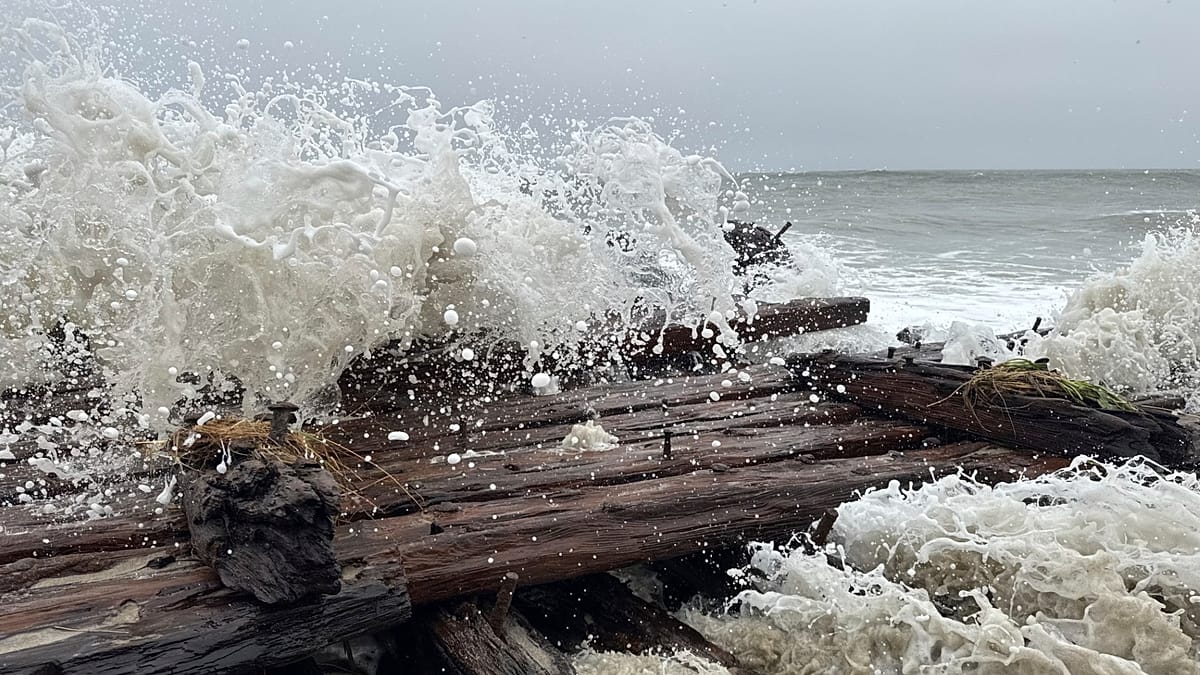
A powerful coastal nor'easter has stripped away deep layers of beach sand along the shoreline of Nantucket, Massachusetts, revealing the splintered wooden framework of a long-buried vessel. Maritime historians and local researchers suspect the exposed timbers belong to the Warren Sawyer, a 19th-century coastal merchant schooner that wrecked along the island's perilous shoals in late 1884. The sudden emergence of the historic wreck following heavy surf and atmospheric erosion has prompted plans for state and regional archaeological specialists to conduct formal on-site field surveys to verify the hull's identity and assess its condition.
Key facts
What happened
In late September 2026, a strong nor'easter swept across the southern New England coast, generating offshore gale-force winds, elevated tides, and intense wave action along exposed beaches. The persistent wave scour dramatically altered Nantucket's coastline overnight, removing heavy sand cover from a southern section of the island's beach.
As the storm abated and low tide receded, local observers discovered heavy, dark-stained timber framing protruding from the remaining sand. Video footage and imagery captured from the shoreline revealed parallel structural ribs, floor timbers, and outer planking typical of mid-to-late 19th-century New England wooden ship construction. The exposed structural elements span several metres across the intertidal zone, featuring heavy fasteners and squared wooden frames.
Preliminary spatial checks against municipal and regional shipwreck archives quickly pointed to the Warren Sawyer. Historical logs record that the vessel ran aground in Nantucket waters during severe weather in December 1884, coming to rest in the dynamic sand shoals that characterize the island's perimeter. State preservation officers and local historical caretakers were notified following the discovery to coordinate documentation before tidal changes and subsequent weather systems re-cover or dismantle the fragile timbers.
Why it matters
The discovery of a 19th-century coastal trading vessel offers rare, direct physical evidence of American maritime commerce during a critical transitional era. In the late 1800s, multi-masted wooden schooners served as the primary transportation network for bulk industrial and agricultural commodities along the United States Atlantic Seaboard, moving coal, timber, granite, and lime between northern ports and rapidly expanding urban centres along the mid-Atlantic coast.
From an archaeological perspective, intact structural remains preserved under anaerobic marine sand provide insights into late-19th-century American wooden shipbuilding techniques, wood selection, and iron or copper fastening methods. While historical archives contain construction ledgers and customs registrations, physical hull remains allow researchers to analyze localized repair patterns, wear, and structural adaptations made during a vessel's operational life.
Furthermore, the uncovering of the site underscores the accelerating rate of coastal erosion driven by severe storm events and rising sea levels across the northeastern United States. The dynamic shifting of Nantucket's barrier beaches frequently uncovers buried cultural resources, but sudden atmospheric exposure also initiates rapid degradation. Once exposed to oxygen, ultraviolet light, marine borers, and physical breaking waves, saturated historical wood can deteriorate significantly within days or weeks, forcing heritage managers to make quick decisions regarding documentation, stabilization, or natural re-burial.
The background
Nantucket Island, situated roughly 30 miles south of Cape Cod, sits adjacent to some of the most treacherous sandbars and shoals in North America. Historically referred to as part of the outer "Graveyard of the Atlantic," the waters surrounding Nantucket feature constantly shifting sandbanks—including the Nantucket Shoals, Rose and Crown Shoal, and the South Shoals—where strong tidal currents from the Gulf Stream meet cold northern ocean currents.
Before the construction of modern navigational canals and deep-water shipping lanes, coastal merchant vessels navigating around Cape Cod were frequently caught in sudden northeast gales. Between the 17th and early 20th centuries, thousands of vessels encountered difficulties along these shores, resulting in hundreds of documented strandings and total losses. To combat the loss of life, the United States Life-Saving Service established multiple stations along Nantucket's coast—including facilities at Surfside, Coskata, and Muskeget—equipped with surfboats and breeches buoys to rescue stranded mariners.
The Warren Sawyer was one of many merchant schooners lost in this region. Constructed during the post-Civil War boom in American coastal shipping, the schooner operated during an era when sail still competed directly with early steamship fleets for heavy coastwise freight. In December 1884, while carrying cargo along the New England coast, the vessel encountered heavy weather, lost navigational positioning, and struck the shoals off Nantucket, ultimately settling into the sand where the wreckage was gradually buried over subsequent decades.
Under state law, cultural resources embedded in shoreline sand or submerged in state waters belong to the Commonwealth of Massachusetts. The Massachusetts Board of Underwater Archaeological Resources (BUAR), created under state legislation in 1973, holds legal statutory jurisdiction over historic shipwrecks, submerged property, and underwater sites. State regulations mandate that exposed wrecks must remain undisturbed by private collectors, reserving excavation and sampling rights for qualified professionals operating under official permits.
Reaction
Regional historians, marine researchers, and local preservationists have responded to the discovery with a mixture of urgency and caution. Local historical organizations, including representatives affiliated with Nantucket's heritage institutions, have emphasized the critical need to document the exposed hull structure immediately while weather conditions permit.
State underwater archaeologists and coastal preservation officers are expected to coordinate with municipal authorities to assess the site's legal status, protection requirements, and physical condition. Preservation entities traditionally advise the public to view exposed shipwrecks strictly from a distance without walking on or removing any timber elements. Beachgoers are reminded that state and federal laws, including the Abandoned Shipwreck Act of 1987, explicitly prohibit the unauthorized disturbance, excavation, or removal of artifacts from historical shipwrecks on public land.
Local law enforcement and beach management officials are monitoring access to the beach section to prevent looting or vandalism while marine archaeologists formulate a formal recording plan.
What we don't know yet
Despite strong initial indications linking the wreckage to the Warren Sawyer, definitive archaeological identification remains unconfirmed. Key diagnostic features—such as official registry numbers carved into the main deck beam (known as the vessel's "read number"), specific structural dimensions, or diagnostic cargo fragments—have not yet been systematically documented or verified.
It is also currently unknown how much of the vessel's overall hull structure survives intact beneath the deeper sand layers. The exposed section represents only a portion of a ship frame, leaving open questions about whether the keel, sternpost, or cargo hold components remain preserved lower in the sediment profile.
Furthermore, environmental conditions present a major unknown. Weather patterns over coming tide cycles will determine whether the wreck remains exposed for field study or is rapidly recovered by shifting sand drifts. Specialists have not yet determined whether emergency physical stabilization or timber sampling will be required before the site is altered by natural beach processes.
What to watch
In the coming days, observation efforts will focus on site assessments conducted by the Massachusetts Board of Underwater Archaeological Resources and regional survey teams. Researchers are expected to employ 3D photogrammetry, high-resolution spatial mapping, and digital measurement modeling to record the exposed timber arrangement without physically disturbing the site.
Archaeologists may also seek permission to collect small wood samples for dendrochronology (tree-ring analysis) and species identification. Testing timber species—such as white oak, yellow pine, or white pine—can confirm whether the wood matches the known construction specifications of the Warren Sawyer built in mid-19th-century American shipyards.
Observers should monitor official announcements from local municipal authorities regarding temporary access restrictions or protective cordons around the beach site, as well as marine forecast tracking, which will dictate how long the historic hull remains visible to researchers and the public.
This account is based on original reporting published by Yolaine De Kerchove Dexaerde.
How this story was produced
This report was written by The Global Wire newsroom from reporting first published by Yolaine De Kerchove Dexaerde. We verify the core facts against the original report, write our own account, and add the background and consequences a short wire item leaves out. Drafting is AI-assisted inside an editor-supervised pipeline, and every story is checked for accuracy of attribution, structure and duplication before it appears — full detail in our AI and funding disclosure.
Spotted an error? Tell us at corrections@horizonglobalnews.com and read our corrections policy or editorial standards.




Reader comments
Loading comments…