

Ohio Solar Facility Hosts Over Three Million Honey Bees in Agrivoltaic Initiative
Developer Leeward Renewable Energy has introduced more than 50 managed hives at its Big Plain Solar site in Madison County, pairing solar power generation with agricultural pollinator habitat.
By The Global Wire Newsroom · Reported from TOI Science Desk
Link preview · horizonglobalnews.com
Ohio Solar Facility Hosts Over Three Million Honey Bees in Agrivoltaic Initiative
Developer Leeward Renewable Energy has introduced more than 50 managed hives at its Big Plain Solar site in Madison County, pairing solar power generation with agricultural pollinator habitat.
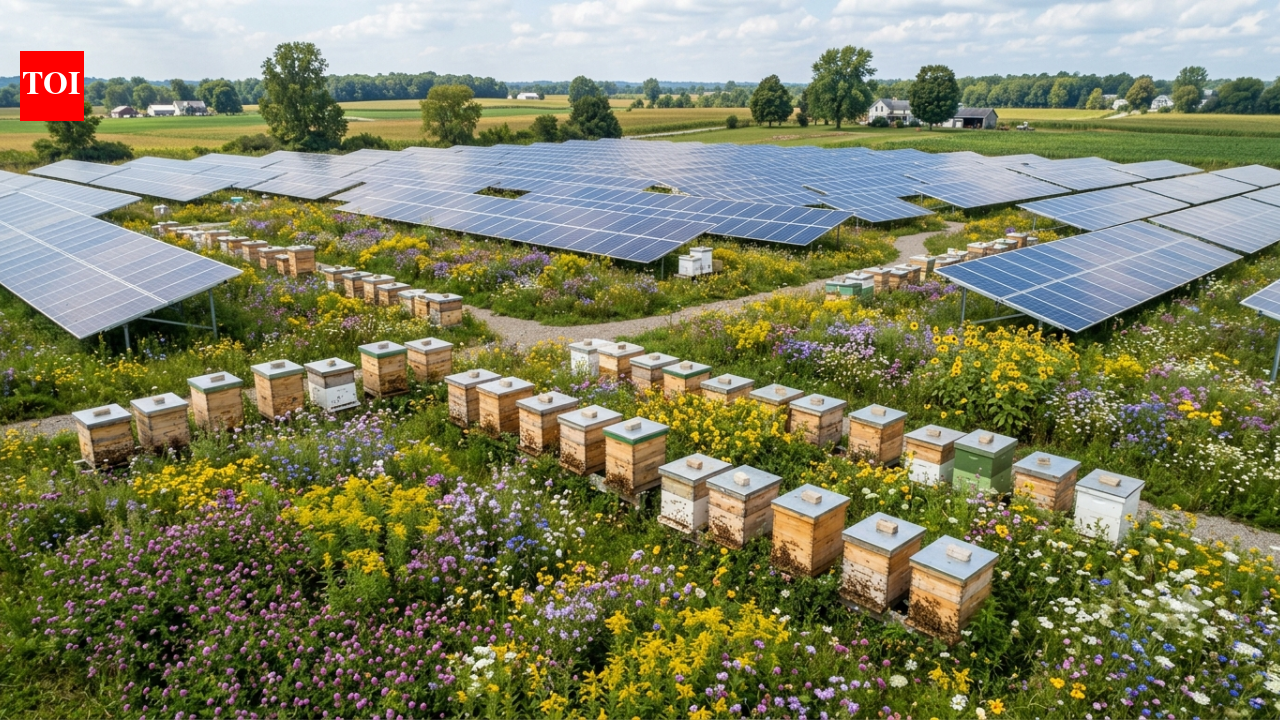
An Ohio solar power installation has integrated commercial-scale beekeeping into its operational footprint, hosting more than three million honey bees across dozens of managed hives, according to reporting by TOI Science Desk. The initiative, located at the Big Plain Solar facility in Madison County, central Ohio, is operated by Dallas-based Leeward Renewable Energy. By placing over 50 active beehives within the perimeter of the photovoltaic arrays, the company is transforming the energy generation site into a multi-use working landscape. The project reflects a growing broader trend within the utility-scale solar industry known as agrivoltaics—or pollinator-friendly solar—where renewable power infrastructure is paired with agricultural or ecological land management strategies to maximize land productivity, support local biodiversity, and provide foraging habitat for crucial pollinator species.
Key facts
What happened
At the Big Plain Solar facility in Madison County, central Ohio, renewable energy developer Leeward Renewable Energy has deployed an extensive apiary project across the grounds of its solar array, according to reporting by TOI Science Desk. The installation incorporates more than 50 managed beehives positioned within the fenced footprint of the solar farm, providing sanctuary and foraging territory for an estimated population exceeding three million honey bees.
The installation demonstrates how ground space surrounding utility-scale photovoltaic infrastructure can be actively repurposed. Rather than maintaining traditional gravel ground cover or turf grass requiring high-frequency mechanical mowing, the land surrounding the solar panel mounting racks is designed to support pollinator life cycles. The managed hives are strategically arranged across the site to ensure the bees have direct access to nearby flowering plants and surrounding agricultural fields without interfering with security perimeters, electrical inverter stations, or solar panel tracking machinery.
Leeward Renewable Energy highlighted the initiative as an example of how modern utility-scale solar facilities can serve functions beyond single-purpose electricity generation. By establishing managed honey bee colonies directly within the security enclosure of a power plant, the site functions simultaneously as clean power infrastructure and an agricultural support hub.
Why it matters
The co-location of three million honey bees within a utility-scale solar installation addresses several pressing environmental, agricultural, and land-use challenges facing the renewable energy sector.
As the United States accelerates its transition toward low-carbon electricity, utility-scale solar energy development requires significant land area. Standard ground-mounted photovoltaic systems typically require between five and ten acres of land to generate one megawatt of alternating current capacity. In major agricultural regions like central Ohio, large solar farms have sometimes faced opposition from local communities concerned about the loss of productive cropland and changes to rural landscapes. Dual-use strategies, such as hosting apiaries or planting pollinator-friendly native vegetation beneath panels, offer a practical middle ground that keeps land agriculturally productive while producing clean electricity.
From an agricultural perspective, honey bees (Apis mellifera) are vital partners for regional crop production. While staple grain crops like corn and wheat are wind-pollinated, crops such as soybeans, fruits, vegetables, clover, and cover crops benefit significantly from managed and wild pollinators. Higher pollinator density can improve seed set and yield in neighboring farms, establishing a mutually beneficial relationship between solar facility operators and local farming communities.
Furthermore, integrating apiaries and vegetative ground cover yields operational advantages for solar facility managers. Low-growing flowering vegetation helps control soil erosion, improves stormwater infiltration, and reduces the need for frequent mechanical mowing or chemical herbicide application, which lowers overall operation and maintenance expenses. Research from national research laboratories has also shown that lush vegetative ground cover creates a cooler microclimate beneath solar panels compared to bare ground or gravel. Because photovoltaic panels lose efficiency as temperatures rise, microclimate cooling can improve panel conversion efficiency and total energy yield on hot summer days.
The background
The practice of combining solar energy production with agricultural activities—commonly termed agrivoltaics or solar-pollinator co-location—has grown rapidly across North America over the past decade. The concept originated in Europe in the 1980s but gained commercial traction in the United States following the passage of state-level pollinator-friendly solar standards, beginning with Minnesota in 2016. Since then, multiple Midwestern states, including Illinois, Indiana, and Ohio, have established guidelines or scorecards to encourage solar developers to plant low-growing native perennials and maintain managed hives on utility-scale sites.
The urgency surrounding pollinator conservation stems from long-term trends in insect decline. Managed honey bee colonies in North America have experienced elevated annual loss rates over the past two decades. Annual surveys conducted by the Bee Informed Partnership and the U.S. Department of Agriculture show that commercial beekeepers in the U.S. routinely lose between 30% and 50% of their managed colonies each year to a combination of factors, including the parasitic Varroa destructor mite, pesticide exposure, habitat fragmentation, and nutritional stress caused by monoculture farming. Supplying protected, pesticide-reduced environments where bees can forage on diverse flowering plants is critical for stabilizing colony health.
Ohio has emerged as a key market for utility-scale solar expansion within the regional PJM Interconnection grid. Central Ohio counties, including Madison County, possess flat terrain, high solar radiation exposure relative to the region, and close proximity to high-voltage electric transmission lines serving major urban centers like Columbus. The Ohio Power Siting Board (OPSB), which evaluates and approves major utility facilities in the state, increasingly considers environmental mitigation plans, topsoil preservation, and post-construction land management when evaluating solar permit applications.
Developer Leeward Renewable Energy, a portfolio company of OMERS Infrastructure, manages a diverse portfolio of wind, solar, and energy storage projects across the United States. Initiatives like the Big Plain Solar apiary reflect an industry-wide effort by major renewable energy asset owners to incorporate environmental stewardship into project design, helping address community concerns during long-term operational phases that typically span 25 to 35 years.
Reaction
Following the public announcement of the Big Plain Solar apiary initiative, as reported by TOI Science Desk, the project highlights how utility-scale solar operators communicate environmental stewardship to host communities and public regulators.
While specific statements from local government officials or regional agricultural associations were not included in the initial report, projects of this nature typically draw close interest from local farm bureaus, university agricultural extension offices, and regional beekeeping associations. Agricultural extensions in the Midwest regularly partner with renewable developers to study the agronomic impacts of managed hives and native plantings on surrounding crop yields. Local zoning boards and county commissioners in agricultural jurisdictions also frequently monitor such dual-use commitments as benchmarks when evaluating future solar development proposals within their boundaries.
What we don't know yet
Several specific details regarding the operational setup and long-term scientific tracking at the Big Plain Solar site remain unconfirmed in available reporting.
First, the initial report does not state the total generation capacity (in megawatts) or total acreage of the Big Plain Solar facility, leaving the exact spatial density of the hives across the property unclear. Second, the report does not detail the precise vegetation species composition planted beneath the solar arrays, such as whether the site uses native wildflower mixtures, white clover, or non-invasive turf grasses.
Additionally, details have not been disclosed regarding who performs daily hive management—specifically whether Leeward Renewable Energy contracts with a local commercial beekeeper or maintains dedicated in-house staff. The report also leaves unstated whether honey harvested from the 50-plus hives will be bottled and commercialized, distributed locally, or dedicated to research purposes. Finally, long-term scientific baseline data measuring local hive survival rates and specific pollination impacts on adjacent farmland in Madison County have yet to be published.
What to watch
In the coming months and years, several key developments will indicate the success and potential expansion of solar apiary programs like Big Plain Solar:
This report is based on original news coverage provided by TOI Science Desk.
How this story was produced
This report was written by The Global Wire newsroom from reporting first published by TOI Science Desk. We verify the core facts against the original report, write our own account, and add the background and consequences a short wire item leaves out. Drafting is AI-assisted inside an editor-supervised pipeline, and every story is checked for accuracy of attribution, structure and duplication before it appears — full detail in our AI and funding disclosure.
Spotted an error? Tell us at corrections@horizonglobalnews.com and read our corrections policy or editorial standards.


Reader comments
Loading comments…