

Madrid Sit-In Escalates Protests Over Soaring Spanish Rent and Housing Shortages
Activists pitch 100 tents in Puerta del Sol following mass rallies demanding federal caps on rent prices and tighter limits on tourist accommodations.
By The Global Wire Newsroom · Reported from Gavin Blackburn; Javier Iniguez De Onzono
Link preview · horizonglobalnews.com
Madrid Sit-In Escalates Protests Over Soaring Spanish Rent and Housing Shortages
Activists pitch 100 tents in Puerta del Sol following mass rallies demanding federal caps on rent prices and tighter limits on tourist accommodations.
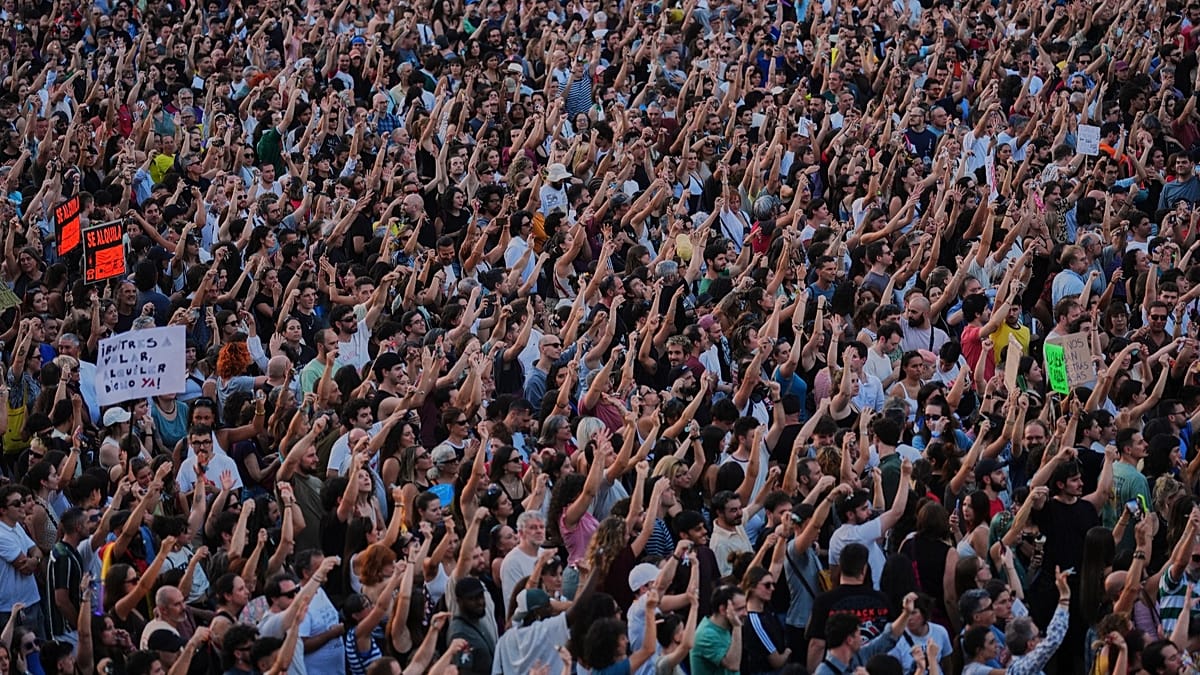
In Madrid, housing activists and city residents have erected a temporary tent city in the central Puerta del Sol plaza, pledging to occupy the landmark public square indefinitely until Spanish authorities enact drastic measures to curb soaring shelter costs. The sit-in, which began with the pitching of approximately 100 tents, came on the heels of major weekend demonstrations that brought tens of thousands of people into the streets of the Spanish capital and other metropolitan centers. Protesters are demanding direct government intervention to suppress rent hikes, enforce stricter regulations on tourist apartments, halt tenant evictions, and drastically increase the national supply of affordable housing.
Key facts
What happened
The occupation of Puerta del Sol represents a sharp escalation in a growing nationwide civil movement targeting Spain's escalating housing affordability crisis. Over the weekend, tens of thousands of demonstrators marched through central Madrid, carrying banners, chanting slogans against real estate speculation, and calling for the resignations of officials deemed inactive on housing policy. Organized by a coalition of tenant unions, neighborhood associations, and youth collectives, the march culminated in the central square, where dozens of participants unpacked camping equipment and established a structured tent city.
By Sunday, roughly 100 tents occupied the paved expanse of Puerta del Sol, surrounded by informational banners and assembly areas. Organizers established working committees responsible for logistical management, legal support, security, and food distribution, signaling an intention to remain in place over an extended period. The encampment's organizers announced that daily open assemblies would be held to coordinate nonviolent civil action and maintain pressure on national and regional authorities.
The movement's core demands center on immediate emergency legislation to roll back rental prices to levels aligned with average household incomes. Demonstrators are also pressing for a total moratorium on no-fault evictions, an aggressive crackdown on unregistered short-term holiday rentals offered via digital platforms, and the conversion of vacant bank-owned properties into municipal social housing. While municipal police monitored the setup of the encampment, initial hours passed without major physical confrontations or forced clearances by law enforcement.
Why it matters
The escalation in Madrid reflects deep-seated socio-economic distress that extends far beyond the capital, directly impacting household stability, economic productivity, and generational mobility across Spain. In recent years, residential rental prices in major urban centers—including Madrid, Barcelona, Valencia, Málaga, and the Balearic Islands—have surged significantly faster than average wage growth, forcing a growing percentage of working-class families and young adults to allocate upwards of 40 to 50 percent of their net income toward basic shelter.
For younger Spaniards, the lack of affordable rental housing has exacerbated a long-standing demographic and economic crisis. Data from national labor and housing studies indicate that the average age at which young adults in Spain can afford to leave their parental home now sits near 30, among the highest figures in the European Union. Stagnant entry-level salaries, combined with widespread temporary work contracts, have effectively locked a generation out of both property ownership and independent rental living.
Politically, the protest puts intense pressure on both Prime Minister Pedro Sánchez’s progressive coalition government and opposition-led regional administrations. The central government faces criticism from its left-leaning political partners and grassroots supporters for failing to enforce uniform nationwide price controls, while conservative regional governments face public fury for actively refusing to deploy statutory rent-capping powers. Furthermore, the housing crisis is inextricably linked to Spain’s massive tourism industry. As residential apartments are increasingly converted into high-yield short-term holiday rentals, urban centers face residential depopulation, neighborhood degradation, and severe distortions in the broader commercial economy.
The background
Spain’s contemporary housing crisis is rooted in decades of structural policy choices, economic shifts, and post-financial-crisis real estate dynamics. For decades, Spanish housing policy prioritized private homeownership over public rental infrastructure, leaving the country with one of the smallest public housing stocks in Western Europe—accounting for less than 3 percent of total residential properties, compared to European Union averages exceeding 9 percent.
Following the 2008 collapse of the domestic real estate bubble and the subsequent euro-area financial crisis, international investment funds acquired tens of thousands of repossessed residential units from distressed Spanish banks at steep discounts. As global capital entered urban residential markets, property values rebounded sharply, driven further by the expansion of short-term vacation rental platforms targeting Spain’s record tourist inflows, which exceeded 85 million international visitors annually in recent years.
In May 2023, the Spanish parliament approved the landmark Law for the Right to Housing (Ley de Vivienda), the country’s first comprehensive federal legal framework designed to regulate residential real estate. The law introduced several key provisions, including capping annual rent increase percentages, offering tax incentives to property owners who lower rent for existing tenants, and allowing autonomous communities to designate "residential stress zones" (zonas tensionadas) where rental prices can be capped directly.
However, Spain’s decentralized governance model delegates primary housing authority to its 17 autonomous regions. Conservative regional governments, most notably the Regional Government of Madrid led by the People’s Party (PP), publicly rejected the application of price controls authorized under the 2023 law. Regional leadership argued that statutory rent ceilings distort free-market mechanics, disincentivize private property development, reduce overall rental supply, and encourage informal rental arrangements. This regulatory fragmentation has resulted in stark geographical discrepancies, with rent controls applied in regions like Catalonia while remaining completely unutilized in Madrid and urban southern regions.
Puerta del Sol itself holds significant symbolic weight in Spanish political history. In May 2011, the plaza was the birthplace of the 15-M movement, also known as the "Indignados," where thousands of citizens established a prolonged tent city to protest high unemployment, bank bailouts, and political corruption following the Great Recession. That occupation ultimately transformed Spanish politics, giving rise to new political parties and altering national discourse around social rights.
Reaction
The encampment in Puerta del Sol has drawn immediate responses from political leaders, municipal authorities, and civic associations across the spectrum. Representatives of tenant organizations and grassroots housing platforms expressed broad solidarity with the occupiers, framing the encampment as a necessary measure of peaceful civil disobedience to confront what they describe as systematic legislative neglect.
Within the national government, coalition figures from the left-wing Sumar alliance voiced support for the protesters' demands, calling on regional governments to immediately activate rent-control mechanisms provided by national law. Conversely, officials from the Madrid regional government and conservative parliamentary opposition reiterated their opposition to state price interventions, maintaining that the solution to rising costs lies in deregulation, streamlined building permits, and increased land release to boost private housing construction.
Real estate sector associations, including landlord advocacy groups and property management federations, warned that prolonged sit-ins and statutory price controls could deter international investment and cause individual property owners to withdraw rental units from the long-term market, ultimately worsening the housing shortage. Meanwhile, tourism and hospitality representatives expressed concern regarding potential disruptions to commercial activity in Madrid’s central district if the encampment persists through the autumn business and travel season.
What we don't know yet
Several critical operational and legal questions surrounding the Puerta del Sol encampment remain unanswered:
What to watch
Key indicators and upcoming events that will determine the evolution of this dispute include:
This news report is based on primary reporting provided by journalists Gavin Blackburn and Javier Iniguez De Onzono.
How this story was produced
This report was written by The Global Wire newsroom from reporting first published by Gavin Blackburn; Javier Iniguez De Onzono. We verify the core facts against the original report, write our own account, and add the background and consequences a short wire item leaves out. Drafting is AI-assisted inside an editor-supervised pipeline, and every story is checked for accuracy of attribution, structure and duplication before it appears — full detail in our AI and funding disclosure.
Spotted an error? Tell us at corrections@horizonglobalnews.com and read our corrections policy or editorial standards.


Reader comments
Loading comments…