

Lockheed Martin Tests Networked F-16 Sensors to Accelerate Passive Target Tracking
Defense contractor Lockheed Martin has flown two F-16 fighter jets equipped with Legion Pod infrared sensors and HiveLink software to share targeting data in real time.
By The Global Wire Newsroom · Reported from Aamir Khollam
Link preview · horizonglobalnews.com
Lockheed Martin Tests Networked F-16 Sensors to Accelerate Passive Target Tracking
Defense contractor Lockheed Martin has flown two F-16 fighter jets equipped with Legion Pod infrared sensors and HiveLink software to share targeting data in real time.
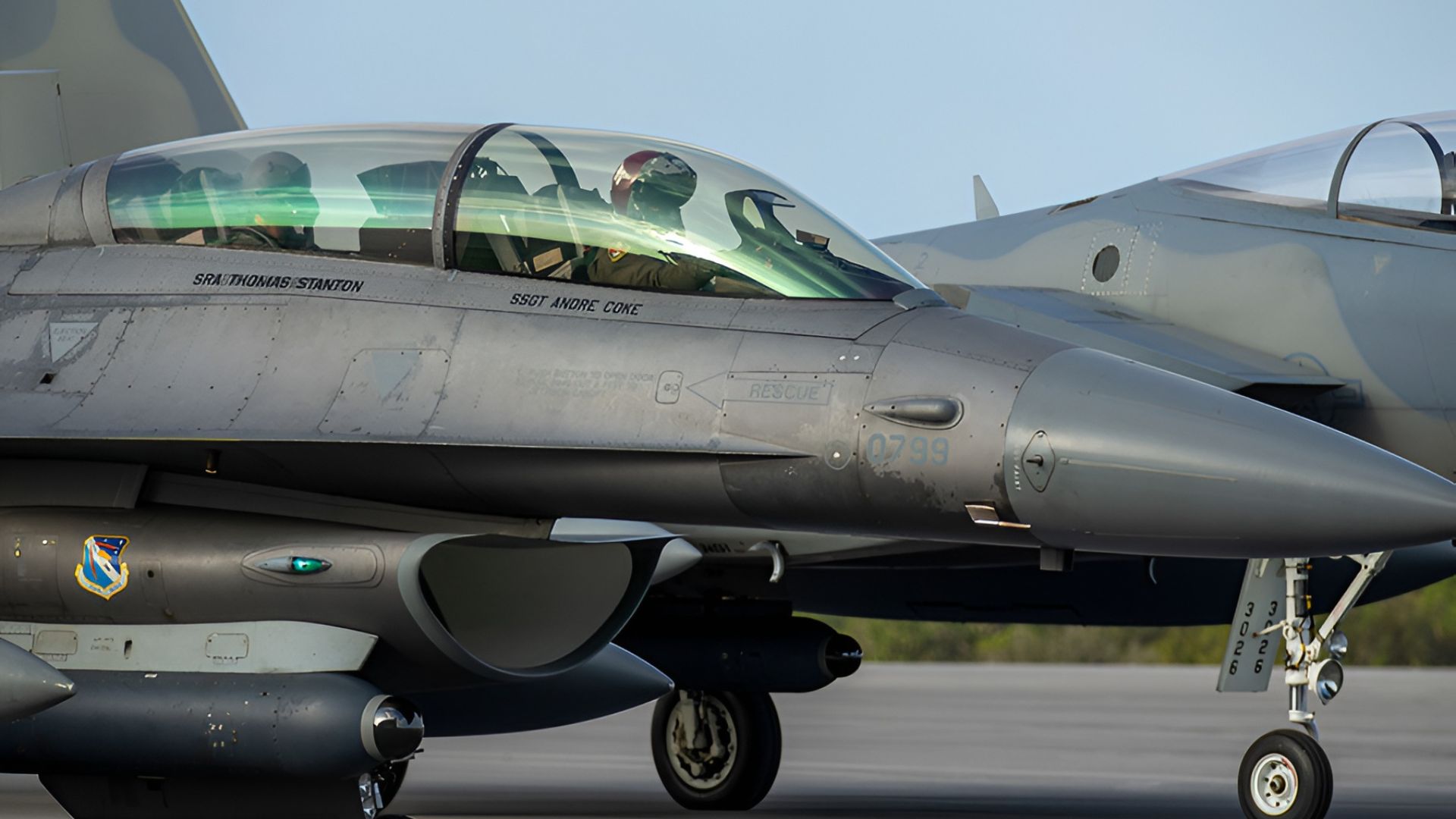
Defense contractor Lockheed Martin has completed flight demonstrations utilizing a networked infrared sensor suite to connect two F-16 Fighting Falcon aircraft, establishing a high-speed data link that allows the fighters to collaboratively locate and track aerial targets without revealing their positions. Operating at speeds approaching 1,500 miles per hour, the two multirole fighter jets were integrated using Lockheed Martin’s Legion Pod hardware and HiveLink networking software. The flight evaluation successfully fused live thermal sensor feeds across both platforms, enabling real-time targeting calculations with elevated positional precision while maintaining electromagnetic silence.
Key facts
What happened
During the recent flight trials, Lockheed Martin conducted operational evaluations using two F-16 aircraft outfitted with external Legion Pod units. Each Legion Pod houses an advanced infrared search and track (IRST) sensor capable of detecting electromagnetic radiation in the thermal spectrum emitted by aircraft engines, leading edges, and skin friction generated during high-speed flight.
Under standard single-aircraft operational parameters, an IRST pod detects thermal targets along a single line of sight, providing accurate angular data—such as azimuth and elevation—but requiring additional maneuvers or elapsed time to establish a reliable distance measurement. During the trial, Lockheed Martin integrated its proprietary HiveLink software architecture to resolve this operational constraint.
HiveLink established a direct, low-latency datalink between the two F-16s as they maneuvered at speeds reaching 1,500 miles per hour (approximately Mach 2). As each pod identified thermal signatures in the surrounding airspace, HiveLink automatically transmitted raw sensor data between the platforms. The system fused the two distinct visual lines of sight using real-time algorithmic triangulation. By cross-referencing the angular geometry from two separated airframes, the networked software calculated instantaneous target distance, altitude, and heading. This cooperative tracking process occurred without requiring either pilot to activate their primary onboard radar systems, significantly increasing track accuracy while cutting the time necessary to form a weapons-quality target track.
Why it matters
The integration of passive infrared networking marks a significant tactical development for air combat tactics in high-threat contested airspace. Modern air warfare relies heavily on pulse-Doppler active electronically scanned array (AESA) radar systems to detect and engage airborne threats. However, active radar broadcasts powerful radio frequency signals that expose the searching aircraft’s location to adversary passive detection sensors, electronic support measures (ESM), and long-range anti-radiation missiles. Additionally, modern low-observable stealth aircraft are explicitly engineered to absorb or deflect radar waves, reducing the effective detection range of conventional active radar systems.
By using the Legion Pod’s IRST sensor suite, aircraft can identify targets based on heat signatures, which stealth airframe shaping cannot eliminate. When paired with HiveLink software, the limitation of single-sensor passive tracking—namely, the delay in calculating target distance—is overcome. Flight leads and wingmen can share passive track data instantly, generating actionable fire-control solutions against low-observable aircraft and cruise missiles without emitting detectable electromagnetic signals.
Furthermore, this multi-platform data fusion reduces the operational workload on pilots during high-speed engagements. By delivering precise distance and velocity metrics directly to cockpit displays without requiring tactical maneuvering to estimate range, the system shortens the target engagement timeline. This provides air forces with a lethal, survivable counter-stealth capability that can be rapidly retrofitted onto existing fourth-generation fighter fleets at a fraction of the cost of acquiring new airframes.
The background
The F-16 Fighting Falcon, originally designed by General Dynamics in the 1970s and subsequently produced and modernized by Lockheed Martin, entered active military service in 1978. Originally conceived as a lightweight daylight dogfighter, the F-16 has evolved over nearly five decades of continuous production into an all-weather, multirole combat platform utilized by more than two dozen air forces globally. To maintain relevance against advancing integrated air defense systems and adversary aircraft, the F-16 platform has undergone successive avionics, radar, and structural upgrades, including Block 50/52 and Block 70/72 configurations.
Infrared search and track technology itself has a long history in aerial warfare. Early IRST systems were deployed during the Cold War on aircraft such as the American F-14 Tomcat and Soviet-designed MiG-29 and Su-27 fighters. However, early thermal sensors suffered from high false-alarm rates, limited processing power, and sensitivity degradation under adverse weather conditions, leading Western air forces to prioritize radar development throughout the late 20th century.
The operational landscape shifted with the proliferation of low-observable stealth technology and powerful digital radio frequency memory (DRFM) radar jammers. In response, Lockheed Martin developed the Legion Pod, built around the flight-proven IRST21 sensor (designated AN/ASG-34 by the U.S. military). The pod was designed as a flexible, multi-function sensor container mounted on standard weapons pylons, enabling tactical jets such as the F-16 and F-15 to carry advanced IRST capability without requiring internal structural modifications to their airframes.
HiveLink represents the next step in this evolution: shifting from platform-centric sensor gathering to distributed network-centric warfare. Rather than treating each pod as an isolated sensor, mesh networking software bridges individual platforms together. This development aligns directly with broader defense modernization strategies, such as the U.S. Department of Defense's Joint All-Domain Command and Control (JADC2) initiative, which seeks to link sensors and shooters across all military branches into a unified operational network.
Reaction
Defense analysts, aerospace engineers, and military strategists view the pairing of podded infrared hardware with high-speed data fusion software as an essential force multiplier for fourth-generation fighter fleets. Industry experts note that as fifth-generation aircraft like the F-35 Lightning II and sixth-generation Next Generation Air Dominance (NGAD) concepts reshape aerial warfare, upgrading legacy jets with networked passive sensors extends their operational viability in contested airspace.
While military officials have advocated for enhanced passive targeting capabilities to counter anti-access/area-denial (A2/AD) networks, operational testing authorities are expected to evaluate how the system performs under real-world electronic warfare conditions. Defense observers anticipate that frontline pilot communities will welcome the reduced engagement timelines, though official operational evaluation reports from military testing agencies remain pending.
What we don't know yet
While the successful flight test demonstrates proof-of-concept for two linked F-16s, several technical and operational details remain undisclosed. The specific maximum range at which HiveLink can maintain stable, low-latency data transmission between fast-moving aircraft in heavily jammed electronic warfare environments has not been published. Additionally, it remains unclear how the system performs against emerging target types, such as small uncrewed aerial systems (sUAS), high-altitude reconnaissance balloons, or high-speed hypersonic glide vehicles displaying unique thermal profiles.
The integration roadmap for operational military units also remains unconfirmed. Lockheed Martin and defense procurement agencies have not specified when HiveLink software will be fully deployed to operational frontline squadrons, nor whether the system will be made available for export to foreign F-16 operators, such as NATO allies or partner nations in the Indo-Pacific region. Furthermore, details regarding full compatibility with existing tactical datalinks like Link 16 or Tactical Targeting Network Technology (TTNT) have not been detailed.
What to watch
Future developments will center on expanding flight evaluations to include larger networks of aircraft. Observers should watch for upcoming flight trials involving three or more interconnected nodes, as well as joint tests combining F-16s with other tactical platforms such as the F-15EX Eagle II, F-35 Lightning II, or emerging autonomous Collaborative Combat Aircraft (CCA).
Key milestones will include formal operational evaluations conducted by the U.S. Air Force Operational Test and Evaluation Center (AFOTEC) and potential live-fire missile trials where weapons are launched using HiveLink-derived passive target tracking data. Defense analysts will also monitor upcoming military budget requests and congressional defense appropriations bills for dedicated funding line items allocated to Legion Pod procurement and software updates. Announcements regarding potential foreign military sales of the HiveLink-enabled Legion Pod system to allied air forces will provide further indication of the technology's production trajectory.
Reporting on this defense aviation advancement was originally published by Aamir Khollam.
How this story was produced
This report was written by The Global Wire newsroom from reporting first published by Aamir Khollam. We verify the core facts against the original report, write our own account, and add the background and consequences a short wire item leaves out. Drafting is AI-assisted inside an editor-supervised pipeline, and every story is checked for accuracy of attribution, structure and duplication before it appears — full detail in our AI and funding disclosure.
Spotted an error? Tell us at corrections@horizonglobalnews.com and read our corrections policy or editorial standards.




Reader comments
Loading comments…