

Galbot Unveils RoboGesture System to Enable Real-Time Humanoid Co-Speech Motion
A new system called RoboGesture enables humanoid robots to generate natural, speech-synchronized body language in real time during human interactions.
By The Global Wire Newsroom · Reported from Jijo Malayil
Link preview · horizonglobalnews.com
Galbot Unveils RoboGesture System to Enable Real-Time Humanoid Co-Speech Motion
A new system called RoboGesture enables humanoid robots to generate natural, speech-synchronized body language in real time during human interactions.
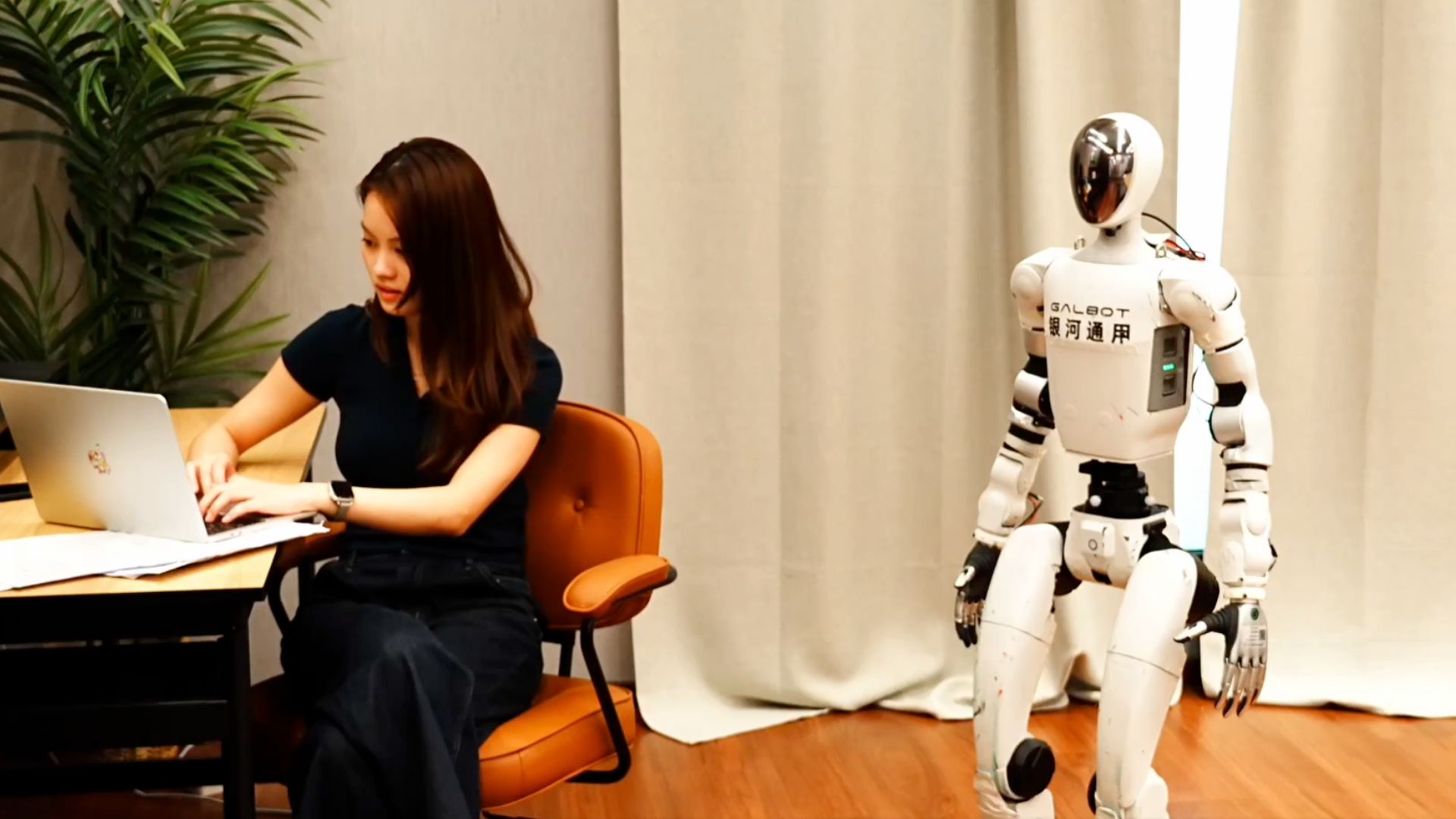
Robotics enterprise Galbot has introduced a framework called RoboGesture that allows humanoid hardware to execute dynamic body gestures synchronized with spoken language in real time, according to reporting published on Sept. 7, 2026, by technology writer Jijo Malayil. The system is designed to synthesize kinetic movements that match the rhythm, emphasis, and context of speech output, addressing a persistent friction point in human-robot interaction where mechanical movements appear rigid or misaligned with vocal communication. By enabling real-time gesture generation, the development marks a shift in embodied artificial intelligence from purely task-oriented physical manipulation toward expressive, socially competent human-robot communication.
Key facts
What happened
As reported by Jijo Malayil, Galbot's RoboGesture framework provides humanoid robots with the capability to generate real-time physical movements that mirror spoken words. Traditional robotic animation and conversational systems have historically relied on pre-rendered gesture libraries or manually programmed routines triggered by specific keywords. These legacy approaches often resulted in unnatural pauses, repetitive movement patterns, or jarring disconnects between the timing of spoken audio and physical body language.
The RoboGesture platform processes linguistic and audio signals to compute continuous movement trajectories for a robot's actuators while vocalization takes place. In human communication, speakers continuously employ non-verbal cues—including open-hand gesticulations, beat gestures that emphasize rhythmic stress, iconics that visually represent concepts, and deictic movements that point to objects or directions. Implementing these dynamics on a physical humanoid machine requires rapid algorithmic processing that translates acoustic prosody and semantic context into joint angles, angular velocity constraints, and torque limits across multi-degree-of-freedom robotic limbs.
According to Malayil's account, RoboGesture is designed to operate dynamically in interactive settings, allowing humanoid machines to adjust their physical expression instantaneously as conversational flow unfolds. This real-time operation is intended to bridge the perceptual gap between artificial verbal synthesis and physical posture, making machine interaction feel less robotic and more intuitive to human observers.
Why it matters
The introduction of real-time co-speech gesture systems carries significant implications for human-robot interaction design, public safety, and the commercial adoption of embodied artificial intelligence. In human psychology, non-verbal communication accounts for a substantial portion of interpersonal meaning. Studies in kinesics and cognitive ergonomics show that when non-verbal signals contradict or lag behind audio delivery, human listeners experience heightened cognitive load and psychological discomfort—a phenomenon closely associated with the "uncanny valley."
For humanoid robots deployed in service sectors such as healthcare, elder care, retail, and hospitality, effective non-verbal communication is critical for establishing trust and clarity. A medical assistant robot or customer service terminal that gestures naturally can convey intent, indicate spatial orientation, and reassure users far more effectively than a platform restricted to monotonic speech paired with motionless limbs. Fluid physical cueing helps human bystanders anticipate a robot's next physical action, which reduces accidental collisions and improves operational safety in shared environments.
From an engineering perspective, integrated co-speech motion framework development represents a key step in building general-purpose humanoid software architectures. Historically, robotic research separated low-level motor control from high-level natural language processing. Systems like RoboGesture signal an architectural consolidation where multimodal generative models handle language comprehension, acoustic prosody processing, and physical trajectory synthesis within unified execution pipelines.
The background
The challenge of synthesizing natural co-speech motion has been studied across computer animation, virtual character design, and physical robotics for decades. Early efforts in the 1990s and 2000s relied on rule-based animation systems, such as the Behavior Expression Animation Toolkit (BEAT), which mapped grammatical parse trees directly to pre-authored gesture clips. While functional in virtual environments, rule-based systems lacked flexibility and could not adapt to unstructured human dialogue.
With the advent of deep learning, researchers began utilizing recurrent neural networks (RNNs), variational autoencoders (VAEs), and generative adversarial networks (GANs) to predict continuous motion sequences from audio waveforms or text transcripts. The development of specialized datasets—such as the Trinity Gesture Dataset, the Body-Expression-Audio-Text (BEAT) benchmark, and the SHOW dataset—provided the training data necessary to map human motion capture (mocap) sequences to speech signals. More recently, transformer architectures and motion diffusion models have enabled researchers to generate high-fidelity, diverse body movements tailored to vocal inflection and semantic content.
Translating these software advancements into physical humanoid hardware presents distinct challenges that do not exist in software avatars. Physical humanoid platforms, manufactured by companies ranging from Galbot and Unitree to Boston Dynamics, Agility Robotics, and Figure AI, operate under strict mechanical and physical constraints. Every physical gesture must respect actuator torque limits, joint range thresholds, thermal dissipation bounds, and whole-body balance control algorithms. If a gesture model generates an arm movement that destabilizes the robot's center of mass, the robot risks falling over. Consequently, modern humanoid gesture architecture must continually balance expressive naturalism against real-time balance preservation and safety constraints.
Galbot, founded as an embodied AI enterprise, focuses on developing bipedal and wheeled humanoid robots integrated with proprietary foundation models for perception, spatial reasoning, and manipulation. The introduction of RoboGesture complements the company's hardware development by focusing on the social interaction layer required for real-world deployment.
Reaction
Following the publication of Jijo Malayil's report, reaction within the robotics and artificial intelligence research communities has centered on the balance between hardware execution speeds and expressive motion fidelity. While theoretical papers on co-speech gesture synthesis are frequently presented at academic venues such as the IEEE International Conference on Robotics and Automation (ICRA) and the Conference on Robot Learning (CoRL), physical demonstrations on commercial humanoid platforms remain relatively limited.
Industry analysts and human-robot interaction researchers are expected to evaluate RoboGesture based on concrete benchmark performance, specifically testing for gesture-speech synchronization accuracy, computational latency, and balance stability during expressive arm movements. Robotics system integrators who deploy humanoids in commercial public settings will watch whether systems of this type can reduce user hesitation and lower training requirements for non-technical operators. Competitors in the humanoid sector—including commercial developers in North America, Europe, and East Asia—are facing similar demands to render their hardware more socially acceptable as bipedal robots transition from controlled factory environments into customer-facing operations.
What we don't know yet
Despite the details reported by Malayil, several key technical and operational parameters regarding RoboGesture remain undisclosed:
Addressing these technical unknowns will be essential to understanding the software's scalability across diverse global deployment scenarios.
What to watch
In assessing the future trajectory of RoboGesture and co-speech gesture technology in humanoid robotics, several key indicators should be monitored:
This report is based on original news reporting by Jijo Malayil published on Sept. 7, 2026.
How this story was produced
This report was written by The Global Wire newsroom from reporting first published by Jijo Malayil. We verify the core facts against the original report, write our own account, and add the background and consequences a short wire item leaves out. Drafting is AI-assisted inside an editor-supervised pipeline, and every story is checked for accuracy of attribution, structure and duplication before it appears — full detail in our AI and funding disclosure.
Spotted an error? Tell us at corrections@horizonglobalnews.com and read our corrections policy or editorial standards.





Reader comments
Loading comments…