

BRICS Summit Adopts Delhi Declaration, Calling for Reform of International Institutions
Leaders at the 20th BRICS summit in India approved a joint declaration prioritizing dialogue over confrontation and advocating for a structural overhaul of global governance.
By The Global Wire Newsroom · Reported from India Today Video Desk
Link preview · horizonglobalnews.com
BRICS Summit Adopts Delhi Declaration, Calling for Reform of International Institutions
Leaders at the 20th BRICS summit in India approved a joint declaration prioritizing dialogue over confrontation and advocating for a structural overhaul of global governance.
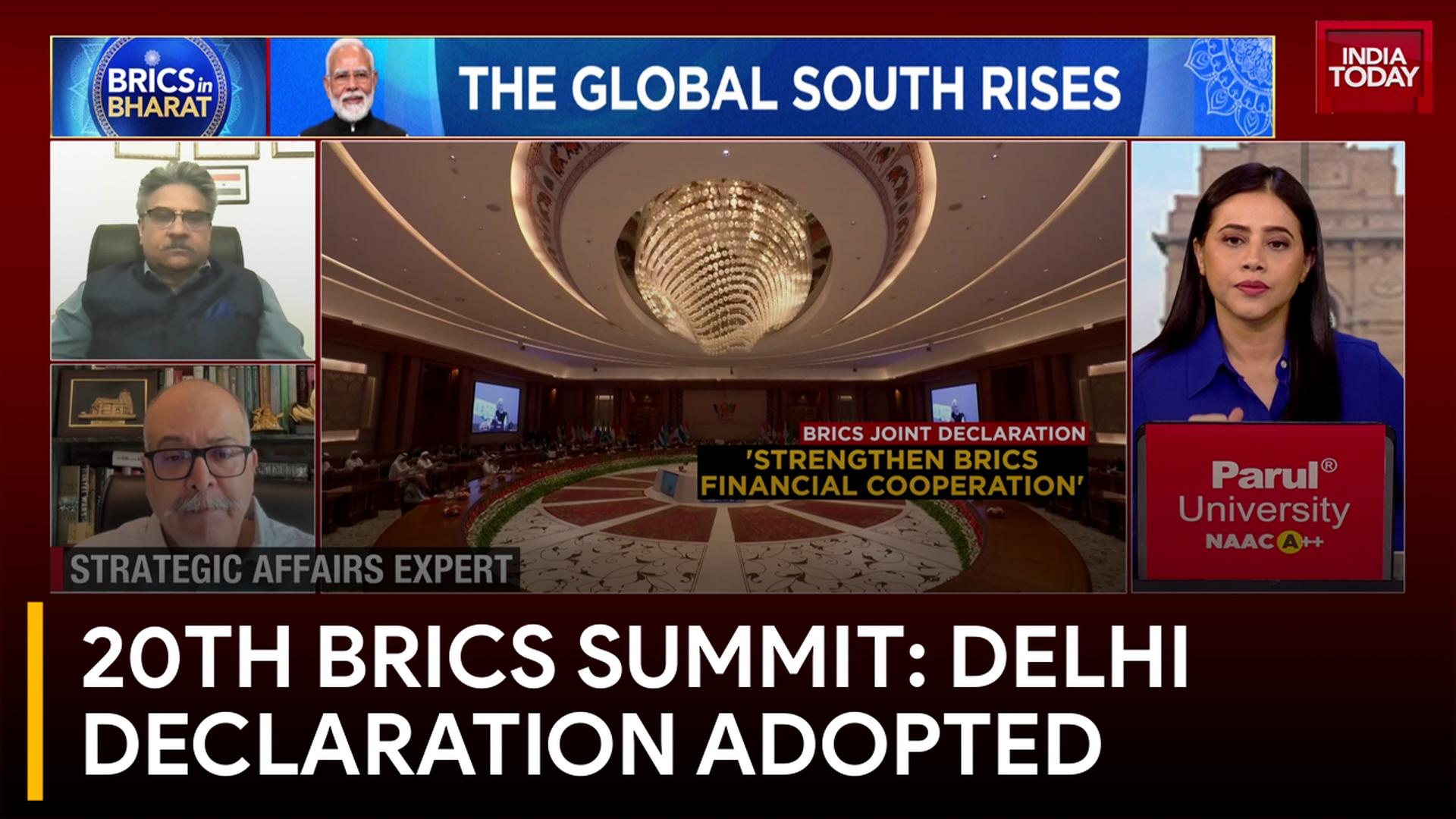
On Sept. 13, 2026, leaders of the BRICS bloc of emerging economies adopted the New Delhi Declaration by consensus during the 20th BRICS Summit hosted in India. Welcoming participating heads of state and government, Indian Prime Minister Narendra Modi used the gathering to advocate for a comprehensive restructuring of the global political and financial architecture. According to reporting by India Today Video Desk, the joint declaration emphasizes peaceful dispute resolution, prioritizes diplomatic dialogue over geopolitical confrontation, and calls for reformed multilateralism. The consensus document reflects an ongoing effort by the expanding group to assert greater collective influence in global governance and amplify the economic and political priorities of emerging markets and the Global South.
Key facts
What happened
The adoption of the New Delhi Declaration marked the culmination of high-level negotiations among BRICS delegation heads in India. Indian Prime Minister Narendra Modi formally received visiting leaders and delivered opening remarks urging the assembly to pursue an ambitious roadmap for global institutional reform. Modi emphasized that existing international frameworks must adapt to better reflect current economic, political, and demographic realities.
Delegates engaged in structured working sessions covering three main focus areas: political and security cooperation, economic and financial coordination, and institutional modernization. According to reporting by India Today Video Desk, the final text of the New Delhi Declaration reflects a consensus position that rejects unilateral confrontation and positions diplomatic negotiation as the principal instrument for settling international conflicts.
In the economic domain, leaders reviewed collective trade mechanisms and initiatives designed to strengthen intra-bloc financial settlement systems. Representatives from host nation India pressed for concrete commitments to address the specific challenges facing non-Western developing nations, including climate transition financing, technological accessibility, and equitable economic growth. The declaration explicitly endorses structural reforms across key international platforms, advocating for expanded voting rights and leadership representation for emerging economies within bodies such as the United Nations, the International Monetary Fund, and the World Bank.
Why it matters
The consensus reached in New Delhi underscores the growing weight of the BRICS platform as an alternative center of gravity in international diplomacy. The member countries of BRICS represent more than 40 percent of the world's population and command a substantial portion of global gross domestic product calculated by purchasing power parity. A unified declaration calling for an overhaul of the international monetary and political order signals that emerging market powers are increasingly coordinating their diplomatic strategies to challenge traditional Western dominance in multilateral bodies.
For global markets and international trade, the emphasis on reformed multilateralism supports broader initiatives to diversify away from exclusive reliance on Western financial systems. By encouraging local currency trade clearing and alternative cross-border payment frameworks, BRICS aims to insulate member economies from external shocks and foreign currency fluctuations. This financial coordination gradual shifts the structural dynamics of global trade and capital flows.
From a diplomatic perspective, India's leadership at the summit demonstrates its strategic positioning as a bridge power. India maintains strong economic and security partnerships with Western nations through forums such as the Quad, while simultaneously steering consensus within BRICS toward inclusive reform rather than outright anti-Western alignment. The focus on peaceful resolution of disputes provides a shared framework that enables member nations with varying foreign policy doctrines to agree on basic principles of global governance.
The background
The BRICS acronym originated in 2001 when Goldman Sachs economist Jim O'Neill coined the term BRIC to highlight the economic growth potential of Brazil, Russia, India, and China. The four original nations held their initial formal diplomatic meeting on the sidelines of the United Nations General Assembly in New York in September 2006, leading to the first official summit of BRIC heads of state in Yekaterinburg, Russia, in June 2009.
South Africa was formally admitted to the group in December 2010, transforming the bloc into BRICS prior to the third summit in Sanya, China, in April 2011. Over the following decade, the grouping shifted from an informal economic dialogue into a structured intergovernmental organization. A key milestone occurred at the sixth summit in Fortaleza, Brazil, in July 2014, where member states established the New Development Bank, headquartered in Shanghai, alongside the Contingent Reserve Arrangement to provide emergency liquidity support.
India has previously hosted several BRICS leaders' summits, including the fourth summit in New Delhi in March 2012—which produced the initial Delhi Declaration—and the 13th summit in September 2021, hosted virtually due to global pandemic restrictions. Throughout its terms as host, India has routinely advocated for United Nations Security Council reform, shared counter-terrorism strategies, and sustainable development initiatives.
The 20th summit follows a substantial membership expansion agreed upon at the 15th summit in Johannesburg, South Africa, in August 2023. That expansion invited several additional developing nations to join, transitioning the group toward a broader platform often referred to as BRICS Plus. The expanded membership aims to deepen economic integration across Asia, Africa, the Middle East, and Latin America while balancing diverse national interests.
Reaction
Responses to the adoption of the New Delhi Declaration reflect broad geopolitical divisions regarding the role of BRICS in global governance. Across developing economies in the Global South, sovereign leaders and international observers are expected to view the declaration favorably, welcoming its emphasis on debt restructuring, equitable climate financing, and increased voting power within global financial bodies.
In Western capitals and G7 diplomatic circles, foreign policy analysts and government officials are monitoring the summit outcomes to evaluate how the expanded bloc intends to execute its trade and financial strategies. While Western leaders frequently acknowledge the necessity of updating global institutions, policymakers in Washington and Brussels monitor alternative trade payment structures closely for their potential impact on international financial stability, regulatory transparency, and compliance standards.
At United Nations headquarters in New York, the joint declaration is expected to feature prominently in ongoing discussions regarding reform of the UN Security Council and the General Assembly. Official statements from UN leadership consistently encourage constructive engagement from regional and economic blocs to strengthen rules-based international frameworks and uphold international law.
What we don't know yet
While the New Delhi Declaration outlines shared diplomatic principles, the document leaves several operational specifics unaddressed. The joint statement does not establish precise operational timelines or mandatory quotas for transitioning bilateral trade among member nations into local currencies, leaving technical implementation to central banks and regional finance ministries.
Additionally, the text does not fully detail how BRICS intends to manage internal political divergences among its member states. Because the bloc operates entirely by consensus, declarations tend to emphasize broad areas of agreement—such as economic development and multilateral reform—while avoiding granular commitments on contested regional security disputes or specific permanent seats on an expanded UN Security Council.
What to watch
Key developments to monitor following the adoption of the New Delhi Declaration include:
This account is based on original news reporting provided by India Today Video Desk.
How this story was produced
This report was written by The Global Wire newsroom from reporting first published by India Today Video Desk. We verify the core facts against the original report, write our own account, and add the background and consequences a short wire item leaves out. Drafting is AI-assisted inside an editor-supervised pipeline, and every story is checked for accuracy of attribution, structure and duplication before it appears — full detail in our AI and funding disclosure.
Spotted an error? Tell us at corrections@horizonglobalnews.com and read our corrections policy or editorial standards.




Reader comments
Loading comments…