

Trump Rebukes Obama's Campaign Role, Pointing to Democratic Losses in 2016
Donald Trump challenged Barack Obama's record as a Democratic surrogate, citing past election results as both parties vie for battleground voters.
By The Global Wire Newsroom · Reported from ET Online
Link preview · horizonglobalnews.com
Trump Rebukes Obama's Campaign Role, Pointing to Democratic Losses in 2016
Donald Trump challenged Barack Obama's record as a Democratic surrogate, citing past election results as both parties vie for battleground voters.
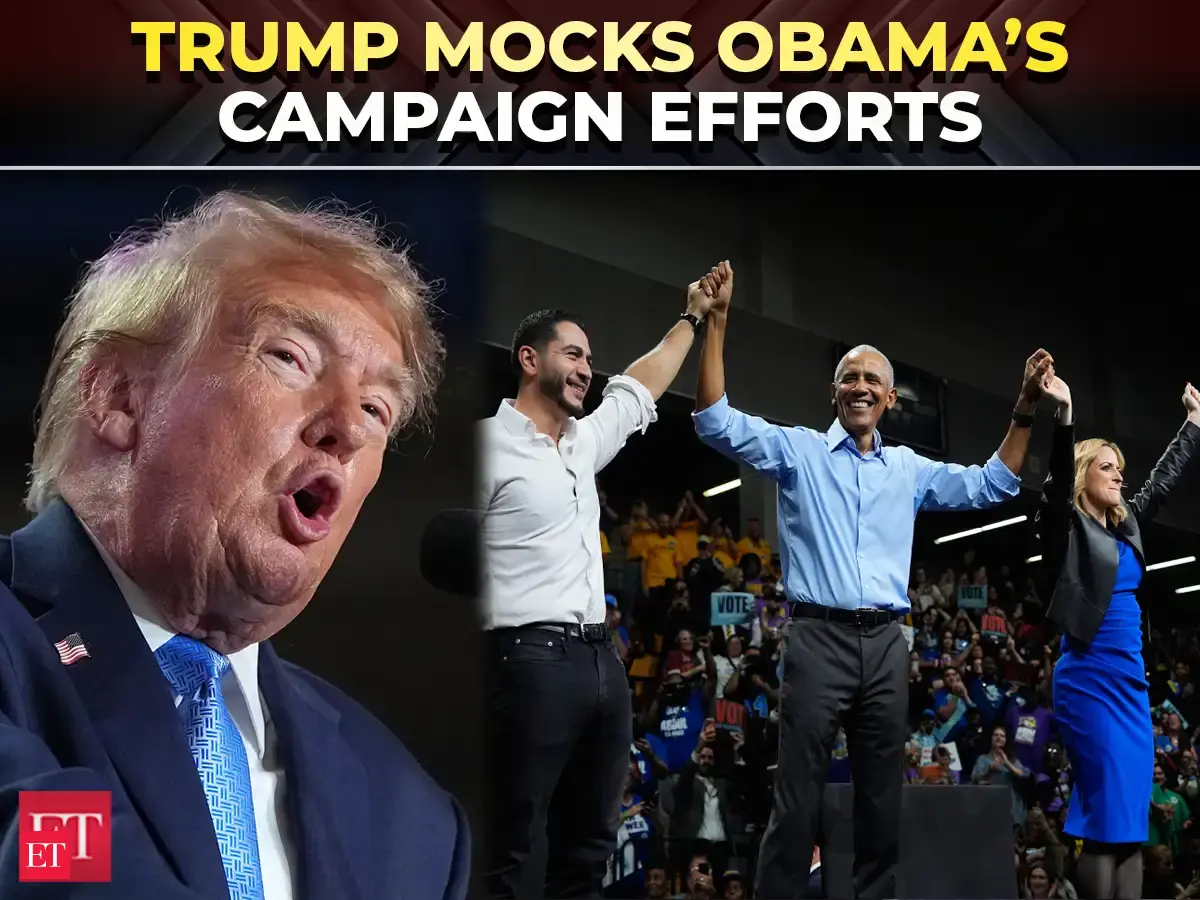
Former President Donald Trump sharply challenged the political influence of former President Barack Obama during campaign remarks, deriding his predecessor's prior electoral forecasts and questioning the effectiveness of his high-profile endorsements on behalf of Democratic candidates. Speaking to supporters in remarks reported by ET Online, Trump revisited past public predictions in which Obama insisted that Trump would never secure the White House, arguing that Obama's past efforts to elect Hillary Clinton failed to deliver victory and contending that his current advocacy for Vice President Kamala Harris would meet a similar fate.
Key facts
What happened
During campaign remarks covered by ET Online, Trump directly confronted Obama's sustained presence on the campaign trail for Democratic candidates. Trump reminded his audience of Obama's past skepticism regarding his political viability, specifically reciting Obama's prior assertion that Trump would never occupy the Oval Office. Turning to historical campaign battles, Trump recalled how Obama campaigned aggressively on behalf of Clinton in the 2016 presidential election cycle, framing that intervention as a high-profile failure by noting that the intensive surrogate effort did not prevent a Republican victory.
Trump linked those earlier campaign dynamics directly to the ongoing contest between himself and Harris. As Obama has assumed an active role on the trail for the current Democratic ticket, Trump sought to diminish the political weight of that endorsement by portraying Obama's campaign track record as flawed and ineffective. Rather than treating Obama's involvement as an insurmountable hurdle, Trump framed his predecessor's warnings and campaign speeches as the continuation of an establishment playbook that had already been tested and defeated in past national balloting.
Why it matters
The strategic value of presidential surrogates is a foundational component of modern American electoral politics, and Trump's direct challenge to Obama strikes at the core of the Democratic Party's voter-mobilization apparatus. For decades, both major political parties have operated under the assumption that a popular former chief executive can energize base voters, persuade undecided moderates, and validate a successor's policy agenda. By actively devaluing Obama's political capital, Trump seeks to neutralize one of the Democratic Party's most recognizable and revered national figures.
For voters and political observers, this rhetorical offensive underscores how surrogate efficacy is perceived across differing coalitions. In competitive swing districts, where voter margins are narrow, the credibility of campaign messengers can influence turnout among demographic groups that might otherwise sit out an election. Democratic strategists traditionally rely on Obama to generate enthusiasm among young voters, suburban moderates, and African American men. Trump's counter-narrative aims to disrupt that dynamic by casting Obama not as an inspiring statesman, but as a partisan operative whose political endorsements have repeatedly failed to persuade working-class voters in key regions. If voters view surrogate appearances as ineffective relics of past campaigns rather than urgent calls to civic action, the return on investment for high-profile surrogate travel diminishes, forcing campaigns to adjust their field operations and media expenditures accordingly.
The background
The political rivalry between Trump and Obama stretches back well over a decade, functioning as a defining fault line in contemporary United States politics. Trump's entry into conservative political prominence was accelerated in 2011 through his public questioning of Obama's birthplace and citizenship, a controversy that culminated in a memorable public confrontation at the 2011 White House Correspondents' Dinner, where Obama openly mocked Trump's political ambitions before a room of national media figures.
During the 2016 presidential election cycle, Obama entered the general election fray with substantial vigor. In October and November of that year, Obama held large-scale rallies across essential battleground states to support Clinton, delivering speeches in which he repeatedly argued that Trump was fundamentally unqualified for the presidency and assured audiences that the electorate would reject Trump's populist vision. Despite those warnings, Trump secured 306 electoral votes on November 8, 2016, defeating Clinton—who captured 232 electoral votes—by flipping critical industrial battleground states, including Pennsylvania, Michigan, and Wisconsin. That outcome marked the first time since 1988 that those three northern industrial states had voted for a Republican presidential nominee.
Following the 2016 result, Obama adopted a more selective public posture during Trump's four-year term, though he returned to the campaign trail in the autumn of 2020 to campaign for Joe Biden and Harris amid the COVID-19 pandemic. After Biden announced his withdrawal from the 2024 presidential race on July 21, 2024, Obama quickly endorsed Harris, who officially accepted the Democratic presidential nomination at the Democratic National Convention in Chicago, Illinois, in August 2024. In the late stages of the race, the Harris campaign dispatched Obama to competitive jurisdictions to boost voter registration and early voting, setting the stage for renewed confrontations between Trump and his predecessor.
Reaction
The initial reporting by ET Online did not document immediate public statements from Obama, Clinton, or the Harris campaign in response to Trump's specific rally remarks. In comparable circumstances, representatives from the Harris-Walz campaign and Democratic national committees have consistently defended Obama's public contributions, pointing to high attendance numbers at his appearances and his sustained popularity among core Democratic constituencies.
Historically, Obama has utilized his appearances on the stump to respond to such attacks indirectly, frequently using humor and sharp critiques of Trump's conduct to rally Democratic crowds rather than issuing formal statements to the press. Democratic strategists regularly emphasize that Obama's appearances are intended to boost field organization, drive early ballot submissions, and mobilize college-educated voters and minority communities rather than engage in personal point-scoring. Conservative commentators and Trump allies, meanwhile, have echoed Trump's perspective across media appearances, reiterating the argument that the Democratic Party's reliance on figures from past administrations demonstrates an inability to present a forward-looking vision to working-class Americans.
What we don't know yet
Several practical and analytical details remain unverified in the immediate wake of the reporting. The source reporting by ET Online does not supply the full transcript or specify the exact geographic location and local crowd metrics of the campaign event where Trump delivered the remarks. Furthermore, the tangible influence of surrogate appearances remains difficult to isolate empirically; political science research has long produced mixed findings regarding whether endorsements by former presidents decisively shift voter preferences or merely reinforce existing partisan loyalties.
It is also unclear whether the Harris campaign plans to alter the cadence or regional focus of Obama's upcoming travel itinerary in response to Trump's direct attacks. Open questions remain regarding whether Obama's concentrated messaging in battleground states will yield measurable gains in early voting turnout, particularly among demographic segments where Democratic strategists have expressed concerns about voter apathy, or whether Trump's attempts to tie Harris to past administrations will resonate more strongly with undecided voters.
What to watch
The immediate development to monitor is the schedule of remaining campaign rallies featuring Obama in the decisive battleground states that will decide the 270 electoral votes required to win the presidency, notably Pennsylvania, Michigan, Wisconsin, Georgia, North Carolina, Arizona, and Nevada. Political observers will examine whether Obama directly addresses Trump's taunts during his upcoming stump speeches or continues to focus his remarks on policy contrasts and voter turnout appeals.
Additionally, early voting and mail-in ballot data released by state election boards across the country will offer preliminary evidence regarding whether surrogate tours correlate with accelerated turnout among targeted demographic groups. Campaign finance filings submitted to the Federal Election Commission will also reveal how both the Trump and Harris campaigns allocate their remaining advertising budgets, showing whether either side chooses to elevate these surrogate debates into paid broadcast and digital media in the final days before the election.
This account is based on original reporting by ET Online.
How this story was produced
This report was written by The Global Wire newsroom from reporting first published by ET Online. We verify the core facts against the original report, write our own account, and add the background and consequences a short wire item leaves out. Drafting is AI-assisted inside an editor-supervised pipeline, and every story is checked for accuracy of attribution, structure and duplication before it appears — full detail in our AI and funding disclosure.
Spotted an error? Tell us at corrections@horizonglobalnews.com and read our corrections policy or editorial standards.



Reader comments
Loading comments…