

Swedish Voters Head to Polls in Election Shaping Country's Political Trajectory
Swedes cast ballots in a general election that could bring a far-right party into formal government or shift the nation back toward its traditional center-left consensus.
By The Global Wire Newsroom · Reported from Simon Johnson; Niklas Pollard
Link preview · horizonglobalnews.com
Swedish Voters Head to Polls in Election Shaping Country's Political Trajectory
Swedes cast ballots in a general election that could bring a far-right party into formal government or shift the nation back toward its traditional center-left consensus.
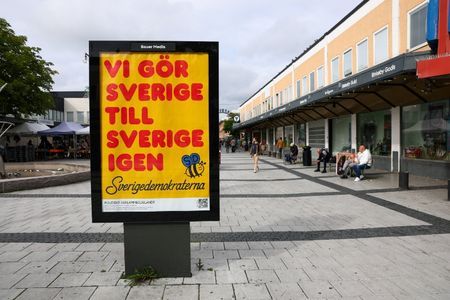
Voters across Sweden cast their ballots on Sunday, Sept. 13, in a national parliamentary election that presents a fundamental choice over the country's governance model, pitting traditional liberal and social democratic policies against an increasingly powerful right-wing bloc seeking executive influence.
Key facts
What happened
Polling locations across Sweden opened on Sunday morning as voters determined the composition of the 349-seat Riksdag, alongside county and municipal assemblies. As reported by Reuters journalists Simon Johnson and Niklas Pollard, the election stands as a pivotal moment for Sweden's political identity, dividing the nation's electoral choice between a right-wing bloc aiming to enter executive office and a center-left opposition seeking to reclaim governance.
The election utilizes Sweden's party-list proportional system, in which citizens select political party ballot papers within private voting booths before handing them to election judges. Turnout in Swedish general elections historically ranks among the highest in Europe, routinely exceeding 80 percent of eligible registered voters. Election operations were managed across thousands of voting stations by local municipal committees under the oversight of the central Swedish Election Authority, Valmyndigheten.
Preliminary counting begins at local precinct locations immediately after polling stations close on Sunday night. Local election staff hand-count the physical paper ballots to establish an initial public count. The preliminary tally is transmitted directly to central electoral servers to provide real-time updates throughout the evening, while final verification and official seat distribution take place over subsequent days as overseas and late mail-in ballots are integrated into the national count.
Why it matters
The outcome of the election carries structural implications for Sweden's domestic policy, its role in European Union legislative bodies, and the broader political stability of Western Europe. Long known for its extensive social welfare architecture, public spending, and commitment to international humanitarian initiatives, Sweden has seen its traditional political consensus gradually reshape over the last decade. An election outcome that integrates far-right political parties into executive cabinet posts would mark a significant departure from the post-war political model that defined Nordic social democracy.
On the domestic front, the parliamentary majority formed after the vote will dictate national legislation regarding public security, energy infrastructure, taxation, and immigration enforcement. Sweden has experienced severe policy debate in recent years regarding gang-related violence, criminal justice reform, and social integration challenges. A government heavily influenced by right-wing populist parties typically advocates for reduced immigration allowances, stricter law enforcement measures, lowered foreign aid budgets, and reduced green regulation on industrial development.
Conversely, a shift back toward center-left governance would prioritize public investments in healthcare, education, social security safety nets, and accelerated climate transition initiatives aimed at meeting European Union carbon reduction goals. Internationally, while Sweden's commitment to NATO membership—formally completed in March 2024—enjoys broad bipartisan agreement, domestic political stability dictates how effectively the country can project diplomatic strategy within the European Union and coordinate defense commitments with neighboring Nordic countries. European political analysts view the election results as an important indicator of whether populist right-wing movements can achieve and maintain executive governance within traditionally social-democratic European states.
The background
To contextualize the Sept. 13 election, it is necessary to examine the political history that brought Sweden to this point. For much of the 20th century, the Swedish Social Democratic Party dominated the political landscape, establishing the modern Swedish welfare state, known locally as the *Folkhemmet* or "People's Home." This governance framework combined universal social security, strong trade union representation, high progressive taxation, and a non-aligned foreign policy.
The long-standing political structure shifted significantly with the rise of the Sweden Democrats (*Sverigedemokraterna*). Established in 1988 from nationalist political roots, the party crossed the 4 percent national threshold to enter the Riksdag for the first time in the 2010 general election, winning 5.7 percent of the vote. For over ten years, Sweden's mainstream center-right and center-left parties maintained an informal political agreement, known as a *cordon sanitaire*, refusing to negotiate or form coalitions with the party due to its radical origin and restrictive anti-immigration platform.
This exclusion broke down following the general elections of 2018 and 2022. In the September 2022 election, the Sweden Democrats achieved a major milestone by becoming the second-largest party in the Riksdag, earning 20.5 percent of the national vote and outpacing the traditional center-right Moderate Party. While the Sweden Democrats did not secure official cabinet seats in the government formed by Moderate Party leader Ulf Kristersson, they established the Tidö Agreement (*Tidöavtalet*). Under this formal arrangement, the Sweden Democrats agreed to provide confidence and supply to a minority coalition composed of the Moderates, Christian Democrats, and Liberals in exchange for substantial policy commitments regarding immigration restriction, law enforcement powers, and criminal sentencing reforms.
The 2026 general election represents the next formal test of this political arrangement. The vote forces Swedish electors to choose between formally consolidating the right-wing bloc into cabinet governance or restoring a center-left coalition capable of establishing a parliamentary majority.
Reaction
Political leaders across Sweden's major political parties conducted extensive campaign operations in the lead-up to the vote, focusing primary arguments on domestic economic management, public safety, and state welfare programs.
Opposition leaders from the center-left bloc, led by the Social Democratic Party alongside the Left Party, Green Party, and Center Party, centered their campaign messaging on protecting democratic norms, public service funding, and environmental protection. Center-left spokespeople argued that formalizing far-right executive power could undermine social cohesion, roll back climate initiatives, and damage Sweden's international standing.
Conversely, figures within the governing right-wing bloc and the Sweden Democrats emphasized national security, strict immigration enforcement, and economic competitiveness. Campaign statements from right-wing representatives emphasized that tighter borders, increased judicial penalties for violent crime, and controlled government spending are essential to maintaining public order and preserving state institutions.
International political observers and diplomatic personnel from European Union member states are tracking the election closely. European policy institutions note that Sweden's political evolution mirrors trends across the continent, where traditional parties in nations such as Italy, the Netherlands, and Finland have increasingly partnered with populist right-wing parties to form stable legislative majorities.
What we don't know yet
Several important factors remain uncertain as the vote count proceeds:
What to watch
Key developments will unfold over the coming days as official election procedures move forward:
This article relies on original reporting conducted by Reuters correspondents Simon Johnson and Niklas Pollard in Stockholm.
How this story was produced
This report was written by The Global Wire newsroom from reporting first published by Simon Johnson; Niklas Pollard. We verify the core facts against the original report, write our own account, and add the background and consequences a short wire item leaves out. Drafting is AI-assisted inside an editor-supervised pipeline, and every story is checked for accuracy of attribution, structure and duplication before it appears — full detail in our AI and funding disclosure.
Spotted an error? Tell us at corrections@horizonglobalnews.com and read our corrections policy or editorial standards.





Reader comments
Loading comments…