

Senate Judiciary Hearing Sparks Clash Over Autopen Use and Biden Executive Authority
Republican lawmakers clashed with Democrats during a Senate Judiciary Committee hearing examining presidential decision-making and autopen usage during former President Joe Biden's term.
By The Global Wire Newsroom · Reported from ET Online
Link preview · horizonglobalnews.com
Senate Judiciary Hearing Sparks Clash Over Autopen Use and Biden Executive Authority
Republican lawmakers clashed with Democrats during a Senate Judiciary Committee hearing examining presidential decision-making and autopen usage during former President Joe Biden's term.
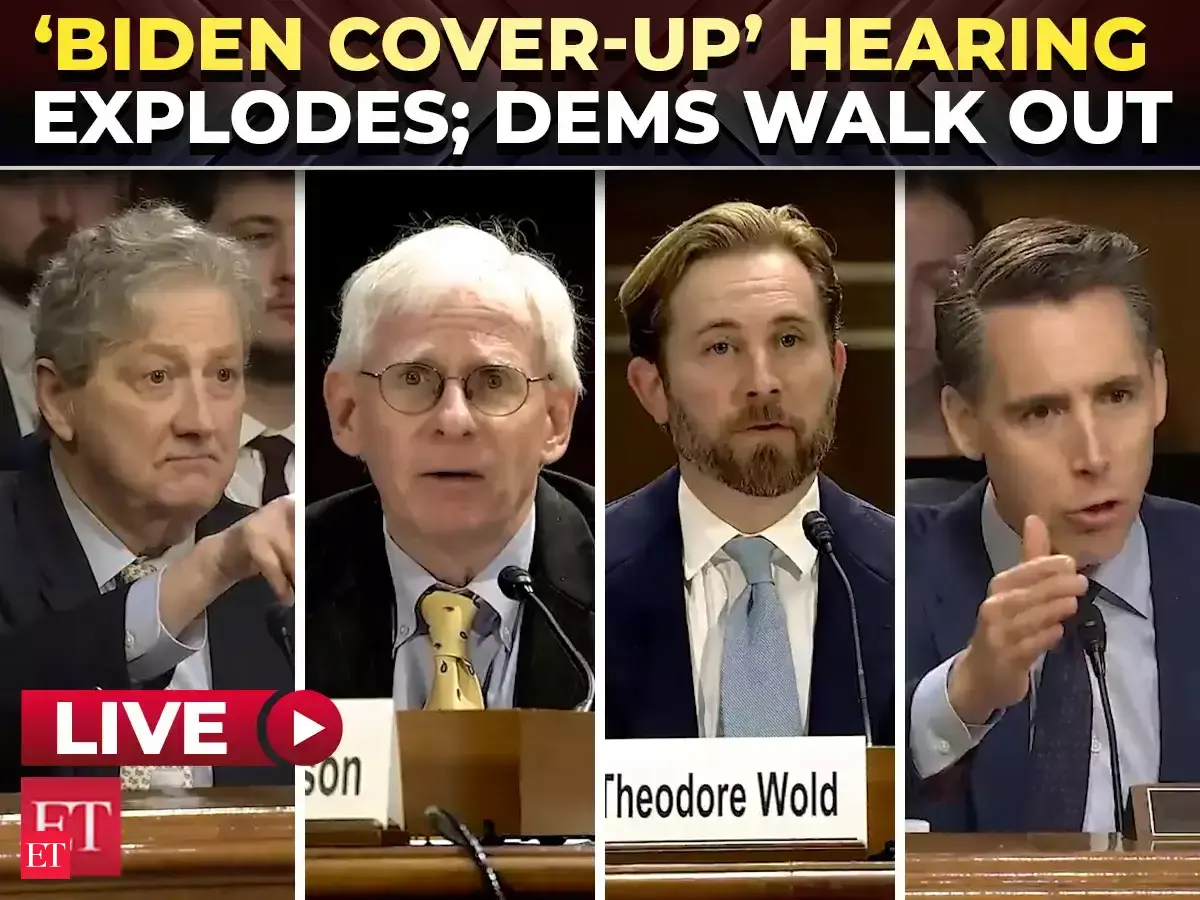
WASHINGTON — Tensions escalated inside the Senate Judiciary Committee as Republican lawmakers confronted Democratic peers and witnesses over executive branch operations during the presidency of Joe Biden. The hearing focused on the former administration's reliance on automated signature devices, known as autopens, and raised sharp questions regarding the delegation of presidential authority during Biden's term in office. Senator Josh Hawley, Republican of Missouri, led a fiery line of questioning accusing administration officials and congressional Democrats of concealing details surrounding the former president's cognitive health and seeking clarification on who exercised ultimate decision-making power when official documents were signed via mechanical means.
Key facts
What happened
The Senate Judiciary Committee hearing was marked by heated verbal exchanges between Republican and Democratic members as lawmakers examined the governance protocols of the Biden White House. The focal point of the proceedings centered on how official executive orders, statutory bills, and administrative memoranda were authorized and signed during former President Joe Biden's tenure.
Republican senators asserted that the frequent employment of autopens raised fundamental questions about who was directing executive operations in Washington. Senator Hawley delivered a series of sharp inquiries, demanding to know the specific individuals responsible for approving signatures on key presidential directives. Hawley argued that the American public deserved full transparency regarding whether Biden was directly reviewing and approving every document bearing his signature or whether senior White House aides were exercising unvetted executive authority.
Throughout the session, GOP lawmakers pointed to the former president's public appearances and subsequent decision to step aside from the 2024 presidential race as justification for investigating White House administrative workflows. They claimed that concerns regarding Biden's cognitive capacity were systematically downplayed by administration staff and congressional allies, leading to an over-reliance on automated signature mechanisms for high-level state business.
Democratic members of the panel strongly pushed back against the Republican line of inquiry. Committee Democrats characterized the hearing as an orchestrated political distraction aimed at undermining the former administration's legislative record. They maintained that the use of autopens is a standard, legally recognized administrative practice routinely employed by both Republican and Democratic chief executives to manage the massive volume of executive paperwork.
Why it matters
The debate over autopen usage strikes at core constitutional principles regarding executive power under Article II of the United States Constitution. Article II explicitly vests executive authority in a single individual: the President. While administrative functions are routinely delegated across executive departments, the power to sign federal legislation into law, grant presidential pardons, or issue executive orders demands clear, verifiable presidential intent.
If official executive acts are executed via autopen without explicit, contemporaneous instruction from the sitting president, those legal instruments could face novel constitutional challenges in federal courts. Opponents of administrative policies enacted during the Biden presidency could attempt to cite procedural defects in document execution to overturn federal regulations, executive orders, or statutory implementations.
Beyond potential legal vulnerabilities, the controversy touches on presidential accountability and government transparency. The executive branch relies heavily on public trust; uncertainty over whether a president personally authorized major policy directives threatens the stability of federal decision-making.
Furthermore, the hearing highlights the ongoing congressional debate regarding presidential health disclosures and the constitutional frameworks governing executive authority. The proceedings serve as a potential catalyst for statutory reform regarding how White House counsel offices log executive approvals, authenticate automated signatures, and manage administrative continuity during times of health concerns or travel.
The background
The use of mechanical signing devices by American chief executives has a long history, evolving alongside technology and expanding administrative burdens. President Thomas Jefferson utilized a polygraph pantograph machine in the early 19th century to produce identical physical copies of his official correspondence. By the mid-20th century, modern electromechanical autopen machines were widely adopted during the administrations of Harry S. Truman and Dwight D. Eisenhower to process constituent mail, routine executive proclamations, and ceremonial certificates.
For decades, White House legal counsel advised presidents against using autopens for constitutional actions, such as signing bills passed by Congress or issuing formal executive orders. That legal standard shifted significantly in 2005 during the presidency of George W. Bush. The Department of Justice's Office of Legal Counsel (OLC) issued a landmark 29-page legal opinion written by Assistant Attorney General Howard C. Nielson Jr. The opinion concluded that the President is not constitutionally required to physically hold a pen to sign legislation and may direct a subordinate to affix the presidential signature using an autopen, provided the president personally authorized the specific action.
Following that OLC guidance, President Barack Obama became the first sitting president to sign federal legislation into law using an autopen. In May 2011, while attending a Group of Eight (G8) summit in Deauville, France, Obama authorized White House staff in Washington to affix his signature to an extension of several provisions of the Patriot Act shortly before the statutory deadline expired. Obama later used the autopen to sign federal spending bills under similar emergency circumstances while traveling away from the capital.
The controversy surrounding Joe Biden's autopen usage intensified following his debate performance in June 2024 and his subsequent decision in July 2024 to step aside from the presidential race. Following his departure from office, Republican oversight committees initiated multiple inquiries into White House operations, focusing on the role played by senior advisors and staff in managing presidential duties.
Reaction
The hearing generated sharp reactions across Capitol Hill, reflecting deep partisan divisions over presidential oversight and executive transparency. Senator Josh Hawley's aggressive questioning drew strong praise from conservative commentators and oversight advocates who argue that White House decision-making procedures require stringent parliamentary scrutiny. Hawley insisted that executive accountability cannot exist without absolute clarity on who authorizes presidential actions.
Conversely, Democratic members of the committee expressed frustration with the direction of the hearing, arguing that the proceedings detracted from pressing judicial appointments and legislative matters. Democratic lawmakers emphasized that autopen usage is well-established in executive branch jurisprudence and accused Republicans of engaging in political theater targeting a retired president.
Legal scholars and constitutional experts have offered mixed reactions regarding the broader implications of the hearing. While many constitutional specialists note that the 2005 Department of Justice OLC opinion firmly established the legality of autopen signatures, others emphasize that the validity of an autopen signature hinges entirely on clear proof of contemporaneous presidential authorization.
What we don't know yet
Despite the intense focus during the committee hearing, several critical factual details remain unverified:
What to watch
In the coming months, several concrete indicators will determine the trajectory of this controversy:
Reporting on this Senate Judiciary Committee hearing and the debate over executive autopen usage was originally provided by ET Online.
How this story was produced
This report was written by The Global Wire newsroom from reporting first published by ET Online. We verify the core facts against the original report, write our own account, and add the background and consequences a short wire item leaves out. Drafting is AI-assisted inside an editor-supervised pipeline, and every story is checked for accuracy of attribution, structure and duplication before it appears — full detail in our AI and funding disclosure.
Spotted an error? Tell us at corrections@horizonglobalnews.com and read our corrections policy or editorial standards.






Reader comments
Loading comments…