

Researchers Repurpose Water-Treatment Waste into High-Efficiency Microplastic Filters
A new study demonstrates that recycled drinking water sludge can filter out up to 97.1 percent of microplastic contaminants in real-world water samples.
By The Global Wire Newsroom · Reported from TOI Science Desk
Link preview · horizonglobalnews.com
Researchers Repurpose Water-Treatment Waste into High-Efficiency Microplastic Filters
A new study demonstrates that recycled drinking water sludge can filter out up to 97.1 percent of microplastic contaminants in real-world water samples.
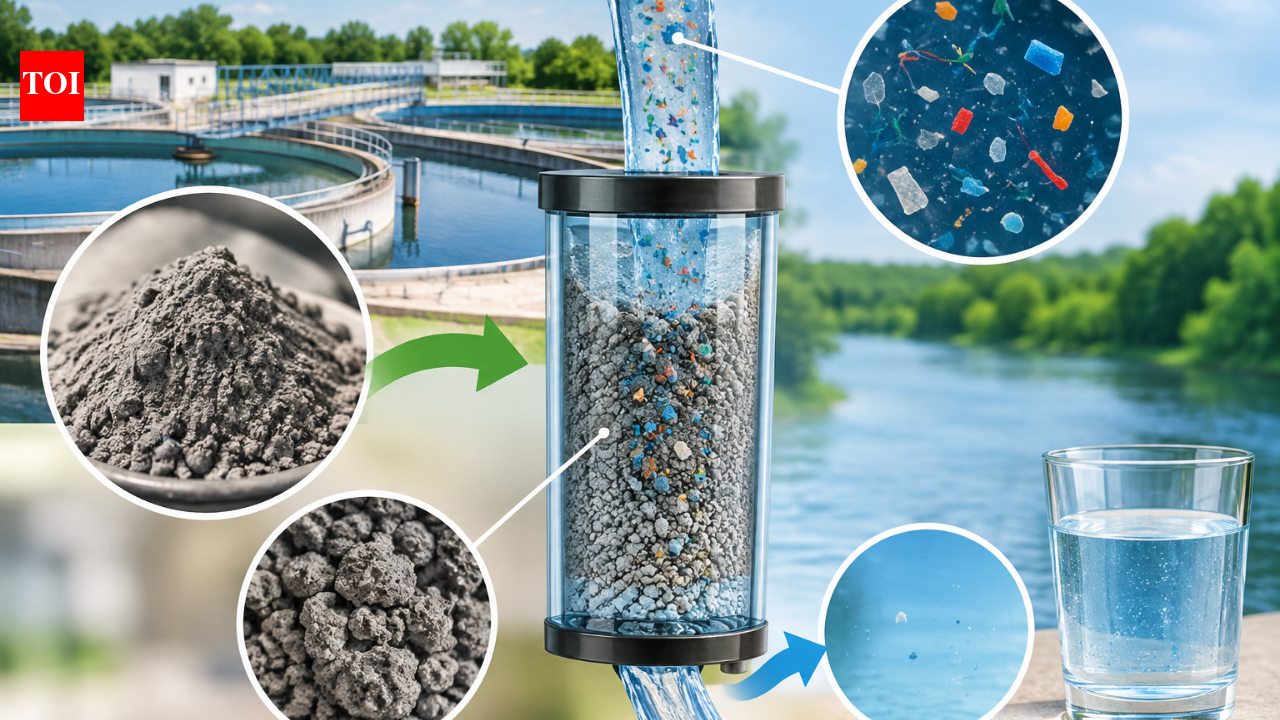
Researchers have successfully repurposed waste byproducts from municipal water treatment into functional filtration media capable of extracting between 86.9 percent and 97.1 percent of microplastic contaminants from real-world water samples, according to reporting published by TOI Science Desk in September 2026. The technical breakthrough offers a potential dual solution to two distinct environmental challenges: the widespread contamination of aquatic ecosystems by microscopic synthetic polymers and the accumulation of solid waste generated during drinking water purification. By converting residual sludge—typically discarded in landfills or incinerated—into porous adsorbent materials, scientists demonstrated that water utilities could potentially lower operational waste while simultaneously enhancing their capacity to capture tiny plastic particles that escape conventional filtration systems.
Key facts
What happened
According to reporting by TOI Science Desk, researchers developed a process that transforms standard water-treatment residuals—often referred to as drinking water sludge—into an engineered filter material specifically targeted at microplastics. In municipal facilities, raw water is routinely treated with coagulants such as aluminum or iron salts to aggregate suspended solids. The resulting precipitate settles out as a dense sludge that contains mineral complexes, metal hydroxides, and organic debris. Historically, this material has been treated as a low-value waste stream requiring costly dewatering, transport, and landfill tipping fees.
In the 2026 investigation reported by TOI Science Desk, scientists harvested these waste residuals and subjected them to specialized thermal or chemical modification processes to create a highly porous material with enhanced surface area and specific chemical affinities. When deployed in filtration columns, the modified sludge material interacts with microplastics through electrostatic forces, physical trapping, and hydrophobic interactions.
To evaluate the material under operational conditions, the research team conducted trials using real-world water samples rather than purely distilled laboratory solutions. Microplastic contaminants in natural and wastewater environments vary widely in shape, size, chemical composition, and surface charge—ranging from synthetic fibers shed by clothing to fragmented polyethylene and polypropylene beads. In these real-water evaluations, the sludge-derived filter achieved retention rates between 86.9 percent and 97.1 percent, capturing a substantial majority of suspended microplastic particles. The findings indicate that the material maintains its performance despite the presence of dissolved organic matter, mineral salts, and other competing substances typically found in environmental water sources.
Why it matters
The study highlights a practical application of circular economy principles within urban infrastructure systems. As global plastic production continues to grow—reaching over 400 million metric tons annually worldwide—microplastics have spread across every major aquatic system, including lakes, rivers, estuaries, and deep-sea trenches. These particles pose ecotoxicological risks by physically blocking the digestive tracts of aquatic organisms and acting as vectors for toxic hydrophobic chemicals, heavy metals, and persistent organic pollutants.
Concurrently, municipal water treatment facilities face mounting costs associated with solid waste disposal. Drinking water plants around the world generate millions of tons of sludge annually. In North America and Europe alone, managing municipal sludge consumes substantial municipal operating budgets, with tipping fees and transport costs rising steadily under stricter environmental regulations.
If scaled successfully, turning sludge into microplastic adsorbents changes the economics of both waste management and water purification. Rather than spending capital to transport sludge to landfills or incinerators—actions that can release greenhouse gases or leachate—water utilities could process their own waste into a functional chemical product. Furthermore, because conventional sand filtration and secondary wastewater treatment processes often struggle to capture fine microplastics smaller than 100 micrometers without expensive tertiary membrane filtration like reverse osmosis or ultrafiltration, this recycled material provides a lower-cost option for upgrading existing facilities.
The background
Microplastics were first broadly recognized as a major marine pollutant in the early 2000s, but recent analytical advances have documented their presence across the entire water cycle, including human drinking water sources. Primary microplastics are manufactured at small scales, such as industrial abrasive powders or cosmetic microbeads, while secondary microplastics result from the mechanical weathering, photo-oxidation, and chemical breakdown of larger consumer items like plastic bottles, packaging, synthetic textiles, and automotive tires.
Standard municipal drinking water treatment relies on a multi-stage process designed primarily to remove biological pathogens, turbidity, and natural organic matter. This process generally involves coagulation, flocculation, sedimentation, sand filtration, and chemical disinfection using chlorine or ultraviolet light. While coagulation and sand filtration can capture larger plastic particles, smaller microplastics—particularly fine synthetic fibers and nanoplastics—frequently pass through sand beds due to their smooth surfaces, low density, and neutral charges.
Advanced tertiary filtration technologies, such as microfiltration membranes, nanofiltration, and activated carbon beds, can achieve high capture rates for tiny particles. However, these systems carry substantial energy costs, require frequent backwashing, and suffer from membrane fouling, which increases operational downtime and capital expenses. At the same time, drinking water treatment residuals (DWTRs) have long presented a management headache for water authorities. DWTRs consist predominantly of metal hydroxides (such as aluminum hydroxide or ferric hydroxide) combined with trapped silt and clay. While researchers have previously explored using DWTRs to absorb phosphorus or heavy metals from agricultural runoff, adapting these residuals into engineered microplastic filters represents a novel expansion of waste recovery in environmental engineering.
Reaction
The scientific and municipal engineering communities are closely reviewing the results to assess the feasibility of industrial scaling. Water resource engineers emphasize that while high extraction rates in real-water tests are promising, real-world deployment requires demonstrating consistent hydraulic flow rates, long-term filter durability, and resistance to clogging over months of continuous operation.
Environmental health policy advocates noted that material recycling innovations must be accompanied by comprehensive testing to ensure that the sludge-based filters do not leach heavy metals, residual aluminum, or bound chemical contaminants back into the treated effluent. Regulatory agencies, such as the U.S. Environmental Protection Agency (EPA) and the European Environment Agency (EEA), have increasingly prioritized microplastic monitoring and solid waste minimization. Industry observers expect municipal water utilities and environmental equipment manufacturers to request larger pilot-scale demonstrations before considering integration into existing municipal facilities.
What we don't know yet
Despite the promising performance reported by TOI Science Desk, several key technical and economic parameters remain unverified in the public literature. First, the exact chemical and thermal conditioning methods used to convert the sludge into an effective filter medium—and the energy inputs required for that conversion—have a direct impact on whether the process is net carbon-negative or cost-effective at commercial scale.
Second, the long-term lifecycle of the filter material remains an open question. It is unclear how many filtration cycles the sludge-derived material can withstand before becoming saturated with microplastics or degraded by biofouling. Additionally, the study summary does not detail the final disposal or regeneration path for the filter once it reaches the end of its operational life. If saturated filters must ultimately be landfilled or incinerated, the microplastics captured during treatment could still pose disposal challenges, highlighting the need for complete lifecycle assessments.
What to watch
In the coming months, researchers and industry partners will likely focus on transitioning from batch laboratory tests to continuous-flow pilot plants. Key milestones to watch include published peer-reviewed data on the filter's hydraulic conductivity, pressure drop characteristics, and performance across varying water pH levels and temperatures.
Monitoring future regulatory developments regarding microplastics in drinking water will also be critical. As jurisdictions in Europe and California implement mandatory monitoring frameworks for microplastics in public water supplies, utility demand for retrofitted filtration solutions is expected to grow. Observers should watch for follow-up studies evaluating the economic feasibility of building localized sludge-processing units directly within municipal wastewater and drinking water treatment facilities, as well as toxicological leaching assays to confirm product safety.
This report is based on original reporting published by TOI Science Desk on September 9, 2026.
How this story was produced
This report was written by The Global Wire newsroom from reporting first published by TOI Science Desk. We verify the core facts against the original report, write our own account, and add the background and consequences a short wire item leaves out. Drafting is AI-assisted inside an editor-supervised pipeline, and every story is checked for accuracy of attribution, structure and duplication before it appears — full detail in our AI and funding disclosure.
Spotted an error? Tell us at corrections@horizonglobalnews.com and read our corrections policy or editorial standards.

Reader comments
Loading comments…