

Record-Breaking 365-Meter Wind Turbine Constructed in Eastern Germany
Engineers in eastern Germany have built a 365-meter wind turbine that surpasses the Eiffel Tower in height, aiming to harvest stronger high-altitude atmospheric winds.
By The Global Wire Newsroom · Reported from ABC News
Link preview · horizonglobalnews.com
Record-Breaking 365-Meter Wind Turbine Constructed in Eastern Germany
Engineers in eastern Germany have built a 365-meter wind turbine that surpasses the Eiffel Tower in height, aiming to harvest stronger high-altitude atmospheric winds.
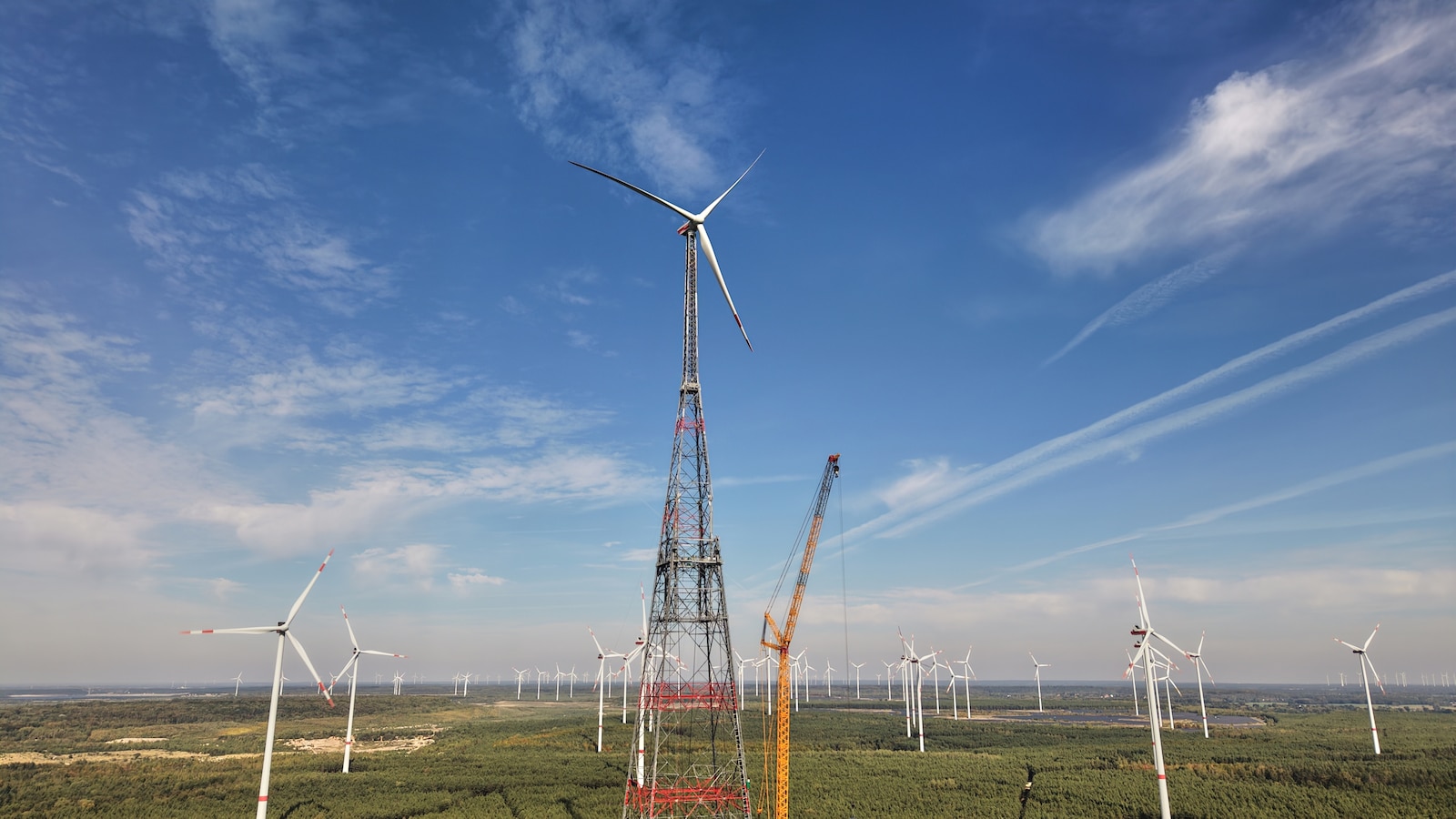
Developers in eastern Germany have completed construction on what is currently reported as the world's tallest wind turbine, an industrial installation reaching a peak tip height of 365 meters (1,197 feet). Built in a sparsely populated rural district of eastern Germany, the colossal structure exceeds the height of the Eiffel Tower in Paris, which stands at 330 meters including its tip antenna. The mega-turbine represents a major engineering milestone for high-altitude onshore wind harvesting, designed specifically to reach upper atmospheric wind currents that deliver stronger, more consistent energy yields than surface-level airflows.
Key facts
What happened
Engineers in eastern Germany have assembled an onshore wind turbine that reaches 365 meters (1,197 feet) into the sky at its highest blade point. According to reporting by ABC News, the developer of the project has identified the installation as the tallest operational wind turbine in the world.
The landmark structure stands taller than the Eiffel Tower, the 330-meter national landmark in France. Sited in the flat terrain of eastern Germany, the project was strategically built in a sparsely populated area where land availability and municipal zoning permitted ultra-tall structural construction.
Erecting a wind turbine to 365 meters presents complex mechanical and civil engineering challenges. Standard commercial onshore turbines typically feature hub heights between 100 and 160 meters, reaching maximum tip heights of roughly 200 meters. Constructing a 365-meter turbine requires specialized heavy-lift crane configurations and modular tower design—often combining reinforced concrete foundations with elevated steel lattice or tubular sections—to sustain structural integrity against high-altitude wind shear and heavy operational loads.
The primary objective of high-altitude wind design is to position the turbine's rotor blades above ground-level atmospheric interference. Near the surface, buildings, forests, and terrain variations create friction that slows wind velocity and induces turbulence. At altitudes approaching 400 meters, wind currents flow faster and with greater uniformity, allowing the turbine generator to produce electricity at a higher operational capacity throughout the year.
Why it matters
The operational deployment of a 365-meter wind turbine marks a significant advancement for onshore wind power, particularly in inland regions far from maritime wind resources. Near the ground, surface turbulence and low wind speeds frequently limit turbine efficiency, producing fluctuating energy outputs that complicate electrical grid management. By reaching upper atmospheric winds, ultra-tall installations can capture stronger airflows, yielding higher capacity factors without requiring costly marine offshore infrastructure.
This technological milestone directly aligns with Germany’s national energy strategy. Under the Energiewende (energy transition) policy framework, Germany has enacted legally binding targets requiring 80 percent of its gross electricity consumption to originate from renewable sources by 2030. Reaching this target requires expanding onshore wind capacity within a geographically constrained country. Because prime coastal locations in northern Germany are already heavily built out, expanding into interior and eastern regions is essential.
Inland areas often experience lower surface wind speeds, making standard 150-meter or 200-meter turbines less economically viable. High-altitude turbines overcome this limitation, enabling efficient power generation across interior regions. Furthermore, because taller turbines harvest substantially more energy per unit, fewer overall structures are required to meet regional megawatt targets, optimizing land use in rural areas where spatial planning regulations strictly govern industrial infrastructure.
The background
The realization of high-altitude wind generation in eastern Germany stems from decades of technological growth and policy evolution in European renewable energy. Following the passage of Germany's Renewable Energy Sources Act (Erneuerbare-Energien-Gesetz or EEG) in 2000, early feed-in tariffs catalyzed rapid nationwide adoption of onshore wind energy. Early commercial units built in the early 2000s were modest, typically reaching hub heights under 80 meters with power capacities below 2 megawatts.
Over the past two decades, wind turbine manufacturers systematically enlarged rotor diameters and tower heights to reduce the levelized cost of energy. In aerodynamic physics, the kinetic energy captured by a wind rotor increases quadratically with blade sweep area and cubically with wind velocity. Doubling the swept area quadruples potential energy capture, while elevating the hub into higher atmospheric layers provides access to faster mean wind speeds.
While offshore wind farms rapidly expanded into deep waters with mega-turbines, onshore developments faced severe transport and construction constraints. Navigating multi-ton generator nacelles and turbine blades exceeding 80 meters in length across narrow European roadways required specialized logistics and extensive municipal permitting. Additionally, assembling super-tall towers required heavy-lift cranes capable of operating safely at extreme heights.
To bypass surface wind limitations in interior regions, German research institutions and engineering firms began developing super-tall turbine concepts in the 2020s. Eastern German states, including Brandenburg and Saxony, proved ideal for these projects due to available rural land, flat topography, and former open-cast mining sites suitable for industrial repurposing. The completion of the 365-meter installation establishes a new benchmark for terrestrial wind energy engineering.
Reaction
The completion of the 365-meter turbine has drawn close attention from energy analysts, aviation authorities, and local community representatives across Germany.
Industry experts view the high-altitude installation as a key test case for expanding onshore wind production into low-wind geographic zones. Renewable energy advocates have welcomed the project, emphasizing that high-altitude harvesting enables interior regions to generate high-density clean energy previously achievable only through marine offshore projects.
Concurrently, super-tall installations raise distinct regulatory considerations. Civil aviation safety authorities, including Germany's Federal Ministry of Digital and Transport and regional air traffic controllers, require strict hazard markings for high-altitude structures. Turbines reaching nearly 400 meters must be equipped with high-intensity obstruction lights and radar-integrated warning systems to avoid interfering with low-altitude aviation and military flight paths.
Community responses in eastern Germany remain mixed. While local municipal leaders generally welcome renewable energy projects for the municipal tax revenue and economic investment they bring, resident groups frequently express concerns regarding visual landscape changes, shadow flicker, and local noise impact. The broader adoption of ultra-tall turbines will depend on how effectively developers address these community concerns while proving the technology's operational reliability.
What we don't know yet
Despite the announcement of the 365-meter turbine, several important technical and financial details remain unconfirmed. According to reporting by ABC News, the specific rated megawatt capacity of the turbine's generator, the exact rotor sweep diameter, and the official name of the turbine manufacturer have not been disclosed.
Furthermore, total construction and engineering costs associated with erecting a single 365-meter tower—including specialized crane mobilization and high-altitude foundation engineering—have not been released. Financial transparency regarding capital expenditure is essential for evaluating whether the extra energy yielded at high altitudes offsets the elevated upfront installation costs.
Crucially, long-term empirical operational data remains unavailable. The performance of the turbine during high-altitude wind shear storms, extreme weather, and continuous long-term operations will only become clear after extended grid-connected testing.
What to watch
In the coming months, several key developments will indicate whether super-tall wind turbines will become standard across the European energy landscape. The immediate focus will be on the turbine's operational commissioning phase, including grid connection testing conducted by transmission system operators to confirm power quality, voltage stability, and grid compliance.
Over the next 12 to 24 months, published performance data will reveal whether high-altitude harvesting delivers the expected capacity factor improvements over conventional 200-meter turbines in similar inland locations. Industry observers will also monitor future onshore wind auctions administered by Germany's Federal Network Agency (Bundesnetzagentur) to see if utility developers begin bidding projects utilizing 300-plus-meter designs.
Additionally, spatial planning agencies and aviation authorities across Germany are expected to evaluate updated safety guidelines and zoning standards for ultra-tall industrial structures as high-altitude wind technology matures.
Reporting in this article is based on news published by ABC News on October 1, 2026.
How this story was produced
This report was written by The Global Wire newsroom from reporting first published by ABC News. We verify the core facts against the original report, write our own account, and add the background and consequences a short wire item leaves out. Drafting is AI-assisted inside an editor-supervised pipeline, and every story is checked for accuracy of attribution, structure and duplication before it appears — full detail in our AI and funding disclosure.
Spotted an error? Tell us at corrections@horizonglobalnews.com and read our corrections policy or editorial standards.



Reader comments
Loading comments…