

Netflix Unveils AI-Driven Telemetry Knowledge Graph to Manage 38 Million Events per Second
Engineers Prasanna Vijayanathan and Renzo Sanchez-Silva detail a shift from reactive monitoring to Claude-powered agentic workflows across unified MELT data.
By The Global Wire Newsroom · Reported from Prasanna Vijayanathan; Renzo Sanchez-Silva
Link preview · horizonglobalnews.com
Netflix Unveils AI-Driven Telemetry Knowledge Graph to Manage 38 Million Events per Second
Engineers Prasanna Vijayanathan and Renzo Sanchez-Silva detail a shift from reactive monitoring to Claude-powered agentic workflows across unified MELT data.
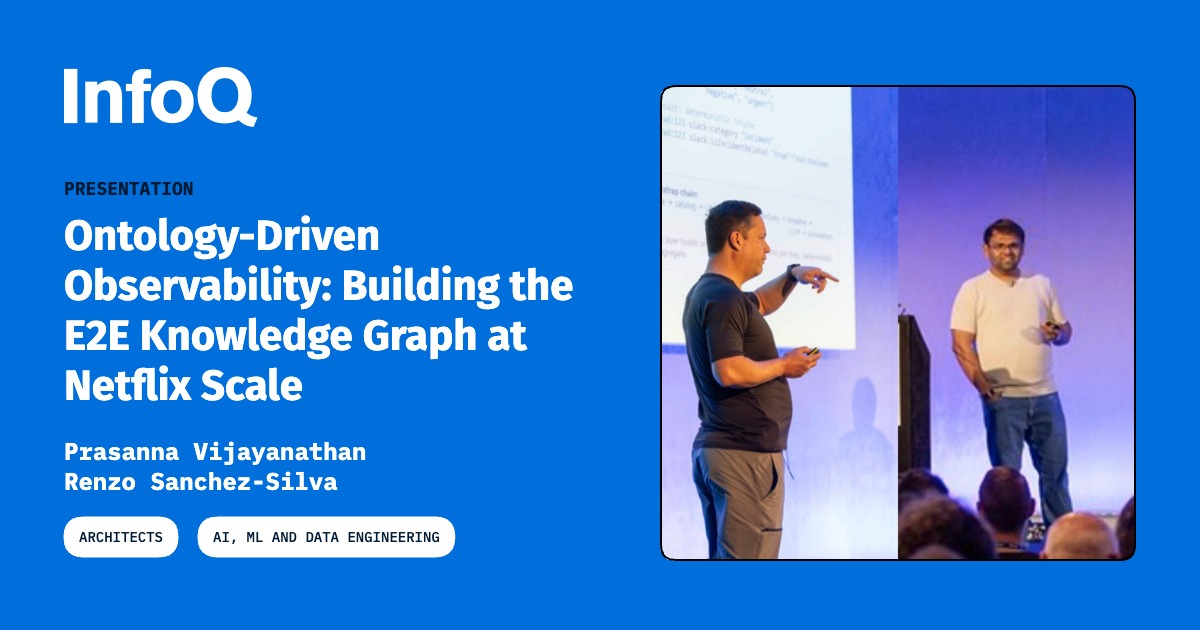
On October 9, 2026, Netflix engineers Prasanna Vijayanathan and Renzo Sanchez-Silva published details of a major architectural evolution in the streaming giant's telemetry infrastructure, revealing how the platform manages real-time monitoring across 38 million events per second. The technical release outlined a transition away from traditional reactive monitoring frameworks toward an AI-driven operational ontology. By unifying metrics, events, logs, and traces—collectively known as MELT telemetry—into a queryable end-to-end knowledge graph, Netflix has integrated agentic artificial intelligence workflows utilizing Anthropic’s Claude model alongside graph database architectures. The deployment aims to transform how one of the world's largest cloud-native operations identifies system dependencies, diagnoses root causes, and manages complex failure modes across thousands of microservices.
Key facts
What happened
According to details released by engineers Prasanna Vijayanathan and Renzo Sanchez-Silva, Netflix has completed a fundamental redesign of its enterprise observability architecture, addressing the operational complexity of handling 38 million telemetry events per second. Historically, massive cloud platforms relied on fragmented monitoring stacks where metrics, log records, application traces, and discrete system events were stored in separate data silos, requiring human operators to manually cross-reference dashboards during operational outages.
Under the new paradigm detailed by Vijayanathan and Sanchez-Silva, Netflix consolidated these disparate telemetry streams—Metrics, Events, Logs, and Traces (MELT)—into a centralized operational ontology. This ontology models the relationships, dependencies, and flow of data across the platform's entire microservices ecosystem. By representing infrastructure components, software applications, and network flows as nodes and edges within a specialized graph database, the framework creates a living end-to-end knowledge graph of the platform's runtime environment.
To operationalize this graph at scale, Netflix integrated agentic artificial intelligence workflows using Anthropic's Claude language model. Rather than relying solely on static threshold alerts or human-triggered queries, the system deploys AI agents that autonomously query the knowledge graph when anomalies occur. These agents traverse network pathways, correlate trace IDs with log spikes and metric deviations, and construct contextual explanations of system failures. According to the technical release, this agentic approach enables automated root-cause analysis by allowing AI systems to reason directly over the continuous structural topology of Netflix's global service footprint.
Why it matters
The transition to an ontology-driven observability graph represents a structural shift in how large-scale enterprise software systems are maintained, with direct implications for cloud engineering standards, site reliability engineering (SRE) practices, and corporate AI deployment strategies.
At a processing scale of 38 million events per second, traditional human-in-the-loop incident response encounters severe physical limitations. In modern cloud architecture, a single user request can trigger hundreds of downstream calls across microservices responsible for user authentication, recommendation algorithms, video encoding, catalog metadata, and content delivery networks. When a failure occurs, alert storms often flood operations centers with thousands of concurrent warnings, creating a signal-to-noise problem that delays mean time to resolution (MTTR).
By replacing static rule sets with a unified MELT knowledge graph and agentic AI reasoning, Netflix addresses the inherent latency of human diagnosis. The ability of an AI agent, powered by models such as Claude, to programmatically query a live graph database means contextual root-cause mapping can occur in seconds rather than hours. For enterprise software organizations, this demonstrates a concrete production implementation of generative AI beyond chatbot interfaces, proving the utility of large language models as operational reasoning engines capable of navigating complex system topologies.
Furthermore, this deployment sets a benchmark for cloud infrastructure management. As enterprises across financial services, logistics, and telecommunications manage increasingly complex multi-cloud environments, the integration of unified telemetry ontologies with autonomous AI agents is likely to become standard architecture for high-availability systems.
The background
To understand the significance of Netflix's technical update, it is necessary to examine the evolution of cloud-native architecture over the past two decades. Netflix was an early pioneer in cloud migration, transitioning its entire streaming platform away from private data centers to Amazon Web Services (AWS) between 2008 and 2016. During this migration, Netflix popularized microservices architecture, breaking apart monolithic software into thousands of independent, specialized services communicating over network APIs.
While microservices provided unprecedented scalability and deployment velocity, they created unprecedented operational complexity. In a traditional monolithic application, debugging involves analyzing a single call stack and localized log file. In a microservice ecosystem, a transient latency spike in one database cluster can ripple across dozens of dependent services, causing cascading failures that are difficult to trace back to their origin.
To manage this complexity, the software industry developed the MELT telemetry framework:
Despite the adoption of MELT standards, most enterprise environments maintained these four data types in isolated databases—such as time-series stores for metrics, search indexes for logs, and graph stores for distributed tracing. Engineers investigating outages had to manually correlate timestamps across these distinct platforms.
In recent years, the concept of operational ontologies—formal representations of knowledge that define the entities and relationships within a system—gained traction as a solution to telemetry fragmentation. By mapping MELT data into a graph database structure, systems can maintain a real-time topology of how services, servers, databases, and network pipes interact. The emergence of reasoning-capable large language models, such as Anthropic's Claude, provided the missing operational component: autonomous agents capable of querying graph structures using natural language and structured domain logic, effectively bridging the gap between raw data collection and actionable insight.
Reaction
While public formal responses from external enterprise tech vendors and cloud providers remain pending following the initial publication, the software engineering community has closely followed Netflix's architectural announcements due to the company's historical role as an open-source innovator.
Industry experts and site reliability engineers are expected to evaluate the operational feasibility of replicating Netflix's knowledge graph architecture in less resource-intensive environments. A primary subject of discussion among systems architects is the computational overhead and financial cost associated with running continuous agentic workflows powered by commercial large language models alongside high-throughput graph databases at a volume of 38 million events per second.
Observability software vendors—including Datadog, Dynatrace, New Relic, and Grafana Labs—are anticipated to face market pressure to incorporate native graph-based ontologies and agentic AI incident analysis into their commercial software-as-a-service platforms. Industry analysts expect enterprise technology leaders to look for technical documentation regarding how Netflix manages graph schema evolution, token consumption costs, and latency constraints when integrating AI models like Claude directly into high-severity automated incident response loops.
What we don't know yet
Several critical technical details regarding Netflix's observability platform remain undisclosed in the initial disclosure by Vijayanathan and Sanchez-Silva:
Clarifying these open points will be essential for assessing whether this ontology-driven model can be cost-effectively adopted by standard enterprise engineering teams.
What to watch
In the coming months, technical monitoring, open-source disclosures, and industry conferences will reveal the broader operational impact of Netflix's architectural shift:
This report is based on technical reporting released by Netflix engineers Prasanna Vijayanathan and Renzo Sanchez-Silva.
How this story was produced
This report was written by The Global Wire newsroom from reporting first published by Prasanna Vijayanathan; Renzo Sanchez-Silva. We verify the core facts against the original report, write our own account, and add the background and consequences a short wire item leaves out. Drafting is AI-assisted inside an editor-supervised pipeline, and every story is checked for accuracy of attribution, structure and duplication before it appears — full detail in our AI and funding disclosure.
Spotted an error? Tell us at corrections@horizonglobalnews.com and read our corrections policy or editorial standards.


Reader comments
Loading comments…