

Myanmar’s Wai Khin Hnin Claims Inaugural Asian Games Women’s Teqball Gold
Wai Khin Hnin defeated Indonesia’s Sumaya 2-1 in the women’s singles final as teqball made its official debut at the Asian Games before high-profile spectators.
By The Global Wire Newsroom · Reported from The Straits Times
Link preview · horizonglobalnews.com
Myanmar’s Wai Khin Hnin Claims Inaugural Asian Games Women’s Teqball Gold
Wai Khin Hnin defeated Indonesia’s Sumaya 2-1 in the women’s singles final as teqball made its official debut at the Asian Games before high-profile spectators.
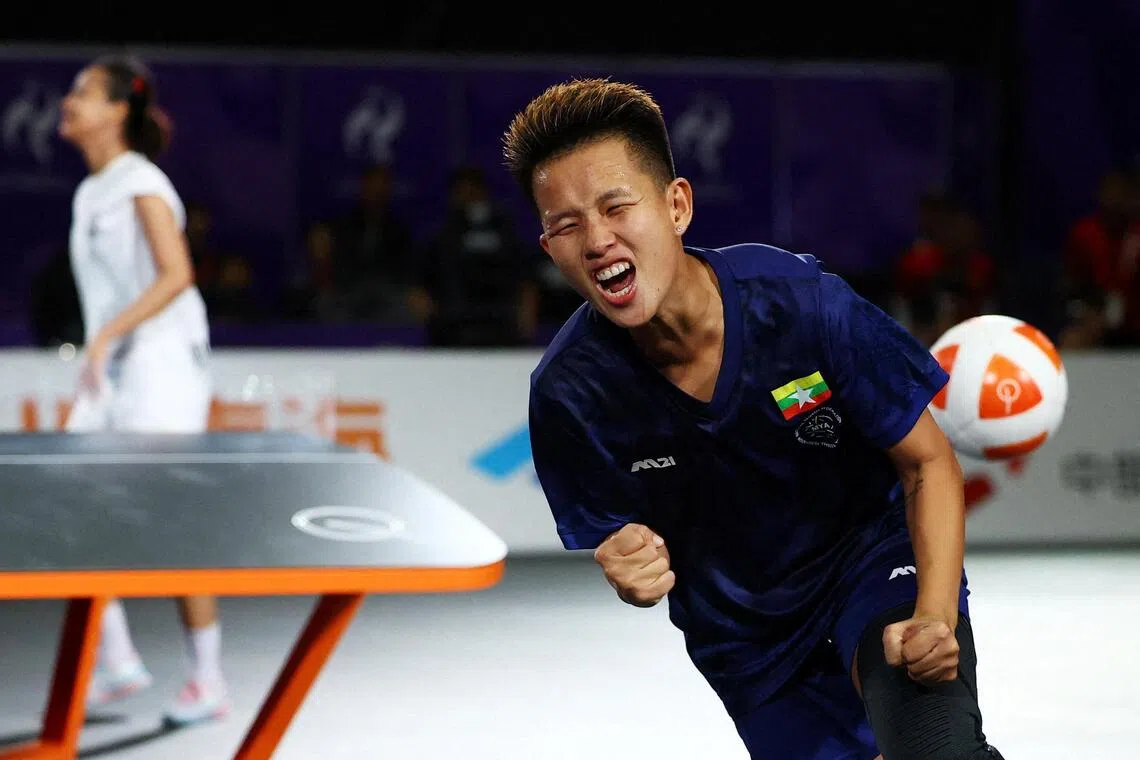
NAGOYA, Japan — Myanmar secured a historic sports milestone on Sept. 20, 2026, as Wai Khin Hnin captured the inaugural women's singles teqball gold medal at the Asian Games. Wai Khin Hnin defeated Indonesia’s Sumaya two sets to one in a competitive final, giving Myanmar its first gold medal in the sport at the continental games. The championship match attracted international attention, drawn in part by the presence of retired Spanish football icon Carles Puyol, who watched the final from the stands as part of his ongoing role in promoting the curved-table sport worldwide. The landmark fixture signaled the formal arrival of teqball on the elite Asian multi-sport stage following years of rapid growth across the region.
Key facts
What happened
The women’s singles competition concluded with a three-set championship duel between Wai Khin Hnin of Myanmar and Sumaya of Indonesia, according to reporting by The Straits Times. The match represented the culmination of the first official teqball tournament held under the auspices of the Asian Games, reflecting the sport’s inclusion as a full medal discipline.
Wai Khin Hnin established an early advantage before Sumaya pushed the contest to a deciding third set. Ultimately, the Myanmar representative secured the final points needed to close out the match two sets to one, ensuring her place as the first individual women’s teqball champion in Asian Games history.
Spectators at the venue included Carles Puyol, the decorated former defender who captained FC Barcelona and won the 2010 FIFA World Cup with Spain. Puyol’s presence highlighted the promotional backing the sport has received from international football figures since its creation. Following the final whistle, Wai Khin Hnin was awarded the gold medal, while Sumaya received the silver medal for Indonesia.
Why it matters
The gold medal victory carries considerable significance for Myanmar's national sporting program, providing an early triumph in a newly introduced Asian Games discipline. For smaller or developing sports delegations in Asia, the introduction of non-traditional and emerging sports creates valuable medal opportunities outside established Olympic events dominated by larger nations.
From an international perspective, the successful execution of the inaugural Asian Games teqball competition provides a crucial proof of concept for the sport’s governing authorities. The International Teqball Federation (FITEQ) has actively campaigned for inclusion in major regional multi-sport competitions as part of a long-term roadmap aimed at eventual Olympic Games admission. Demonstrating high-level competition, spectator interest, and star power—such as the presence of global sports ambassadors like Puyol—is vital for convincing the International Olympic Committee (IOC) of teqball's global appeal and operational readiness.
Additionally, the all-Southeast Asian final underscores the geographic shift in teqball’s competitive hierarchy. While the sport originated in Central Europe, nations in Southeast Asia have rapidly integrated teqball into their athletic infrastructures, leveraging existing regional expertise in related kicking sports.
The background
To understand teqball's rise to the Asian Games, it is necessary to examine the sport's origins and rapid institutional expansion over the past decade. Invented in Hungary around 2012 by former professional football player Gábor Borsányi, computer scientist Viktor Huszár, and businessman György Gattyán, teqball is played on a specially designed curved table called a Teqboard.
The sport combines elements of table tennis and football. Competitors use a standard size 5 soccer ball and may use any part of the body except their arms and hands to return the ball over a solid acrylic net across the middle of the curved surface. Players are limited to a maximum of three touches before returning the ball, and consecutive touches with the same body part are forbidden. These rules place an exceptional premium on ball control, aerial agility, spatial awareness, and fast reaction times.
The governing body, Fédération Internationale de Teqball (FITEQ), was established in Lausanne, Switzerland, in 2017. FITEQ quickly gained official recognition from continental Olympic governing bodies, including the Olympic Council of Asia (OCA). Teqball made earlier appearances as a demonstration or medal sport in regional events such as the Asian Beach Games, the African Beach Games, and the Southeast Asian (SEA) Games before achieving full medal status at the Asian Games.
Southeast Asian athletes have adapted to teqball with remarkable speed due to the deep cultural roots of traditional foot-based court games in the region. In particular, Myanmar has a long history with Chinlone—a non-competitive, highly technical game focused on acrobatic ball control—and both Myanmar and Indonesia are traditional powerhouses in Sepak Takraw, a sport where players kick a rattan ball over a high net. The physical reflexes, flexibility, and touch required in Sepak Takraw and Chinlone transfer directly to teqball, giving Southeast Asian players a distinct technical advantage over competitors from regions without similar traditions.
Reaction
While official post-match press conference transcripts were not immediately released, the presence of Carles Puyol underlined the global promotional push supporting the event. Puyol has served as one of several high-profile ambassadors for FITEQ alongside other former international football stars such as Ronaldinho, Luís Figo, and Robert Pires. His appearance in the arena brought added media visibility to the final match.
In Myanmar and Indonesia, national sports federations and fans have closely tracked their athletes' performances as both countries seek to maximize their medal counts at the Games. Myanmar's sports authorities are expected to celebrate Wai Khin Hnin's gold medal as a testament to the country's strategic focus on technical foot sports, while Indonesian sports officials have praised Sumaya's silver-medal run as evidence of the nation's growing strength across emerging court disciplines.
FITEQ officials have consistently highlighted continental games finals as essential benchmarks for demonstrating the sport's gender equity, low equipment barriers, and youth appeal.
What we don't know yet
Several specific details regarding the inaugural women's singles tournament remain unconfirmed in available reports. The precise scoreline of each individual set in the 2-1 final between Wai Khin Hnin and Sumaya was not detailed in initial summaries provided by The Straits Times. Additionally, the full draw results, including the identity of the bronze medalists and the paths both finalists took through the earlier knockout rounds, were not specified.
It also remains unknown whether teqball will be formally included on the core sports program for future editions of the Asian Games, or whether FITEQ will secure inclusion as a medal sport at the Olympic Games in upcoming host cities such as Los Angeles in 2028 or Brisbane in 2032. The Olympic International Federations recognition process requires sustained global participation across multiple continents, and the long-term inclusion of teqball in multi-sport programs remains subject to ongoing review by regional and international governing bodies.
What to watch
In the immediate future, sports observers will watch the conclusion of the remaining teqball events at the Asian Games, which include men's singles, men's doubles, women's doubles, and mixed doubles categories. The outcome of these events will clarify whether Southeast Asian nations maintain their dominance across all divisions or face stiff competition from East Asian and Central Asian delegations.
Following the continental games, athletes will turn their attention to the upcoming FITEQ World Teqball Championships, where players from Asia will compete against top-ranked competitors from Europe and the Americas. Analysts will also monitor upcoming meetings of the Olympic Council of Asia and the International Olympic Committee to see whether teqball gains further provisional or permanent status on official championship calendars leading into the 2030s.
This report is based on original news coverage published by The Straits Times.
How this story was produced
This report was written by The Global Wire newsroom from reporting first published by The Straits Times. We verify the core facts against the original report, write our own account, and add the background and consequences a short wire item leaves out. Drafting is AI-assisted inside an editor-supervised pipeline, and every story is checked for accuracy of attribution, structure and duplication before it appears — full detail in our AI and funding disclosure.
Spotted an error? Tell us at corrections@horizonglobalnews.com and read our corrections policy or editorial standards.





Reader comments
Loading comments…