

Kyiv hit by second consecutive day of Russian drone strikes targeting warehouses and homes
Russian forces launched waves of strike drones at Ukraine's capital and surrounding region for a second day, damaging residential and commercial property, officials said.
By The Global Wire Newsroom · Reported from Dan Peleschuk; Anna Pruchnicka
Link preview · horizonglobalnews.com
Kyiv hit by second consecutive day of Russian drone strikes targeting warehouses and homes
Russian forces launched waves of strike drones at Ukraine's capital and surrounding region for a second day, damaging residential and commercial property, officials said.
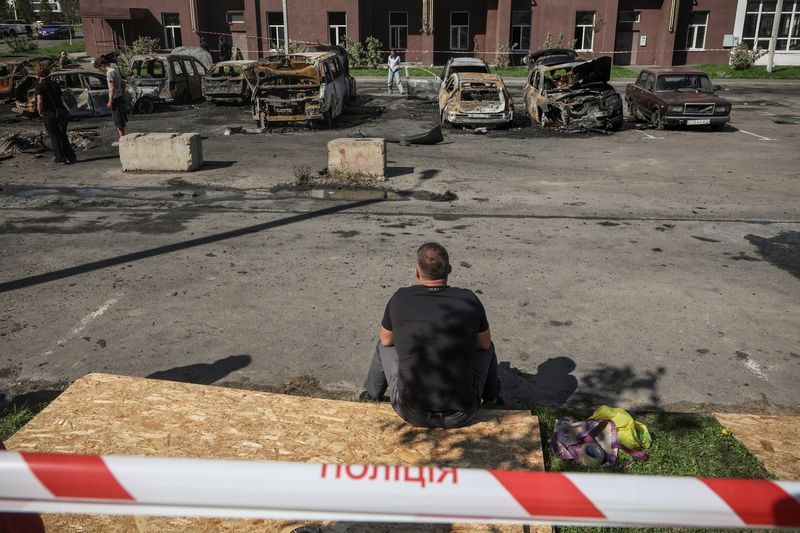
Russian forces launched multiple waves of uncrewed aerial vehicles targeting the Ukrainian capital of Kyiv and its surrounding administrative region on Friday, August 28, 2026, marking a second consecutive day of intensive aerial bombardment on the metropolitan area. The strikes damaged residential properties and commercial warehouse infrastructure, according to Ukrainian municipal and regional officials. Authorities in Kyiv described the repeated early-morning strikes as a systematic attempt by Russian military commanders to disrupt civilian routines and destabilize normal daily life for millions of residents residing in and around the capital city.
Key facts
What happened
The aerial barrage began during the early hours of Friday morning, as Russian units launched successive waves of attack drones aimed at Kyiv and the broader Kyiv region. Ukrainian air defense systems were activated across the capital territory to intercept the incoming loitering munitions as air raid sirens sounded throughout the municipality.
According to reporting by Reuters, the incoming strikes inflicted damage on multiple facilities across the affected zone, including commercial warehouses and private dwellings. Cascading detonations and falling debris from intercepted or impacting drones caused physical damage to structures, though complete assessments of the structural destruction remained underway throughout Friday morning.
The attack represented the second straight day that Russian commanders directed sustained drone operations against the capital region. On both days, the wave-based tactics appeared structured to saturate air defense tracking capacity, forcing Ukrainian military units to exhaust defensive munitions while air defense teams rushed to neutralize incoming targets across multiple vectors simultaneously.
Ukrainian officials confirmed that while defense forces worked to destroy incoming air vehicles, the persistent alerts and scattered strikes shut down transportation routes, disrupted municipal services, and forced thousands of urban residents into underground bomb shelters, metro stations, and designated basements for the second day in succession.
Why it matters
The sustained targeting of Ukraine's principal political, economic, and cultural center carries immediate and medium-term consequences for civilian resilience, urban supply chains, and military resource allocations. By maintaining back-to-back days of aerial pressure on Kyiv, Russian forces exert physical and psychological strain on a civilian population that has weathered more than four years of continuous wartime conditions since the full-scale invasion commenced in February 2022.
From an economic perspective, damage to commercial warehouses and storage facilities threatens regional distribution networks. Supply chains for food, essential consumer goods, and industrial materials rely heavily on the ring of logistics parks situated in the suburban belt surrounding Kyiv. Physical destruction of warehouse capacity raises operating costs for businesses, increases insurance premiums, and risks localized shortages of commercial goods. Furthermore, residential property damage directly displaces families, placing additional burdens on municipal emergency housing services and social welfare budgets.
From a strategic and military perspective, continuous drone raids compel Ukrainian defense commanders to maintain high-density air defense coverage around the capital. Kyiv is guarded by a multi-layered air defense umbrella that includes sophisticated Western-supplied surface-to-air missile batteries such as the MIM-104 Patriot, NASAMS, and IRIS-T systems, alongside mobile fire groups equipped with anti-aircraft cannon and heavy machine guns. Deploying and expending expensive interceptor missiles against relatively low-cost uncrewed aerial vehicles presents a persistent asymmetric challenge. Every air defense missile expended over Kyiv is a munition unavailable for frontline combat sectors in the east and south, where Ukrainian ground forces face heavy Russian offensive pressure.
Finally, the disruption to daily life in a city of roughly three million people undermines economic productivity. Air raid alerts force workers to halt labor, temporarily close offices and shops, and suspend public transportation networks, compounding the economic drag on Ukraine's national war economy.
The background
Since launching its full-scale invasion of Ukraine on February 24, 2022, the Russian Federation has repeatedly utilized long-range strike campaigns to target Ukrainian cities, energy grids, and transportation nodes far behind the primary battle lines. In the initial weeks of the conflict, Russian ground forces advanced toward Kyiv from the north and northeast before being repelled in late March 2022. Following their retreat from the capital region, Russian forces shifted strategies, increasingly relying on stand-off aerial bombardment using cruise missiles, ballistic missiles, and long-range uncrewed aerial vehicles.
Beginning in the autumn of 2022, Moscow introduced regular long-range drone raids using Iranian-designed Shahed-136 and Shahed-131 loitering munitions, manufactured locally under the designation Geran-2. These delta-wing drones, powered by small internal combustion engines, carry explosive warheads ranging from 30 to 50 kilograms and possess operational ranges exceeding 1,000 kilometers. Their low manufacturing cost relative to conventional cruise missiles has allowed Russian forces to manufacture and launch them in large operational quantities.
Over the course of 2023, 2024, and 2025, Ukraine transformed its air defense architecture with extensive military assistance from Western partners. The United States, Germany, Norway, the United Kingdom, and other allies provided state-of-the-art missile systems, radar networks, and short-range air defense equipment. Ukraine also pioneered the deployment of thousands of specialized mobile air-defense teams—units mounted on light trucks equipped with searchlights, thermal optics, and heavy automatic weapons—to destroy incoming drones without expending high-value interceptor missiles.
Despite high interception rates, which frequently exceed 80 to 90 percent during major attacks, the volume of incoming projectiles means that warhead detonations and falling metallic shrapnel regularly inflict localized devastation on residential blocks, commercial facilities, and municipal energy infrastructure across the Kyiv metropolitan area.
Reaction
Ukrainian authorities reacted swiftly to the Friday morning strikes, condemning the ongoing aerial assault as a deliberate strategy of terror aimed at intimidating non-combatants. Regional civic administrators and municipal public safety agencies dispatched emergency rescue crews, firefighters, and structural engineers to inspect damaged warehouses and residential homes, extinguish fires, and clear street debris.
Ukrainian officials emphasized that consecutive daily strikes demonstrate Moscow's intent to grind down public morale and disrupt urban functioning during the late summer season. Officials reiterated urgent calls to international allies for additional air defense interceptors, spare parts, and radar units to fortify the skies above major population centers.
While official Russian defense ministry statements regarding the specific August 28 targets were not immediately available in the initial reporting by Reuters, Moscow has routinely maintained in public briefings that its long-range strike campaign focuses exclusively on military targets, dual-use industrial sites, energy facilities supporting defense production, and logistics hubs. Ukrainian authorities and international human rights observers have consistently rejected those claims, pointing to thousands of documented cases where residential buildings, schools, medical centers, and commercial storage hubs have sustained direct impacts or collateral damage.
What we don't know yet
Several critical details regarding the August 28 strike on Kyiv remain unconfirmed in the immediate aftermath of the attack. First, the total number of uncrewed aerial vehicles launched by Russian forces during the wave, as well as the precise number successfully intercepted by Ukrainian air defense units, has not been fully tabulated or publicly released in the initial Reuters report.
Second, the full extent of physical casualties and injuries among the civilian population remains unverified. Emergency services continue to search damaged residential sites and industrial warehouses, leaving the final casualty count subject to revision as search and recovery operations progress.
Third, the specific nature of the goods stored inside the damaged warehouses has not been disclosed by local authorities due to operational security protocols. It remains unclear whether the impacted commercial structures housed civilian food reserves, industrial machinery, or logistics supplies connected to municipal maintenance.
Finally, the precise launch origin of the drone waves—whether deployed from locations within western Russia, such as the Kursk or Bryansk regions, or from occupied territories in southern Ukraine—has not been publicly specified by military intelligence officers.
What to watch
In the days following the August 28 attack, several key developments will indicate the broader trajectory of the aerial campaign over northern Ukraine.
This report incorporates information originally reported by Dan Peleschuk and Anna Pruchnicka for Reuters.
How this story was produced
This report was written by The Global Wire newsroom from reporting first published by Dan Peleschuk; Anna Pruchnicka. We verify the core facts against the original report, write our own account, and add the background and consequences a short wire item leaves out. Drafting is AI-assisted inside an editor-supervised pipeline, and every story is checked for accuracy of attribution, structure and duplication before it appears — full detail in our AI and funding disclosure.
Spotted an error? Tell us at corrections@horizonglobalnews.com and read our corrections policy or editorial standards.





Reader comments
Loading comments…