

Iran and UAE Engage in Regional Talks as Tehran Highlights Strategic Ties with India
High-level diplomatic discussions between Iranian President Masoud Pezeshkian and Abu Dhabi Crown Prince Sheikh Khaled emphasize West Asian stability and multi-aligned foreign policy.
By The Global Wire Newsroom · Reported from India Today Video Desk
Link preview · horizonglobalnews.com
Iran and UAE Engage in Regional Talks as Tehran Highlights Strategic Ties with India
High-level diplomatic discussions between Iranian President Masoud Pezeshkian and Abu Dhabi Crown Prince Sheikh Khaled emphasize West Asian stability and multi-aligned foreign policy.
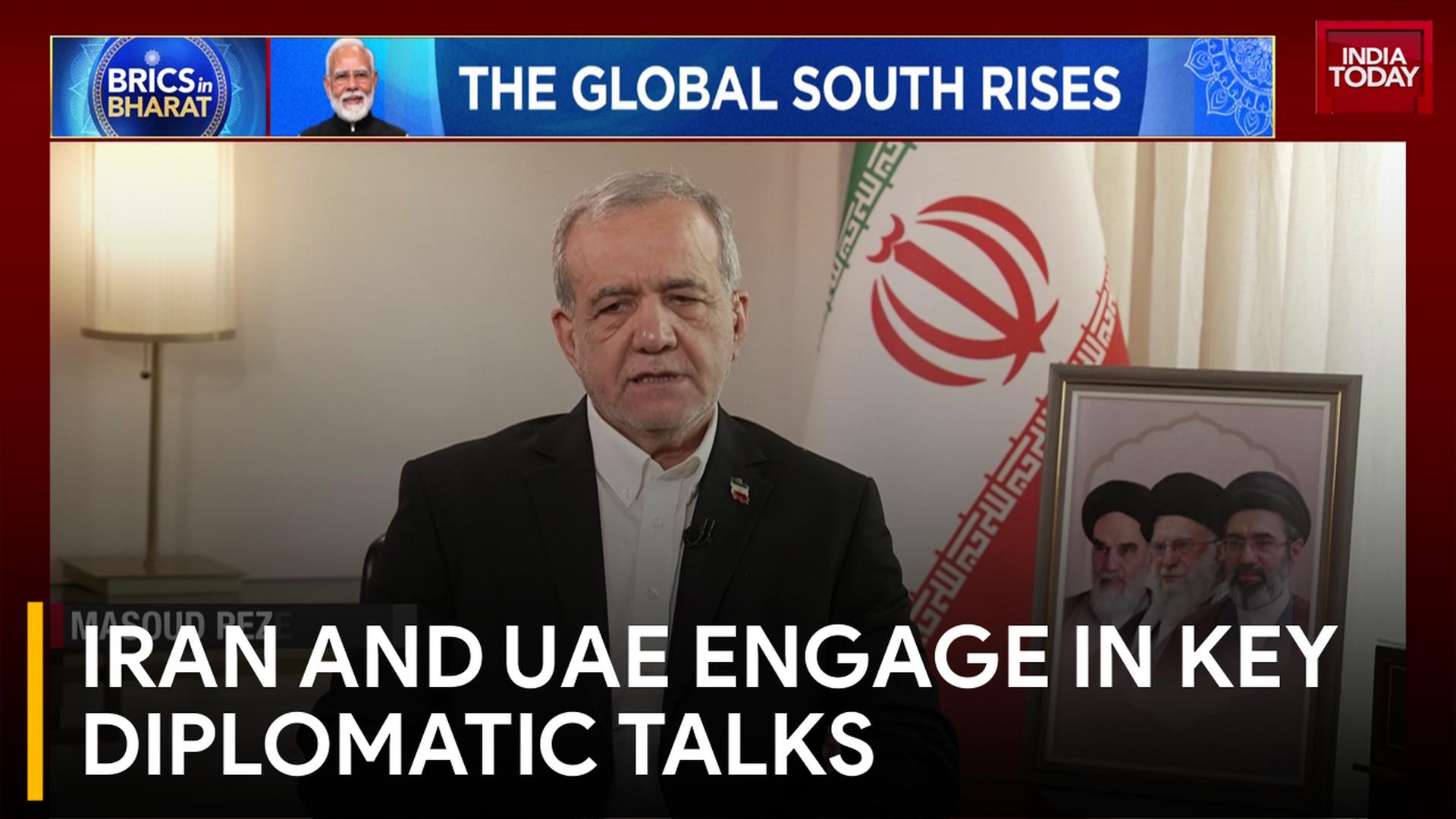
High-level diplomatic interactions between the United Arab Emirates and Iran have underscored the changing geopolitical landscape in West Asia, as Iranian President Masoud Pezeshkian held talks with Abu Dhabi Crown Prince Sheikh Khaled bin Mohamed bin Zayed Al Nahyan while also outlining the trajectory of Tehran’s bilateral relationship with New Delhi. According to reporting by India Today, President Pezeshkian addressed both regional dynamics with the UAE leadership and the state of Iranian-Indian cooperation in broadcast remarks. The meeting highlights ongoing diplomatic outreach in the Persian Gulf as regional powers prioritize economic stabilization and de-escalation, coinciding with Indian Prime Minister Narendra Modi’s sustained diplomatic engagements across rival Middle Eastern capitals.
Key facts
What happened
Iranian President Masoud Pezeshkian met with Sheikh Khaled bin Mohamed bin Zayed Al Nahyan, the Crown Prince of Abu Dhabi, for diplomatic discussions focused on regional stability, trade security, and bilateral ties in West Asia. The interaction marks another notable contact between top officials from Tehran and the United Arab Emirates as both nations seek to maintain open communications despite historic geopolitical friction in the Persian Gulf.
During the same diplomatic cycle, President Pezeshkian delivered remarks in a televised interview regarding Iran’s bilateral relationship with India, as reported by India Today. Pezeshkian highlighted the historic depth of Indian-Iranian relations and noted the shared economic interests connecting the two countries. The Iranian president's comments came in the broader context of Indian Prime Minister Narendra Modi’s ongoing global outreach, which has sought to position New Delhi as a key economic and diplomatic partner across the Middle East without becoming embroiled in regional schisms.
The meeting between Pezeshkian and Sheikh Khaled focused on pressing regional dynamics, including maritime security, economic cooperation, and broader security considerations across West Asia. While specific text from the private bilateral consultations was not made public, the engagement fits into a deliberate pattern of diplomatic exchanges aimed at reducing tensions around vital shipping lanes and economic corridors in the region.
Why it matters
The high-level engagement between Iran and the UAE, coupled with Tehran's public emphasis on its ties with India, carries significant implications for international trade, energy security, and diplomatic alignments across West Asia.
For the Persian Gulf region, direct dialogue between senior Iranian officials and leadership from Abu Dhabi reflects the durable nature of the de-escalation trend initiated in recent years. The United Arab Emirates serves as a principal commercial and transit hub for the Middle East, while Iran sits opposite the Strait of Hormuz, through which roughly one-fifth of global petroleum consumption passes. Stable bilateral channels between Tehran and Abu Dhabi reduce the operational risks for commercial shipping and energy exports in one of the world's most critical maritime bottlenecks.
For India, maintaining robust, independent relationships with both Iran and the Arab Gulf monarchies is a cornerstone of its foreign policy strategy. New Delhi relies on the Gulf Cooperation Council (GCC) member states—particularly the UAE and Saudi Arabia—for crude oil imports, massive foreign direct investment, and employment for over eight million Indian expatriates living in the region. At the same time, India views Iran as indispensable for accessing landlocked Central Asian markets and Russia, bypassing land route constraints posed by Pakistan.
President Pezeshkian’s positive framing of Iran-India relations underscores Tehran’s commitment to preserving key Asian diplomatic bridges despite Western sanctions. For New Delhi, securing long-term operational rights at strategic nodes like Iran's Chabahar Port while simultaneously deepening security and economic ties with the UAE demonstrates the viability of Prime Minister Modi’s multi-aligned foreign policy approach.
The background
Relations between Iran and its Arab neighbors in the Persian Gulf have underwent notable shifts over the past decade. Diplomatic ties between the UAE and Iran were formally downgraded in January 2016 following attacks on Saudi diplomatic missions in Iran. However, commercial interactions between Dubai and Iranian traders continued, preserving baseline economic links. Recognizing the high economic costs of perpetual regional friction, the UAE reinstated its ambassador to Tehran in August 2022, initiating a gradual process of political normalization.
Iran’s domestic political leadership underwent a significant transition in July 2024 following the election of Masoud Pezeshkian as president. Pezeshkian, a former heart surgeon and parliamentarian, took office after the unexpected death of President Ebrahim Raisi in a helicopter crash in May 2024. Pezeshkian’s administration has consistently stated a foreign policy objective of strengthening ties with immediate neighbors in West Asia and expanding economic cooperation with major Asian partners such as India and China to mitigate the impact of international sanctions.
India's diplomatic trajectory in West Asia has expanded significantly under Prime Minister Narendra Modi since he took office in 2014. Modi has made numerous official visits to the UAE, establishing a close working relationship with UAE President Sheikh Mohamed bin Zayed Al Nahyan. In 2022, India and the UAE signed a landmark Comprehensive Economic Partnership Agreement (CEPA), aiming to boost non-oil bilateral trade to $100 billion. Furthermore, at the G20 summit in New Delhi in September 2023, India, the UAE, Saudi Arabia, the European Union, and the United States announced the India-Middle East-Europe Economic Corridor (IMEC), designed to connect India to Europe via Gulf rail and port networks.
Simultaneously, India has maintained its strategic presence in Iran. In May 2024, India signed a 10-year main contract with Iran to operate the Shahid Beheshti terminal at Chabahar Port. Developed jointly by India and Iran, Chabahar provides New Delhi with a direct trade pathway to Afghanistan and Central Asia through the International North-South Transport Corridor (INSTC), a multi-modal transit network linking India, Iran, Azerbaijan, and Russia. Navigating the delicate balance between American sanctions against Iran and New Delhi's strategic transit requirements has remained a defining feature of Indian foreign policy.
Reaction
Diplomatic responses to the recent talks highlight a mutual desire among West Asian states to stabilize regional governance through direct dialogue. While full transcripts of the discussion between President Pezeshkian and Crown Prince Sheikh Khaled were not released, official diplomatic reporting from both countries emphasized regional security, economic stability, and shared diplomatic priorities.
International observers note that formal multilateral platforms are increasingly providing forums for these interactions. Both Iran and the United Arab Emirates were formally admitted as full members of the BRICS economic bloc, joining original members Brazil, Russia, India, China, and South Africa. This shared membership provides additional regular avenues for Iranian and Emirati leaders to meet alongside Indian representatives.
Western nations, particularly the United States, monitor diplomatic developments involving Iran closely. Washington continues to enforce unilateral financial and economic sanctions against Iranian state institutions and key economic sectors. However, Indian diplomats have consistently asserted that New Delhi's involvement in Iranian infrastructure, such as Chabahar Port, serves broader humanitarian and connectivity goals for regional stability in Central Asia, a stance that has previously received targeted exemptions or waivers from U.S. authorities.
What we don't know yet
Several critical operational and political details regarding these diplomatic engagements remain unconfirmed in current reporting:
What to watch
In assessing the progression of West Asian regional diplomacy and India's role within it, several upcoming benchmarks will provide clear indicators:
This news report is based on original reporting published by India Today Video Desk.
How this story was produced
This report was written by The Global Wire newsroom from reporting first published by India Today Video Desk. We verify the core facts against the original report, write our own account, and add the background and consequences a short wire item leaves out. Drafting is AI-assisted inside an editor-supervised pipeline, and every story is checked for accuracy of attribution, structure and duplication before it appears — full detail in our AI and funding disclosure.
Spotted an error? Tell us at corrections@horizonglobalnews.com and read our corrections policy or editorial standards.


Reader comments
Loading comments…