

Iberian Copper Traced to Nordic Bronze Age Artifacts in Sweeping Prehistoric Trade Study
Geochemical analysis connects a 1300 BC mine in southwestern Spain to bronze artifacts discovered thousands of kilometers away in Scandinavia.
By The Global Wire Newsroom · Reported from TOI Science Desk
Link preview · horizonglobalnews.com
Iberian Copper Traced to Nordic Bronze Age Artifacts in Sweeping Prehistoric Trade Study
Geochemical analysis connects a 1300 BC mine in southwestern Spain to bronze artifacts discovered thousands of kilometers away in Scandinavia.
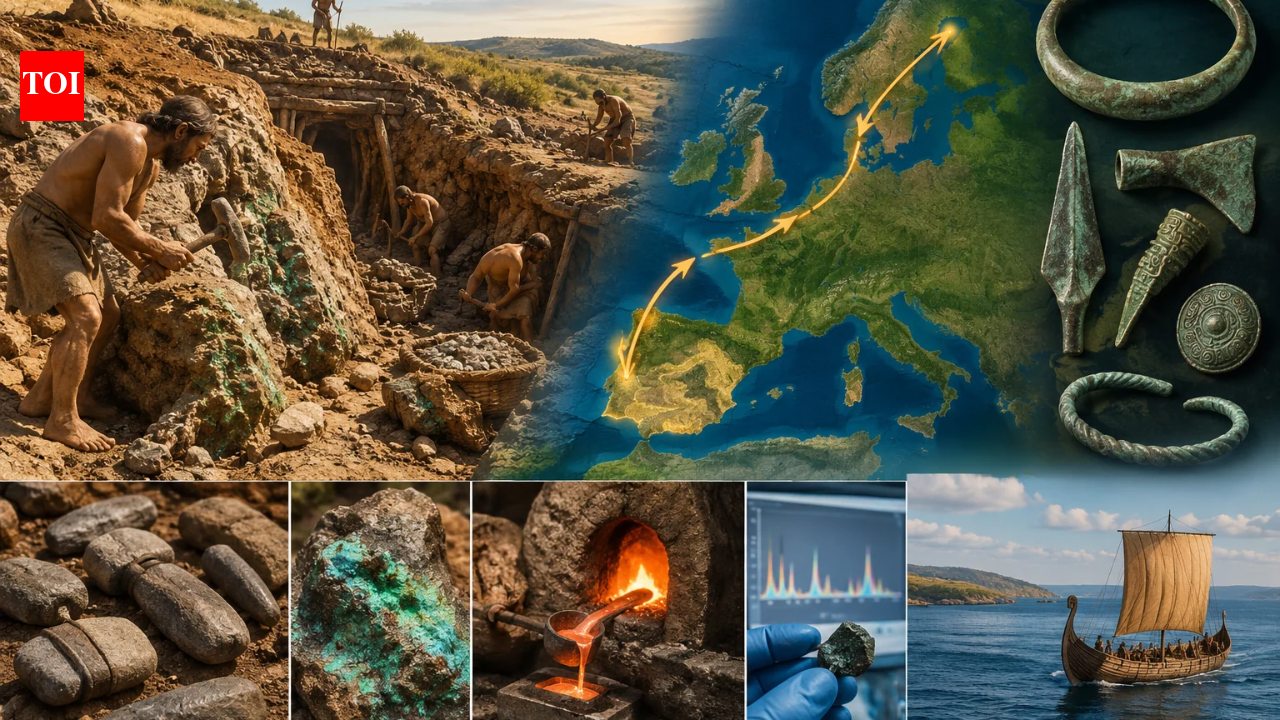
Archaeologists and geochemists investigating prehistoric trade routes across Europe have linked copper extracted from a Bronze Age mining complex in southwestern Spain to finished bronze artifacts discovered in Scandinavia. Chemical signatures recovered from the site of Las Minillas, where miners extracted ore around 1300 BC using hundreds of stone tools, show direct compositional matches with 11 bronze objects excavated in northern Europe. The findings indicate that raw materials circulated across thousands of kilometers along the Atlantic seaboard and continental waterways, demonstrating that regional metal production in the late second millennium BC fed into an integrated, continent-wide exchange network far more expansive than previously confirmed.
Key facts
What happened
Field investigations and laboratory testing at Las Minillas, located in southwestern Spain, uncovered substantial evidence of intensive late second millennium BC extraction activity. Working along exposed mineral veins, prehistoric laborers used hundreds of handheld stone hammers, commonly referred to by archaeologists as hammerstones or mauls, to shatter host rock and extract copper-bearing ores around 1300 BC. The density of abandoned stone tools pointed to an organized, prolonged mining effort rather than opportunistic, small-scale digging.
Subsequent isotopic and elemental testing carried out on the geological material allowed researchers to establish a precise chemical fingerprint for the Las Minillas deposit. Such geochemical profiles typically rely on ratios of lead isotopes—which remain unaltered throughout the smelting and casting process—alongside distinct trace element patterns such as arsenic, antimony, silver, and nickel.
When comparing the Las Minillas profile against existing metallurgical databases of European prehistoric artifacts, researchers identified matches in 11 separate bronze objects recovered from Scandinavian archaeological contexts, according to reporting by TOI Science Desk. The artifacts, which belong to the Nordic Bronze Age, reflect finished prestige items or functional implements cast from metal that originated in the far southwest of the European continent.
Because Scandinavia possesses virtually no indigenous copper or tin deposits that were exploitable with prehistoric technology, every bronze object manufactured in the region during the period depended entirely on imported metal. The match between Las Minillas and the Scandinavian assemblage establishes that Iberian metal traveled beyond regional Iberian or central Mediterranean circuits, reaching communities along the Baltic and North Sea coasts.
Why it matters
The identification of southwestern Spanish copper in Scandinavian metalwork carries major ramifications for how historians and archaeologists conceptualize prehistoric European economies. For decades, scholarly debate has centered on whether ancient exchange systems operated primarily through localized, down-the-line barter—where goods passed slowly between adjacent communities—or through structured, long-distance trade corridors managed by specialized seafaring or merchant groups.
Connecting an extraction site active in 1300 BC directly to artifacts located more than 2,500 kilometers away demonstrates that Late Bronze Age supply chains were resilient, sophisticated, and capable of moving heavy bulk goods across open ocean and major river valleys. This finding challenges the assumption that northern European communities relied almost exclusively on closer copper sources, such as those in the central European Alps, the British Isles, or modern-day Slovakia. While those nearer sources certainly supplied northern workshops, the presence of Iberian copper indicates a diversified procurement strategy.
Furthermore, this connectivity illustrates that the societies of Bronze Age Europe were economically interdependent. A disruption in mining activity or maritime transport along the Atlantic seaboard could theoretically alter metal availability thousands of kilometers to the north. For modern researchers, the data reinforces the utility of archaeometallurgy and high-precision isotopic databases in reconstructing economic patterns that left behind no written records, demonstrating how rigorous physical science can resolve longstanding questions about prehistoric human mobility, technology, and economic integration.
The background
The European Bronze Age, which roughly spanned from the late third millennium BC to the early first millennium BC, was defined by the widespread adoption of bronze—an alloy created by smelting copper with approximately 10 percent tin. While copper is relatively abundant across parts of southern Europe, the Alpine belt, and the British Isles, rich tin deposits are rare and geographically restricted, found mainly in regions such as Cornwall, Brittany, and parts of northwestern Iberia. This fundamental geological mismatch forced prehistoric communities to establish transcontinental exchange networks to bring the two metals together.
The Iberian Peninsula, particularly its southwestern territory encompassed by the Iberian Pyrite Belt and the Ossa-Morena Zone, was one of the most prolific polymetallic regions in the ancient world. Mining at sites like Rio Tinto, Tharsis, and smaller deposits such as Las Minillas began in the Chalcolithic (Copper Age) and expanded significantly during the Bronze Age. Miners utilized grooved cobbles collected from nearby riverbeds, hafting them onto wooden handles with leather thongs to smash the hard quartz and gossan outcrops that encased copper minerals like malachite, azurite, and chalcopyrite.
Simultaneously, southern Scandinavia developed one of the most visually distinctive metalworking cultures in prehistoric Europe, known as the Nordic Bronze Age (dating from approximately 1700 BC to 500 BC). Despite boasting an extraordinary density of bronze swords, ceremonial lurs, axes, and elaborate personal ornaments found in burials and ritual hoards, the region had no local copper or tin mines. Nordic communities acquired finished ingots and recycled scrap in exchange for northern prestige commodities, primarily amber—fossilized tree resin found along the Baltic coasts—as well as furs, animal hides, and possibly slaves.
Previous scientific programs, including extensive pan-European lead isotope surveys conducted over the past two decades, had already demonstrated that Nordic artisans melted down copper sourced from various parts of Europe. British and Alpine coppers dominated different phases of the Scandinavian record. However, definitive links between specific, identifiable mining operations in the far southwest of the Iberian Peninsula and northern European bronze collections have historically been scarce, making confirmed matches particularly consequential.
Reaction
The broader archaeological and metallurgical research community has increasingly turned its focus to validating maritime transport networks operating along the Atlantic facade during the second millennium BC. Specialists in European prehistory anticipate that these findings will prompt researchers curating northern European museum collections to re-examine existing isotopic databases to determine whether Iberian signatures were previously misattributed or overlooked due to incomplete reference libraries.
Institutions managing heritage sites in southwestern Spain are expected to highlight the discovery as further evidence of the global archaeological importance of the region's mining heritage. Prehistorians studying the Nordic Bronze Age are similarly expected to integrate the Las Minillas data into ongoing debates concerning seafaring capabilities, particularly regarding whether raw metal was transported primarily along Atlantic coastal sea lanes using sewn-plank wooden boats, or moved inland via trans-European river routes such as the Rhone, Rhine, and Elbe corridors.
Formal academic evaluations and conference presentations regarding the findings are slated to continue across regional archaeological congresses, where specialists will review the statistical boundaries of the isotopic matches against competing geological profiles from other European ore fields.
What we don't know yet
While the chemical connection between Las Minillas and the 11 Scandinavian artifacts is verified by the geochemical analysis, several major questions regarding the mechanics of the transfer remain unresolved. Current archaeological evidence cannot determine the exact route the copper took to reach Scandinavia. The metal may have moved north entirely by sea along the Atlantic coastline of Portugal, Spain, and France before crossing the English Channel and the North Sea. Alternatively, it could have been offloaded in western France or the Mediterranean basin and carried along navigable river networks into Central Europe before reaching northern consumers.
It is also unclear whether the copper traveled as unrefined raw metal, standardized casting ingots, or pre-formed objects that were later melted down and recast by Scandinavian metalsmiths. Because ancient bronzesmiths frequently blended scraps from different geographical sources, isotopic signatures can sometimes reflect mixed origins rather than a single ore body, though clear isotopic clustering strongly points to Las Minillas. Finally, researchers have yet to establish who controlled the trade: whether it was driven by itinerant prospectors, organized merchant syndicates, or through indirect relay trade involving dozens of intermediary tribal communities.
What to watch
Moving forward, the primary benchmark to track will be the publication of comprehensive peer-reviewed data detailing the exact isotopic ratios and trace-element concentrations used to match the Las Minillas ores to the Scandinavian bronzes. Independent verification by international archaeometallurgy laboratories will confirm whether any overlapping signatures exist in other lesser-known European deposits.
Researchers will also monitor ongoing excavations at Las Minillas and surrounding sites in southwestern Spain for evidence of habitation, processing furnaces, or slag heaps that could indicate the scale of on-site smelting operations around 1300 BC. In Scandinavia, expanding chemical surveys of newly excavated Bronze Age hoards—particularly those recovered through development-led archaeology and systematic metal-detecting initiatives in Denmark, Sweden, and northern Germany—will show whether Iberian metal was an occasional curiosity or a consistent, significant pillar of the Nordic metal economy.
This account is based on original reporting by TOI Science Desk.
How this story was produced
This report was written by The Global Wire newsroom from reporting first published by TOI Science Desk. We verify the core facts against the original report, write our own account, and add the background and consequences a short wire item leaves out. Drafting is AI-assisted inside an editor-supervised pipeline, and every story is checked for accuracy of attribution, structure and duplication before it appears — full detail in our AI and funding disclosure.
Spotted an error? Tell us at corrections@horizonglobalnews.com and read our corrections policy or editorial standards.




Reader comments
Loading comments…