

Gemini Notebook Integrates OpenStax and S Chand Textbooks to Expand AI Study Tools
Google expands Gemini Notebook with curated academic volumes from OpenStax and S Chand, enabling automated study guides and quizzes grounded in peer-reviewed textbooks.
By The Global Wire Newsroom · Reported from Priya Venkatraman
Link preview · horizonglobalnews.com
Gemini Notebook Integrates OpenStax and S Chand Textbooks to Expand AI Study Tools
Google expands Gemini Notebook with curated academic volumes from OpenStax and S Chand, enabling automated study guides and quizzes grounded in peer-reviewed textbooks.
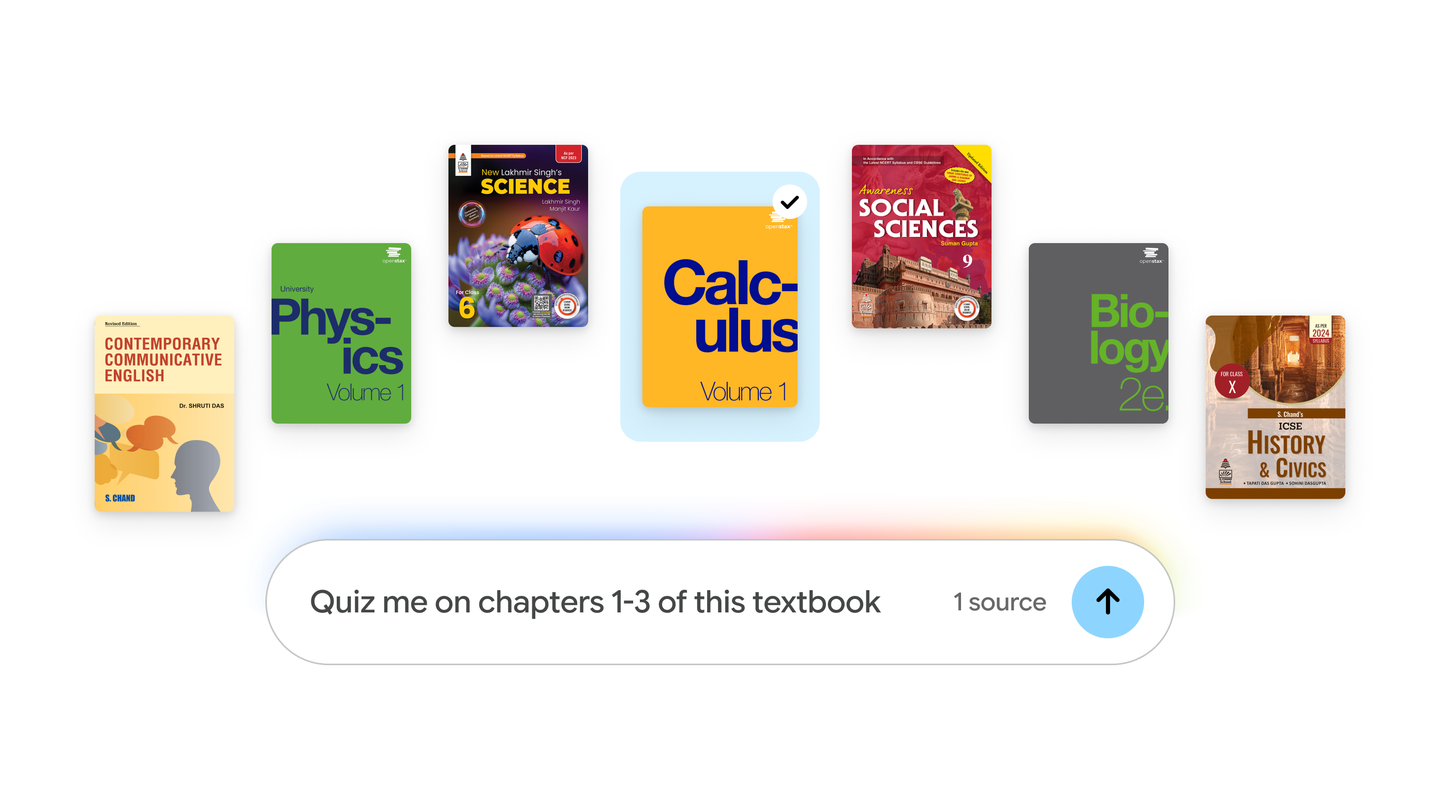
Google has broadened the reach of its educational artificial intelligence tooling by integrating hundreds of verified academic textbooks directly into Gemini Notebook, allowing students and educators to ground generative queries in curated curriculum materials. The expansion incorporates open-access collegiate textbooks from the United States-based non-profit OpenStax alongside school and higher-education volumes from S Chand Publishing, one of India's largest and oldest academic publishing houses. The update enables users to select volumes directly from an integrated catalog to automatically generate structured study outlines, conceptual summaries, and practice quizzes tethered directly to designated course literature.
Key facts
What happened
According to reporting by Priya Venkatraman, the update embeds a dedicated repository of standardized textbooks directly into the interface of Gemini Notebook. Previously, users of Google's notebook-based generative workspace were primarily required to manually supply their own source documentation—such as uploaded Portable Document Format files, Google Docs, copied text excerpts, or audio recordings—to create a localized knowledge base for synthesis.
Under the newly introduced catalog system, learners can browse and attach complete, pre-loaded educational titles without leaving the application. The initial catalog draws heavily from two distinct publishing domains: higher-education open educational resources and South Asian primary and secondary educational texts.
From OpenStax, the platform brings in peer-reviewed titles covering staple collegiate subjects, including introductory biology, calculus, macroeconomics, physics, anatomy, and United States history. From S Chand, the catalog integrates foundational texts aligned with Indian educational frameworks, including curricula overseen by the Central Board of Secondary Education and the Council for the Indian School Certificate Examinations. Once a textbook is linked to a user's digital notebook, Gemini Notebook processes the contents to facilitate natural-language interrogation. Students can prompt the system to explain complex theorems, contrast historical events documented in specific chapters, build flashcard decks, or generate practice multiple-choice and short-answer assessments with automated answer keys referencing the underlying pages.
Why it matters
The formal inclusion of established academic textbooks addresses one of the most persistent hazards confronting generative artificial intelligence in educational environments: factual inaccuracy and hallucination. When general-purpose consumer chatbots generate pedagogical explanations, they frequently blend disparate or unverified web sources, sometimes inventing non-existent citations, formulas, or historical timelines. By strictly tethering generative synthesis to authoritative texts published by recognized institutions, Gemini Notebook utilizes retrieval-augmented generation to keep outputs verifiable and traceable.
For students, the platform offers an interactive layer atop static reading assignments. Rather than passively reviewing dense chapter prose, learners can interrogate specific passages, extract custom summaries tailored to their learning pace, and test their retention before formal exams. The inclusion of OpenStax eliminates subscription barriers for many university students, while the addition of S Chand addresses one of the world's largest student demographics in India, where digital learning aids are seeing rapid adoption alongside competitive national entrance examinations.
From a publishing and intellectual property perspective, the development highlights diverging industry strategies. While several traditional commercial textbook publishers have pursued litigation or established strict proprietary licensing arrangements to prevent unauthorized scraping by artificial intelligence laboratories, partnerships with open-access entities like OpenStax and established regional houses like S Chand indicate a willingness to build controlled, authorized ecosystems. This hybrid model allows publishers to retain brand identity and pedagogical integrity while exposing their material to modern automated study workflows.
The background
Google first publicly signaled its ambition to develop source-grounded note-taking software at its annual I/O developer conference in May 2023 under the prototype moniker Project Tailwind. Developed within Google Labs, the software was subsequently branded as NotebookLM before integrating more deeply into the broader Gemini model ecosystem. Unlike open-ended conversational models that draw unpredictably across vast training corpuses, the workspace was architected around a "grounded" paradigm: users establish a defined corpus of documents, and the model restricts its answers, summaries, and citations strictly to that supplied perimeter.
The technical viability of processing entire textbooks within an interactive notebook relies on recent advancements in model context length. Google's Gemini models feature context windows capable of processing hundreds of thousands—and in some configurations, over one million—tokens of information in a single operational session. This capability allows the system to digest a 600-page academic textbook in its entirety, preserving cross-chapter narrative coherence, mathematical formulas, and indexical cross-references that traditional, fragmented search techniques often scramble.
The two content providers involved reflect distinct operational histories. OpenStax was launched in 2012 by Rice University engineering professor Richard Baraniuk, backed by philanthropic foundations including the William and Flora Hewlett Foundation and the Bill & Melinda Gates Foundation. Its mission was to combat escalating textbook costs in the United States, where college students frequently spend over $1,200 annually on course materials. OpenStax titles are published under Creative Commons licenses, making them legally accessible for digital redistribution and algorithmic ingestion.
S Chand & Company, by contrast, operates as a commercial corporate enterprise founded in 1939 by Shyam Lal Gupta in New Delhi. Over eight decades, the company grew into one of India’s preeminent educational conglomerates, listing on the National Stock Exchange of India and the BSE. S Chand prints millions of textbooks annually across elementary, secondary, engineering, and commerce tracks, maintaining entrenched distribution across thousands of private and public schools throughout South Asia.
Reaction
The incorporation of pre-loaded textbooks into generative platforms sits within an ongoing debate among educational policymakers, university administrators, and teachers regarding the role of automated software in student assessment. While formal statements from educational boards regarding this specific rollout remain pending, academic bodies have generally expressed divided views on automated study generators.
Proponents of retrieval-based study aids argue that automated quiz and guide generation promotes active recall and spaced repetition—two learning techniques supported by cognitive science research. By shifting artificial intelligence usage away from unmonitored essay drafting toward personal tutoring and comprehension testing, proponents maintain that platforms like Gemini Notebook direct students toward deeper textual engagement.
Conversely, curriculum supervisors and instructional design specialists have voiced concern over the risk of cognitive offloading. If students rely on automated algorithms to condense complex arguments into bulleted outlines rather than performing the analytical reading themselves, instructors warn that long-term reading comprehension, stamina, and synthetic reasoning could degrade. Institutional reaction will likely depend on whether regional school systems perceive the software as an authorized digital tutor or an unauthorized shortcut around rigorous textual analysis.
What we don't know yet
Several structural and operational aspects of the deployment remain unspecified in the initial release. It is not currently clear whether access to the S Chand catalog is bound by geographical restrictions, limiting access primarily to users in India, or whether the titles are accessible to Gemini Notebook users globally. Furthermore, the financial and licensing mechanisms governing the agreement between Google and S Chand have not been disclosed, leaving it unclear whether compensation is calculated through platform usage metrics, a fixed enterprise licensing fee, or promotional partnership terms.
Additionally, the technical guardrails governing textbook updates remain unclarified. When new editions of academic volumes are published—incorporating updated scientific consensus, statistical data, or revised historical analyses—it is unknown how rapidly Gemini Notebook's internal repository refreshes or whether users will retain the option to query older editions tied to specific university course syllabi. Finally, Google has not published an exhaustive public index detailing the exact total count of titles incorporated or whether user interaction logs within the catalog will be utilized to train broader Gemini model architectures.
What to watch
The trajectory of this initiative will be shaped by upcoming academic cycles and institutional responses. Observers will be monitoring whether student uptake increases during the Northern Hemisphere's mid-term examination periods and the intense spring preparation phase for Indian board examinations, including the CBSE Class 10 and 12 assessments.
A critical factor to watch will be whether competing global textbook publishers—such as Pearson, McGraw Hill, Cengage, and Wiley—respond by opening their own proprietary catalogs to competing platforms like OpenAI's ChatGPT, Anthropic's Claude, or Microsoft Copilot. Several of these publishers have previously piloted closed-door proprietary artificial intelligence tools; Google’s integration may force competitors to decide whether to maintain walled gardens or partner with major consumer technology platforms.
Finally, monitoring will center on whether Google expands the catalog to incorporate non-English educational texts, multilingual curriculum variants, and specialized technical manuals for vocational and professional certifications, which would signal a shift from an experimental collegiate feature to an enterprise-scale educational infrastructure.
This article is based on reporting by Priya Venkatraman.
How this story was produced
This report was written by The Global Wire newsroom from reporting first published by Priya Venkatraman. We verify the core facts against the original report, write our own account, and add the background and consequences a short wire item leaves out. Drafting is AI-assisted inside an editor-supervised pipeline, and every story is checked for accuracy of attribution, structure and duplication before it appears — full detail in our AI and funding disclosure.
Spotted an error? Tell us at corrections@horizonglobalnews.com and read our corrections policy or editorial standards.





Reader comments
Loading comments…