

Far-Right and Far-Left Figures Lead Polling Scenarios for France's 2027 Presidential Race
Early polling indicates growing political polarization in France as Marine Le Pen leads first-round matchups and Jean-Luc Mélenchon secures second place in most scenarios ahead of the 2027 election.
By The Global Wire Newsroom · Reported from thestar.com.my
Link preview · horizonglobalnews.com
Far-Right and Far-Left Figures Lead Polling Scenarios for France's 2027 Presidential Race
Early polling indicates growing political polarization in France as Marine Le Pen leads first-round matchups and Jean-Luc Mélenchon secures second place in most scenarios ahead of the 2027 election.
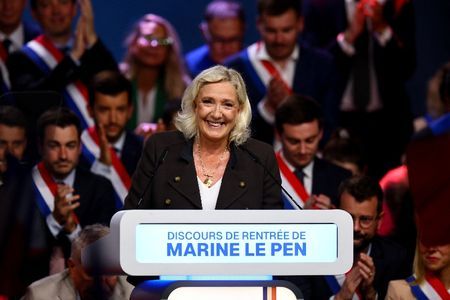
A public opinion survey released in Paris shows far-right leader Marine Le Pen maintaining a decisive lead in voting intentions for France's 2027 presidential election, with far-left politician Jean-Luc Mélenchon placing second across the majority of tested scenarios. The polling data, reported by Reuters, demonstrates the sustained polarization of the French electorate as the country approaches the conclusion of President Emmanuel Macron’s second and final term. Under the rules of the French Constitution, Macron is prohibited from seeking a third consecutive mandate, creating a power vacuum at the center of French politics. The strong performance of political figures from outside the traditional mainstream highlights a profound structural shift in the Fifth Republic, where voters are increasingly gravitating toward populist and radical platforms rather than the centrist coalition that has governed since 2017.
Key facts
What happened
The newly released survey evaluated multiple potential first-round voting configurations for the upcoming presidential contest scheduled for the spring of 2027. According to reporting by Reuters, the data indicates that Marine Le Pen, the longtime leader and parliamentary head of the National Rally (Rassemblement National), commands a firm top position regardless of which candidates are fielded by rival parties.
In the majority of political matchups presented to respondents, Jean-Luc Mélenchon, the founder of the far-left La France Insoumise (France Unbowed) movement, emerged in second place. This positioning would potentially qualify him alongside Le Pen for the two-candidate runoff election that decides the French presidency, provided no candidate secures an absolute majority in the initial round of voting.
The poll results highlight the severe pressure facing potential candidates from Macron's governing coalition, Renaissance, as well as those from traditional center-right and center-left parties. While several prospective candidates from the centrist majority—including former prime ministers and senior cabinet members—have begun organizing prospective campaigns, none of the tested scenarios showed a centrist contender establishing a dominant lead over the candidates of the political margins. The data emphasizes that the political center, which successfully united moderate voters against the far right in 2017 and 2022, faces an uphill battle to retain control of the Élysée Palace without Macron on the ballot.
Why it matters
The polling figures signify a potential watershed moment for European governance, international alliances, and domestic economic policy. If current voter sentiment holds through 2027, France could face a presidential runoff between candidates who have historically advocated for radical alterations to the country's institutional and foreign policy commitments.
A presidency led by either the far right or the far left would dramatically reshape France’s relationship with the European Union. Marine Le Pen’s National Rally has long championed national sovereignty over European integration, proposing strict border controls, restrictions on immigration, and a reduction in financial contributions to Brussels. Conversely, Jean-Luc Mélenchon and La France Insoumise have frequently criticized EU fiscal rules, advocated for unilateral departures from European treaty obligations on economic policy, and proposed sweeping redistribution plans that could challenge EU competition laws.
For financial markets and institutional investors, the prospect of a runoff between extreme political camps introduces significant uncertainty. France is currently grappling with elevated public debt and budget deficits that exceed the European Union's 3 percent of gross domestic product threshold. The absence of a strong centrist alternative in early polling raises concerns over future fiscal discipline, public spending commitments, and sovereign debt borrowing costs. Furthermore, changes in French leadership could fundamentally alter European defense strategy, Western policy toward NATO, and the continuation of military and financial support for Ukraine.
The background
The political dynamics governing the 2027 contest are rooted in the structural mechanics of the French Fifth Republic, founded by Charles de Gaulle in 1958. Under Article 6 of the French Constitution, the president is directly elected for a five-year term using a two-round majority system. If no candidate receives more than 50 percent of the valid votes cast in the first round, a runoff election is conducted two weeks later between the top two finishing candidates.
Constitutional rules updated in 2008 limit an individual to serving a maximum of two consecutive five-year terms. Because Emmanuel Macron won presidential victories in April 2017 and April 2022, he is ineligible to stand as a candidate in 2027. Macron's original election victory shattered the historic political duopoly between the center-right (now represented by Les Républicains) and the center-left (the Socialist Party), which had alternated power for decades.
Over the past decade, French politics has increasingly reorganized into three distinct ideological blocs: a nationalist right led by Le Pen, a radical left anchored by Mélenchon, and a pro-European centrist coalition assembled by Macron. In the 2017 presidential election, Macron defeated Le Pen in the second round with 66.1 percent of the vote. Five years later, in the 2022 presidential contest, Macron again defeated Le Pen in the runoff, though his winning margin narrowed significantly to 58.5 percent. In that same 2022 election, Mélenchon narrowly missed the second-round runoff, finishing third in the first round with 21.95 percent of the vote.
Subsequent parliamentary elections have underscored the erosion of centrist dominance. In the June 2022 legislative elections, Macron’s coalition lost its absolute majority in the Assemblée Nationale. A subsequent snap election called by Macron in the summer of 2024 resulted in an even more fragmented parliament, split roughly into three mutually hostile factions: the New Popular Front left-wing alliance, the centrist presidential bloc, and the National Rally alongside its allies. This legislative deadlock has made governing increasingly difficult, leading to frequent cabinet reshuffles and persistent political instability in Paris.
Reaction
Following the publication of the poll, political factions across France expressed contrasting views on the trajectory of the 2027 campaign. Representatives aligned with the National Rally framed the survey results as validation of Le Pen's prolonged effort to broaden her party's appeal and present herself as a viable president-in-waiting. Party strategists highlighted the consistency of her lead across diverse candidate scenarios as evidence of a structural realignment among working-class and rural voters.
Within far-left circles, allies of Jean-Luc Mélenchon emphasized that the polling confirms his status as the primary standard-bearer for the left, arguing that his platform offers the only effective opposition to the far right. However, figures within the broader left-wing coalition—including elements of the Socialist Party, the Ecologists, and moderate left groups—have periodically questioned whether Mélenchon’s style limits his potential to secure a majority in a national runoff election.
Among centrist lawmakers and supporters of President Macron, the survey has intensified urgency around selecting a unifying candidate to represent the presidential majority. Potential contenders, such as former Prime Minister Édouard Philippe, former Prime Minister Gabriel Attal, and other senior government figures, face growing pressure to clarify their candidacies and consolidate support behind a single platform to prevent a complete lockout of the political center from the second round.
What we don't know yet
Despite early polling indicators, several critical factors remain uncertain and could substantially alter the composition of the 2027 presidential race. The survey summary reported by Reuters did not disclose full details regarding margin of error, sample size, or the specific numerical percentages for each candidate tested in the various scenarios, limiting a complete assessment of the statistical distance between contenders.
Additionally, the definitive candidate lineup for 2027 remains unconfirmed across major political parties:
What to watch
In the coming months, several key political developments will signal how the 2027 presidential field will solidify:
This report is based on original news coverage reported by Reuters and published by The Star.
How this story was produced
This report was written by The Global Wire newsroom from reporting first published by thestar.com.my. We verify the core facts against the original report, write our own account, and add the background and consequences a short wire item leaves out. Drafting is AI-assisted inside an editor-supervised pipeline, and every story is checked for accuracy of attribution, structure and duplication before it appears — full detail in our AI and funding disclosure.
Spotted an error? Tell us at corrections@horizonglobalnews.com and read our corrections policy or editorial standards.



Reader comments
Loading comments…