

Chang'e-6 Samples Reveal Asteroid Fragment Offering Clues to Lunar Water Origin
Laboratory analysis of soil returned from the Moon's far side has uncovered an asteroid fragment that illuminates how water and volatile compounds reached the lunar surface.
By The Global Wire Newsroom · Reported from TOI Science Desk
Link preview · horizonglobalnews.com
Chang'e-6 Samples Reveal Asteroid Fragment Offering Clues to Lunar Water Origin
Laboratory analysis of soil returned from the Moon's far side has uncovered an asteroid fragment that illuminates how water and volatile compounds reached the lunar surface.
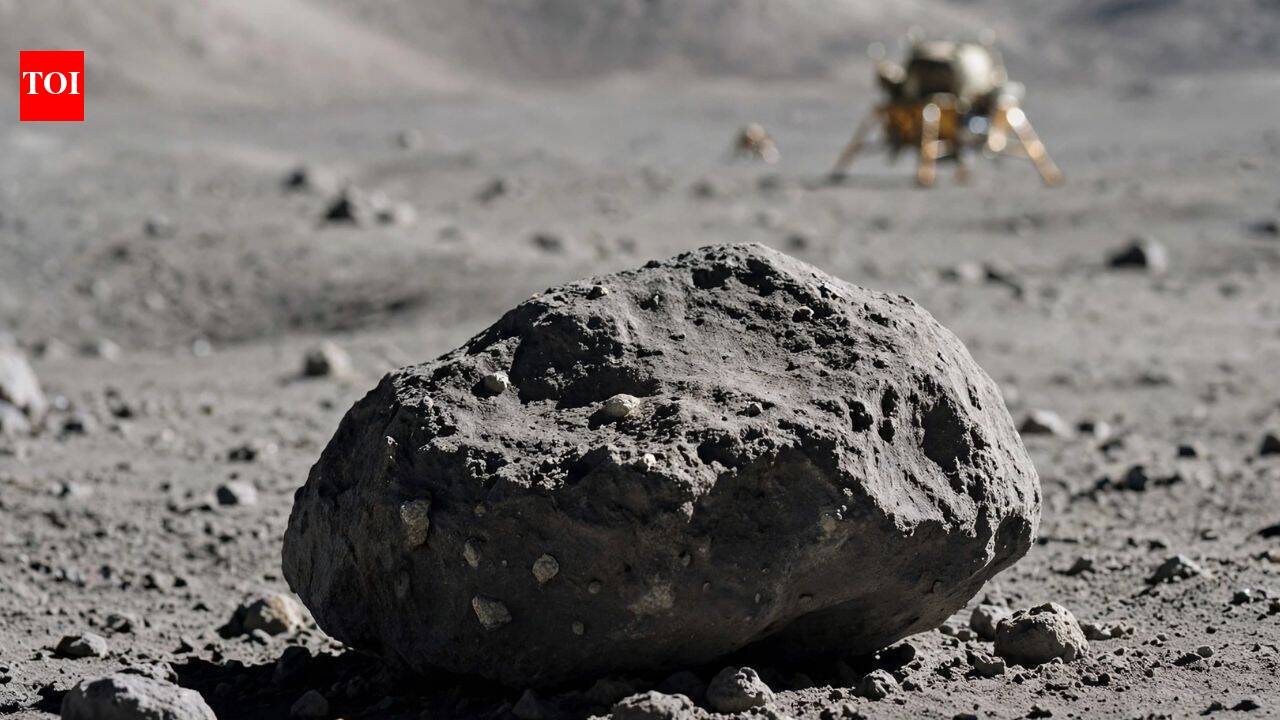
BEIJING — Planetary researchers examining lunar regolith retrieved from the far side of the Moon have identified an uncommon mineral fragment produced during the collision of a carbon-rich asteroid, according to reporting by the TOI Science Desk. The discovery, derived from samples brought to Earth by China's Chang'e-6 spacecraft, offers direct physical evidence that volatile-bearing impactors struck the Moon and deposited external material onto its ancient crust, potentially solving enduring questions regarding the delivery mechanisms of lunar water and prebiotic chemical precursors across the inner solar system.
Key facts
What happened
Laboratories analyzing regolith collected during China's historic lunar exploration drive isolated an atypical mineral fragment embedded in the loose dust. Microscopic and spectroscopic analyses revealed chemical and isotopic characteristics inconsistent with native lunar magmatic rocks. Instead, the fragment exhibited signatures typical of a high-energy impact involving a carbon-rich extraterrestrial body, such as a carbonaceous chondrite asteroid.
When asteroids collide with an airless planetary surface at cosmic velocities—often exceeding 15 to 20 kilometers per second—the immense kinetic energy generally vaporizes or melts both the projectile and the immediate target rock. However, under specific impact trajectories, deceleration profiles, and lower relative velocity regimes, shock pressures can preserve residual fragments or form distinctive impact-melt breccias that chemically fuse meteoritic material with native soil.
The research teams working on the Chang'e-6 cache identified mineralogical assemblages and carbonaceous markers within the sample that indicate the parent impactor was rich in carbon compounds and bound volatiles. By tracing the mineral composition of this rare clast, researchers reconstructed the presence of exogenous volatile elements, verifying that material from primitive, water-bearing solar system bodies not only collided with the Moon but successfully contributed mass to the local surface environment.
Why it matters
Understanding the exact provenance of lunar volatiles has direct implications for planetary science, the history of Earth's habitability, and future deep-space exploration. The traditional paradigm established during the Apollo era long regarded the Moon as entirely bone-dry, with initial laboratory assays suggesting volatile elements had boiled away during the violent giant impact that originally formed the Earth-Moon system roughly 4.5 billion years ago. Over the past two decades, orbital instruments and revised analytical techniques demonstrated that water ice persists in permanently shadowed polar craters, while trace hydroxyl molecules reside within volcanic glasses.
However, the origin of this water has remained fiercely debated between two leading hypotheses: delivery via primordial endogenous lunar degassing from the mantle, or external delivery by water-rich comets and carbonaceous asteroids during periods of heavy planetary bombardment. The physical detection of carbonaceous asteroid material in the Chang'e-6 soil provides tangible, observable verification for the external delivery model.
Beyond basic planetary science, the presence and distribution of asteroid-delivered hydration bearing minerals carry economic and logistical consequences for crewed space exploration. Both the United States, through NASA's Artemis program, and China, through the International Lunar Research Station initiative, intend to establish permanent surface bases reliant on in-situ resource utilization. If carbon-rich impactors regularly enriched lunar regolith with water, carbon, and other light elements across wide geographic areas—rather than merely within deep, frozen craters—future extraction infrastructure may access vital raw materials for life support and propellant manufacturing over a broader operational footprint than previously anticipated.
The background
China's lunar program, managed by the China National Space Administration, has followed a systematic, multi-decade trajectory of orbiters, landers, rovers, and sample return vehicles named after the mythological Chinese Moon goddess Chang'e. The Chang'e-6 mission launched aboard a Long March 5 heavy-lift rocket from the Wenchuan Satellite Launch Center on May 3, 2024. Its target was the southern portion of the Apollo crater, located within the colossal South Pole-Aitken (SPA) basin on the lunar far side.
The SPA basin is one of the largest and oldest recognized impact structures in the solar system, measuring roughly 2,500 kilometers across and plunging up to eight kilometers deep. Because the collision that excavated the SPA basin punched through the Moon's upper crust approximately 4.2 to 4.3 billion years ago, scientists consider its floor an unvarnished archive of the early solar system's impact history. Prior sample returns—including the 382 kilograms brought back by the American Apollo missions between 1969 and 1972, the 300-plus grams recovered by Soviet Luna robotic probes in the 1970s, and the 1,731 grams gathered by China's Chang'e-5 mission in 2020—were collected exclusively from the lunar near side.
The near side and far side exhibit striking geologic asymmetry. The near side is dominated by dark, basaltic volcanic plains known as maria, which smoothed over ancient impact scars. The far side possesses a substantially thicker crust, fewer basaltic lava floods, and an intensely cratered terrain that has preserved ancient material far more effectively. Chang'e-6 operated on the surface for approximately 48 hours using a robotic scoop and drill, successfully sealing 1,935.3 grams of subsurface cores and surface dust inside an ascent module. The return capsule landed safely beneath parachutes in the grasslands of Inner Mongolia on June 25, 2024.
Following standard quarantine and curation protocols at the National Astronomical Observatories of the Chinese Academy of Sciences in Beijing, small aliquots of the soil were distributed to designated research consortiums. The analysis of these samples has focused on determining the age of far-side volcanism, measuring mantle compositions, and identifying impact-shock metamorphism that differs fundamentally from near-side geology.
Reaction
The broader planetary science community has anticipated data from the Chang'e-6 samples since their retrieval, viewing them as essential calibration targets for orbital remote sensing datasets. While formal institutional statements on this specific discovery have circulated primarily through peer-reviewed academic channels and symposiums, researchers focused on impact dynamics and cosmochemistry have long emphasized the necessity of physical ground truth from the far side.
Specialists in meteorite science and asteroidal composition are expected to scrutinize the geochemical isotopic ratios of hydrogen, oxygen, and carbon in the recovered fragment. Such data will allow investigators to cross-reference the lunar find with data collected from carbonaceous asteroids by recent sample return missions, such as the Japan Aerospace Exploration Agency's Hayabusa2 mission to Ryugu and NASA's OSIRIS-REx mission to Bennu. Comparing the impact clast against unaltered samples from Ryugu and Bennu will help cosmochemists establish how much volatile mass is lost to space as vapor during hypervelocity impacts versus how much is captured by regolith silicates.
What we don't know yet
Critical gaps remain regarding the precise age, classification, and regional significance of the identified rock clast. First, scientists have yet to definitively date the impact event that created the fragment. Without radiometric isotopic dating, researchers cannot confirm whether the collision occurred during the Late Heavy Bombardment—a hypothesized spike in collisions roughly 3.9 billion years ago—or resulted from a much more recent, localized impact event.
Second, the exact classification of the parent carbonaceous chondrite remains unverified. Carbonaceous meteorites span multiple distinct chemical groups, including CI, CM, CR, and CV chondrites, which contain wildly divergent proportions of water, ranging from less than 2 percent to more than 10 percent by weight. Establishing the specific chondrite group is vital to estimating how much water the collision could have actually introduced to the local area.
Finally, it is not yet established whether the volatiles associated with this fragment migrated into adjacent soil matrices or remained entirely locked within the refractory shock-melt glass. If volatiles typically vaporize and escape into space during such collisions, asteroid impacts may serve as inefficient delivery mechanisms, leaving open the question of what proportion of polar ice deposits originated from asteroids rather than comets or volcanic outgassing.
What to watch
In the coming months, several concrete developments will clarify the broader implications of the Chang'e-6 asteroid clast:
This report is based on original reporting by the TOI Science Desk.
How this story was produced
This report was written by The Global Wire newsroom from reporting first published by TOI Science Desk. We verify the core facts against the original report, write our own account, and add the background and consequences a short wire item leaves out. Drafting is AI-assisted inside an editor-supervised pipeline, and every story is checked for accuracy of attribution, structure and duplication before it appears — full detail in our AI and funding disclosure.
Spotted an error? Tell us at corrections@horizonglobalnews.com and read our corrections policy or editorial standards.


Reader comments
Loading comments…