

Astronaut Photo Captures White Ash Cone at Tanzania's Unique 'Mountain of God' Volcano
An astronaut photograph highlights the distinct white summit of Ol Doinyo Lengai, a Tanzanian stratovolcano known for its unusually cool and fast-moving lava.
By The Global Wire Newsroom · Reported from Harry Baker
Link preview · horizonglobalnews.com
Astronaut Photo Captures White Ash Cone at Tanzania's Unique 'Mountain of God' Volcano
An astronaut photograph highlights the distinct white summit of Ol Doinyo Lengai, a Tanzanian stratovolcano known for its unusually cool and fast-moving lava.
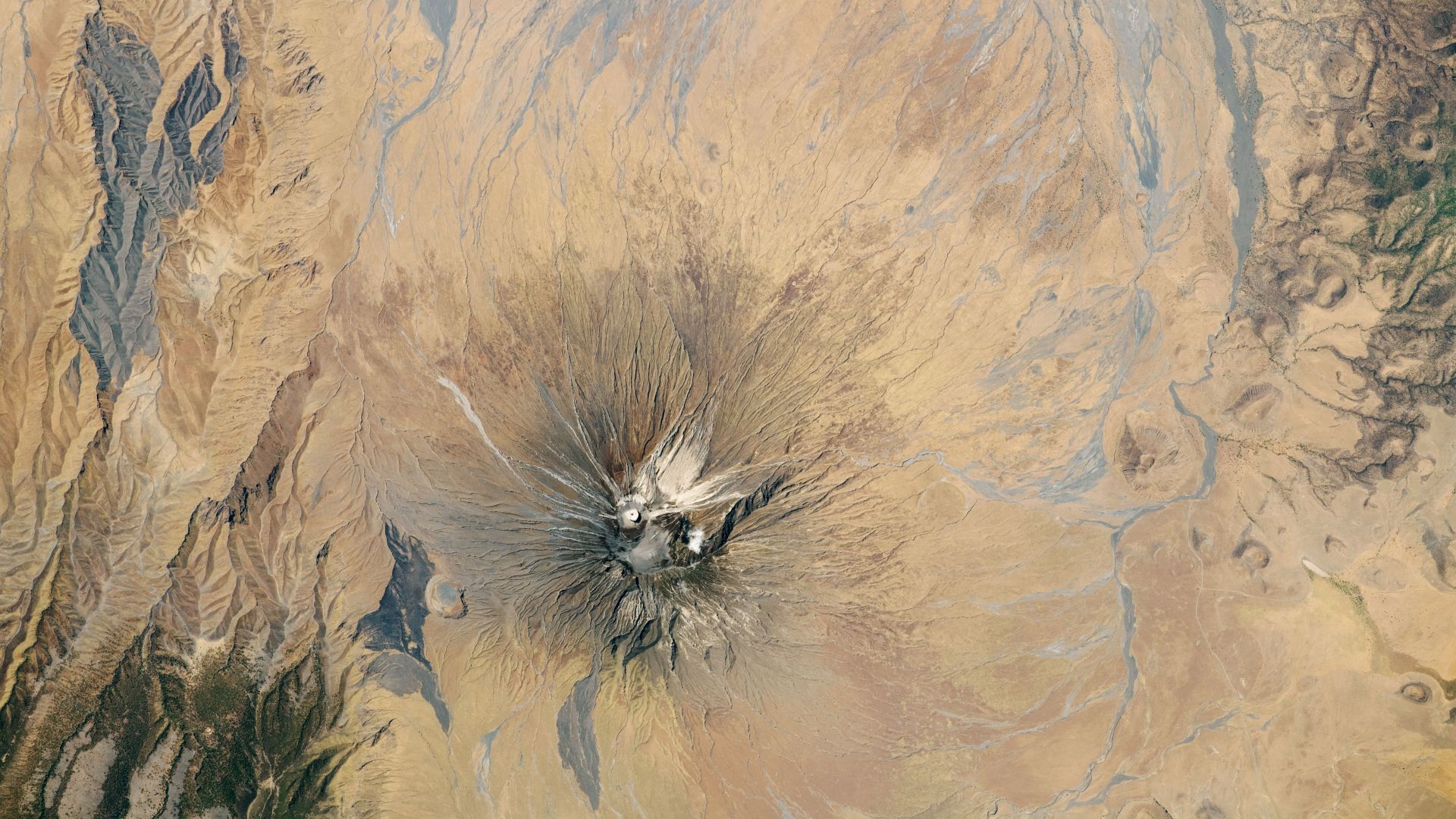
A high-altitude image captured by astronauts from space has offered a clear view of Ol Doinyo Lengai, an extraordinary active stratovolcano situated in northern Tanzania. Known locally as the "Mountain of God," the geological formation stands out globally due to its rare physical composition and eruptive behavior. According to reporting by Harry Baker, the photograph, taken in 2020, captures a bright white "ash cone" at the volcano's peak, highlighting the structural changes that define this unique peak.
Beyond its visual appearance from orbit, Ol Doinyo Lengai is renowned among earth scientists for producing a type of lava found nowhere else in active surface volcanism. The volcano's erupted material possesses an unusually low temperature compared to standard terrestrial lavas, yet it flows with exceptional speed across the landscape. The combination of thermal anomalies, extreme fluidity, and distinct summit features makes the mountain a critical subject of study in global volcanology.
Orbital Perspectives on Earth's Volcanic Features
The 2020 astronaut photograph showcases the distinct features of Ol Doinyo Lengai from a vantage point hundreds of kilometers above the Earth's surface. From orbit, the contrast between the volcano's dark surrounding terrain and its brightly colored summit region is pronounced. The bright white ash cone visible in the image is a direct consequence of the volcano's unique mineral output, which chemically alters rapidly upon contact with moisture in the atmosphere.
Space-based observation platforms, including handheld cameras operated by astronauts aboard orbital laboratories, regularly monitor remote features across the globe. These photographs provide researchers with valuable visual records of dynamic geological landscapes. In the case of Ol Doinyo Lengai, orbital imagery documents the ongoing accumulation of eruptive materials that alter the shape and appearance of the summit crater over time.
Low Temperatures and High Fluidity
The physical characteristics of the lava produced by Ol Doinyo Lengai set it apart from every other active volcano on Earth. As detailed in the reporting by Harry Baker, the volcano erupts a rare form of lava that is remarkably cool compared to common silicate lavas. Traditional molten rock, such as basalt found in Hawaii or Iceland, typically reaches temperatures well above 1,000 degrees Celsius upon eruption. In contrast, the lava extruded by Ol Doinyo Lengai erupts at substantially lower thermal thresholds.
Despite its low temperature, this rare lava demonstrates extremely low viscosity. Rather than moving as a thick, slow-creeping mass of molten rock, the fluid flows with remarkable speed across the terrain. Scientists recognize it as the fastest-flowing lava on the planet. The high degree of fluidity allows the material to travel rapidly down the volcano's steep slopes, creating thin, widespread flow fields rather than dense, built-up structures. Once exposed to air and atmospheric humidity, the dark, freshly erupted material rapidly undergoes chemical weathering, transforming into the powdery, bright white ash and mineral deposits that give the summit its distinctive light appearance.
Structural Architecture of Stratovolcanoes
Geologically, Ol Doinyo Lengai is classified as a stratovolcano, a cone-shaped mountain formed by successive layers of hardened lava, tephra, pumice, and volcanic ash. Stratovolcanoes are typically characterized by steep profile slopes and periodic explosive or effusive activity. Over long timeframes, alternating cycles of lava flows and explosive ash emissions build up the overall height and steep contour of the edifice.
The presence of the recently formed white ash cone inside or around the active summit crater illustrates the dynamic nature of stratovolcanic vents. Ash cones are constructed when gas-rich eruptions expel fine material high into the air, which then falls back around the vent to form a steep, symmetrical hill. At Ol Doinyo Lengai, the interaction between explosive ash generation and effusive liquid flows constantly reshapes the top of the volcanic mountain.
Monitoring Remote Volcanic Systems
Monitoring active volcanoes in remote regions of East Africa poses logistically challenging requirements for field researchers. In-situ instrumentation, such as tiltmeters, ground-based thermal cameras, and seismometers, requires continuous maintenance and power infrastructure. Consequently, satellite remote sensing and astronaut photography serve as vital complementary tools for tracking morphological shifts in isolated peaks.
Orbital imagery allows geologists to detect macroscopic changes at the crater site, including the growth of new cones, changes in crater floor elevation, and the distribution of fresh ash deposits. By comparing images taken across different years, researchers can assess patterns of activity and better understand the long-term behavior of rare volcanic systems without relying solely on ground expeditions.
Significance for Terrestrial and Planetary Geology
The study of Ol Doinyo Lengai extends beyond local hazard monitoring and contributes broader insights to the field of planetary science. Because the volcano generates lavas with physical properties vastly different from standard terrestrial volcanism, it offers a rare natural laboratory for examining unusual magmatic processes.
The low-temperature, highly fluid magmas seen at the Tanzanian peak provide geologists with an analogue for studying thermal fluid dynamics under extreme conditions. Furthermore, planetary scientists frequently look to unique terrestrial environments to interpret landforms observed on other worlds, where exotic volatile compositions and lower eruption temperatures may operate. Analyzing how these rare lavas flow, cool, and weather over time helps scientists refine models of surface evolution across different planetary environments.
This article contains reporting originally published by Harry Baker concerning orbital observations and volcanic characteristics of Ol Doinyo Lengai in Tanzania.
How this story was produced
This report was written by The Global Wire newsroom from reporting first published by Harry Baker. We verify the core facts against the original report, write our own account, and add the background and consequences a short wire item leaves out. Drafting is AI-assisted inside an editor-supervised pipeline, and every story is checked for accuracy of attribution, structure and duplication before it appears — full detail in our AI and funding disclosure.
Spotted an error? Tell us at corrections@horizonglobalnews.com and read our corrections policy or editorial standards.

Reader comments
Loading comments…