

US Envoys Present Revised Peace Proposals in Kyiv, Ukrainian Officials Say
American envoys brought updated proposals aimed at resolving the Russia-Ukraine conflict to Kyiv, with Ukrainian representatives describing the framework as more effective than earlier plans.
By The Global Wire Newsroom · Reported from news.rthk.hk
Link preview · horizonglobalnews.com
US Envoys Present Revised Peace Proposals in Kyiv, Ukrainian Officials Say
American envoys brought updated proposals aimed at resolving the Russia-Ukraine conflict to Kyiv, with Ukrainian representatives describing the framework as more effective than earlier plans.
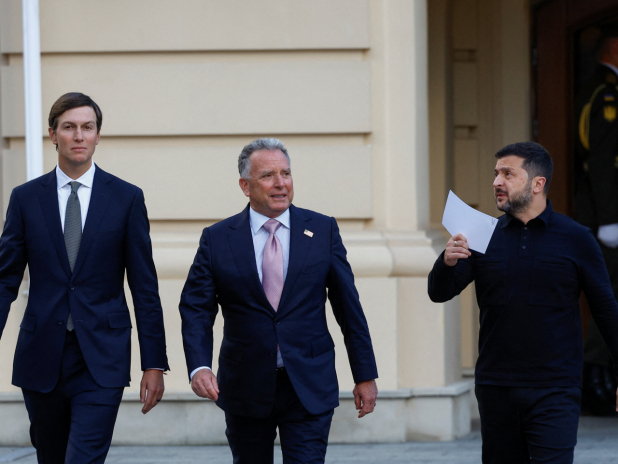
Kyiv received a new set of diplomatic proposals from American envoys aimed at negotiating an end to the war with Russia, Ukrainian officials signaled on September 6, 2026. Characterized by Ukrainian representatives as "more effective" than earlier diplomatic blueprints, the revised American framework comes during a critical juncture in the conflict. The arrival of the US diplomatic delegation in Kyiv highlights an ongoing effort by Washington to reshape the diplomatic architecture surrounding potential peace talks, as both sides contend with prolonged battlefield stagnation, shifting international support, and intense strategic pressure across Eastern Europe.
Key facts
What happened
American envoys arrived in Kyiv on September 6, 2026, delivering updated peace proposals directly to Ukrainian leadership. Ukrainian authorities acknowledged receipt of the documents, describing the updated American approach as offering more realistic and actionable pathways toward resolving the conflict than earlier proposals.
While specific line items of the revised proposals were not immediately made public in full detail, the consultations between American envoys and Ukrainian leadership focused on refining terms for eventual negotiations. Ukrainian officials indicated that the new suggestions addressed several longstanding friction points that had limited the utility of previous draft peace plans. Washington's diplomatic team conducted high-level meetings with key advisers in Kyiv, evaluating both battlefield realities and the political constraints facing Ukraine's government.
The delivery of these proposals marks a fresh attempt by the United States to align strategic objectives with Ukrainian officials before presenting any potential framework to broader international channels or mediator states. According to reporting by RTHK, Ukrainian stakeholders expressed openness to the revised recommendations, emphasizing that the new American framework provides a stronger foundation for safeguarding national sovereignty while creating viable diplomatic leverage.
Why it matters
The introduction of a revised American diplomatic proposal represents a potential shift in how Washington approaches the endgame of the Russia-Ukraine war. For Ukraine, securing an effective diplomatic framework backed by the United States is critical to ensuring that any future negotiations do not compromise its fundamental territorial integrity or national defense capabilities.
For global markets, particularly energy and commodity sectors, any tangible movement toward a diplomatic settlement carries significant implications. Prolonged conflict in Eastern Europe has disrupted Black Sea grain exports, destabilized European energy supplies, and forced Western governments to dedicate hundreds of billions of dollars to military and economic support packages. A credible peace process could help normalize global supply chains and reduce geopolitical risk premiums across international equity and debt markets.
Furthermore, the strategic posture of NATO and European partners depends heavily on the parameters established by Washington and Kyiv. European capitals have monitored US diplomatic maneuvers closely, recognizing that US military aid, intelligence sharing, and political backing remain the cornerstone of Ukraine's defense posture. If the new US proposals succeed in establishing a unified Western negotiating position, it could compel Moscow to re-evaluate its diplomatic calculus, though previous diplomatic efforts have struggled against Russia's maximalist war aims.
The background
The conflict between Russia and Ukraine escalated into a full-scale war in February 2022 when Russian forces launched a multi-axis invasion of Ukrainian territory. Prior to the full-scale invasion, the regional security landscape had been defined by the 2014 annexation of Crimea by Russia and the subsequent armed conflict in the Donbas region, which was nominally governed by the Minsk I and Minsk II agreements brokered in 2014 and 2015 by France and Germany under the Normandy Format.
Direct peace talks between Ukrainian and Russian delegations occurred in Belarus and Turkey during the early weeks of the 2022 invasion. However, those Istanbul consultations stalled by April 2022 following the discovery of widespread civilian atrocities in Bucha and other reoccupied areas, as well as fundamental disagreements regarding Ukrainian neutrality, security guarantees, and territorial control. Late in 2022, Ukrainian President Volodymyr Zelenskyy introduced a 10-point peace formula demanding the full withdrawal of Russian troops, the restoration of Ukraine's 1991 borders, nuclear safety, food security, and accountability for war crimes.
Conversely, Russian officials under President Vladimir Putin have repeatedly demanded that Ukraine acknowledge "new territorial realities"—referring to Moscow's claimed annexations of Donetsk, Luhansk, Zaporizhzhia, and Kherson oblasts in September 2022, alongside Crimea—and accept permanent demilitarization and non-alignment with NATO.
Throughout 2024, 2025, and into 2026, diplomatic momentum oscillated between international peace summits—such as the June 2024 summit held in Bürgenstock, Switzerland—and unilateral diplomatic initiatives. Washington's role as Ukraine's primary security benefactor has consistently made US diplomatic proposals the pivot point for broader Western strategy. The arrival of updated US proposals in September 2026 follows sustained bilateral efforts to bridge the gap between Kyiv's uncompromising requirement for sovereignty and realistic diplomatic mechanisms capable of ending hostilities.
Reaction
Following the announcement of the updated US proposals in Kyiv, official reactions reflected cautious optimism among Ukrainian stakeholders alongside sharp scrutiny from international observers. Ukrainian representatives highlighted the "more effective" nature of the new American draft, indicating a higher degree of synchronization between Washington and Kyiv than seen in previous rounds of diplomatic exchanges.
While detailed formal statements from the Kremlin were pending immediately following the Kyiv meetings, Russian officials have historically rejected peace proposals that do not recognize Russia's unilateral territorial claims or that involve ongoing Western integration for Ukraine. Russian diplomatic spokespeople in Moscow are expected to respond once official details are transmitted through diplomatic channels or presented in international forums such as the United Nations Security Council.
European Union leaders and NATO officials in Brussels are closely monitoring the developments. European capitals, including Berlin, Paris, and London, are expected to request detailed briefings on the content of the US proposals during upcoming ministerial meetings to ensure that allied policies on sanctions, military supply lines, and reconstruction guarantees remain tightly coordinated with the American strategy.
What we don't know yet
Despite the positive characterization by Ukrainian officials, critical details regarding the substance of the new US proposals remain undisclosed. It is currently unknown whether the revised American plan includes specific compromises on territorial control, timelines for potential ceasefires, or the exact mechanisms for long-term security guarantees.
Furthermore, the reporting by RTHK leaves unconfirmed whether these proposals have been shared with Russian negotiators, either directly or through backchannel intermediaries such as Turkey, Saudi Arabia, or Qatar. Another major unknown is whether the new proposal modifies Ukraine's aspirational path toward NATO membership or proposes alternative multilateral defense pacts. The degree of consensus among US lawmakers and key European allies regarding this updated framework also remains to be fully demonstrated in public forums.
What to watch
Key indicators in the coming weeks will determine whether the new US proposals can transition from a bilateral discussion in Kyiv into a functional diplomatic process:
This report is based on original reporting by RTHK.
How this story was produced
This report was written by The Global Wire newsroom from reporting first published by news.rthk.hk. We verify the core facts against the original report, write our own account, and add the background and consequences a short wire item leaves out. Drafting is AI-assisted inside an editor-supervised pipeline, and every story is checked for accuracy of attribution, structure and duplication before it appears — full detail in our AI and funding disclosure.
Spotted an error? Tell us at corrections@horizonglobalnews.com and read our corrections policy or editorial standards.




Reader comments
Loading comments…