

Senate Hearing Escalates as Moreno Questions Minnesota Attorney General Over Fraud Oversight
A Senate Homeland Security Committee oversight session turned tense as lawmakers pressed Minnesota Attorney General Keith Ellison over state enforcement practices.
By The Global Wire Newsroom · Reported from ET Online
Link preview · horizonglobalnews.com
Senate Hearing Escalates as Moreno Questions Minnesota Attorney General Over Fraud Oversight
A Senate Homeland Security Committee oversight session turned tense as lawmakers pressed Minnesota Attorney General Keith Ellison over state enforcement practices.
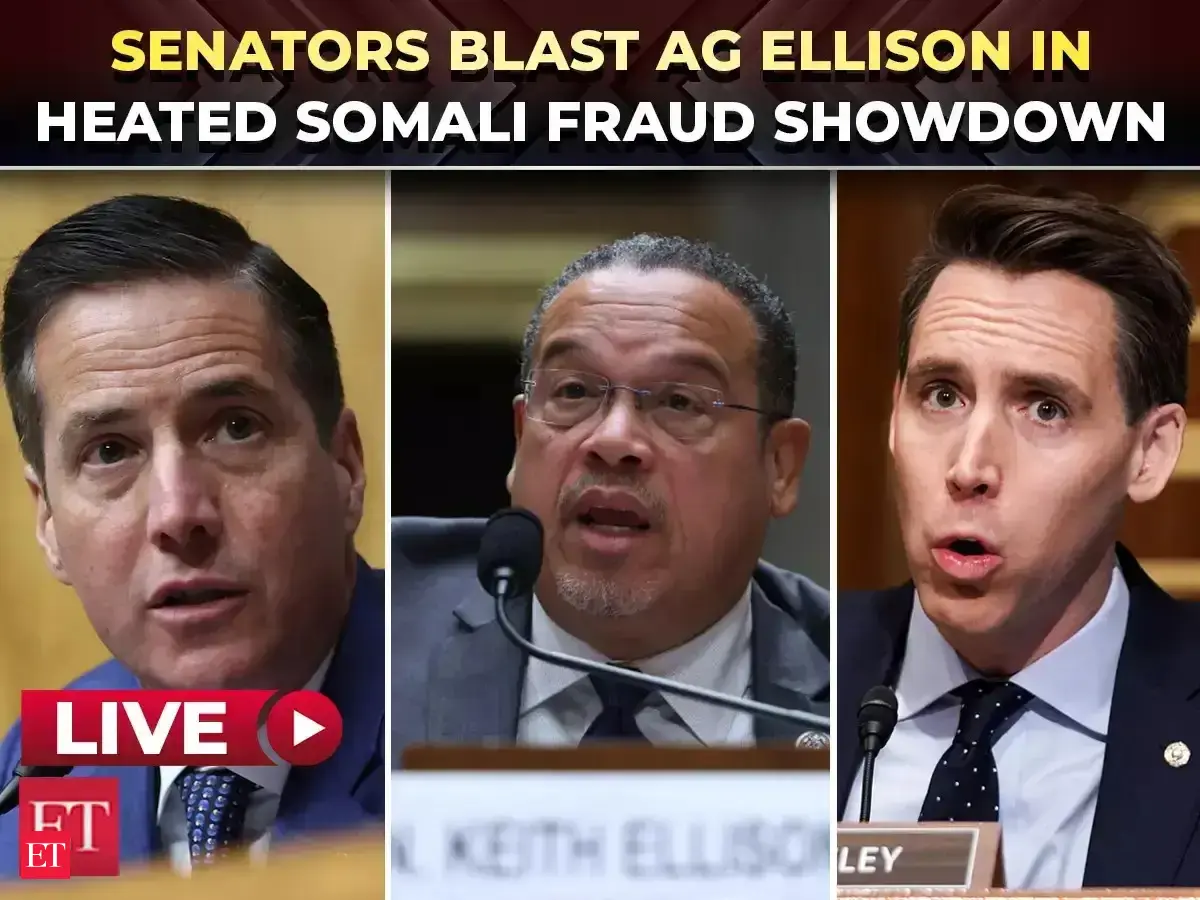
WASHINGTON — Tensions flared on Capitol Hill during a Senate Homeland Security Committee oversight hearing as lawmaker scrutiny turned toward state-level responses to large-scale financial crimes. Sen. Bernie Moreno, a Republican from Ohio, engaged in a sharp verbal confrontation with Minnesota Attorney General Keith Ellison, questioning the top legal officer’s record regarding a multi-billion-dollar fraud scheme. The exchange highlighted growing federal focus on how state law enforcement officials monitor, investigate, and prosecute complex financial fraud operations within their jurisdictions.
Clash at the Senate Homeland Security Committee
According to reporting by ET Online, the altercation occurred during a formal session of the Senate Homeland Security and Governmental Affairs Committee, which was conducting oversight into public sector accountability and the prevention of systemic fraud. During his questioning, Moreno directed critical inquiries at Ellison, pressing the attorney general on his office’s oversight mechanisms and alleging that insufficient regulatory enforcement had inadvertently aided perpetrators involved in an estimated $9 billion scam.
Ellison, who has served as Minnesota’s attorney general since 2019, defended his agency's performance and record before the panel. The confrontation underscored the heightened friction between federal lawmakers seeking accountability for large-scale financial malfeasance and state officials tasked with enforcing consumer protection and anti-fraud statutes on the ground.
Examining the $9 Billion Fraud Allegations
The debate centered on systemic vulnerabilities that allowed a massive fraud operation to extract funds, prompting federal lawmakers to question whether state authorities acted with sufficient urgency. While financial scams of this magnitude typically fall under joint federal and state jurisdiction, congressional oversight committees frequently examine local enforcement practices to determine if administrative delays or policy oversights contributed to institutional failures.
As detailed in reporting by ET Online, lawmakers on the committee examined the timelines and supervisory measures employed by state law enforcement agencies. Moreno’s questioning focused heavily on whether warning signs were overlooked or if regulatory enforcement was deferred, allowing fraudulent activities to expand.
In response, state officials appearing before congressional panels often point to jurisdictional boundaries, resource constraints, and ongoing active investigations that limit public disclosures. State attorney general offices typically balance civil enforcement actions alongside criminal referrals to federal prosecutors, a division of labor that frequently becomes a point of debate during congressional inquiries into financial regulatory systems.
The Role of State Attorneys General in Anti-Fraud Enforcement
State attorneys general occupy a unique position within the American legal framework, serving as chief legal officers responsible for enforcing consumer protection laws, investigating trade practice violations, and safeguarding public funds. When large-scale fraudulent networks emerge, state agencies are generally expected to deploy civil investigative demands, asset freezes, and legal injunctions to halt illicit operations before financial damage escalates.
However, high-profile financial fraud cases often present significant institutional challenges. Complex schemes frequently involve intricate networks of shell companies, falsified documentation, and cross-border transactions designed to evade regulatory detection. Federal lawmakers often argue that state legal departments must exercise proactive oversight to prevent public resources and federal program funds from being compromised.
When large sums are misappropriated, federal legislative bodies maintain statutory authority to conduct investigations into how state institutions administer oversight. The Senate Homeland Security Committee, in particular, exercises broad jurisdiction over government operations, national security, and the efficiency of public programs, making it a primary venue for examining systemic regulatory breakdowns.
Partisan Dynamics and Congressional Oversight
The confrontation between Moreno and Ellison also highlighted the political dimensions that frequently characterize high-profile congressional committee hearings. Oversight sessions involving state officials often serve as battlegrounds where federal lawmakers push for institutional reforms while scrutinizing the administrative records of state leaders from opposing political parties.
Congressional oversight serves as a key mechanism for legislative evaluation, allowing committees to assess whether existing federal statutes and grant programs provide adequate safeguards against fraudulent activity. During tense proceedings, lawmakers utilize public questioning to press for policy adjustments, demand internal records, and hold executive officers accountable for regulatory oversight.
Critics of aggressive congressional questioning often characterize such exchanges as partisan theater, arguing that federal oversight should prioritize structural solutions over public confrontations. Conversely, proponents argue that forceful questioning is necessary to expose institutional negligence and compel state agencies to adopt more rigorous anti-fraud measures.
Systemic Challenges in Financial Crime Oversight
The hearing brought renewed attention to the broader systemic issues surrounding the detection and prosecution of multi-billion-dollar fraud networks. Financial crimes involving public grants, regulatory loopholes, or widespread institutional deception often require extensive collaboration between local law enforcement, state auditors, and federal agencies such as the Department of Justice and the Federal Bureau of Investigation.
In many instances, regulatory agencies face criticism for delayed interventions, where fraudulent entities operate for extended periods before formal charges or civil remedies are pursued. Committee members emphasized that effective fraud prevention requires real-time data sharing, stringent compliance auditing, and swift enforcement action when irregularities are detected.
State enforcement agencies frequently contend that complex investigations require significant time to assemble admissible evidence without tipping off targets or compromising parallel federal inquiries. Nevertheless, congressional panels continue to push for greater transparency and speed in state-level enforcement actions.
Future Steps and Legislative Impact
Following tense oversight sessions, congressional committees typically compile testimony, request additional documentation from state regulatory bodies, and consider legislative remedies aimed at strengthening fraud prevention standards. The findings from committee hearings can influence federal funding conditions, leading to mandates that require state agencies to implement enhanced compliance monitoring systems.
The proceedings before the Senate Homeland Security Committee underscore an ongoing national dialogue regarding accountability, public trust, and the responsibilities of elected legal officials. As federal lawmakers continue their review, state enforcement agencies remain under pressure to demonstrate effective stewardship and decisive action against financial predators.
This report is based on original reporting conducted by ET Online.
How this story was produced
This report was written by The Global Wire newsroom from reporting first published by ET Online. We verify the core facts against the original report, write our own account, and add the background and consequences a short wire item leaves out. Drafting is AI-assisted inside an editor-supervised pipeline, and every story is checked for accuracy of attribution, structure and duplication before it appears — full detail in our AI and funding disclosure.
Spotted an error? Tell us at corrections@horizonglobalnews.com and read our corrections policy or editorial standards.



Reader comments
Loading comments…