

Polish Police Guard Top Court as Demonstrators Protest Leadership Dispute
Riot police deployed in Warsaw after hundreds rallied outside the Constitutional Tribunal demanding the reinstatement of the court's president.
By The Global Wire Newsroom · Reported from Pawel Florkiewicz; Justyna Pawlak
Link preview · horizonglobalnews.com
Polish Police Guard Top Court as Demonstrators Protest Leadership Dispute
Riot police deployed in Warsaw after hundreds rallied outside the Constitutional Tribunal demanding the reinstatement of the court's president.
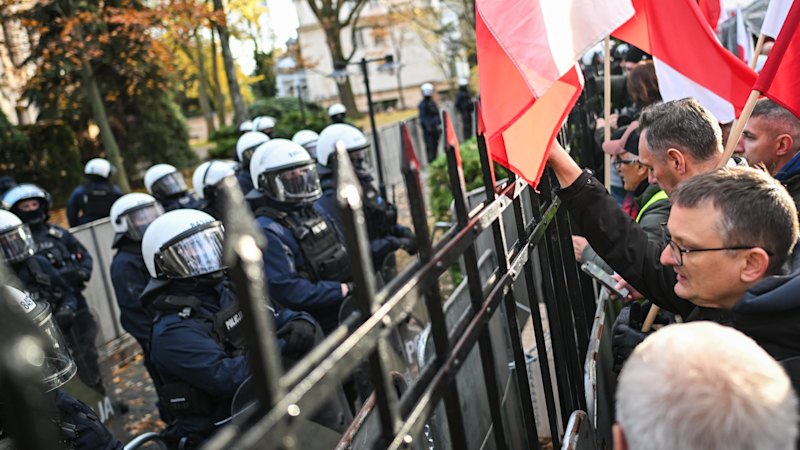
Polish riot police took up positions around the Constitutional Tribunal in Warsaw as hundreds of demonstrators gathered outside the building to demand the reinstatement of the court's president, drawing a public pledge of government support from the country's prime minister amid an entrenched institutional crisis. Security units established perimeters around the courthouse compound on a Friday afternoon following the assembly of several hundred protesters, marking the latest confrontation in a protracted battle over the leadership, independence, and composition of the country's highest judicial bodies.
Key facts
What happened
According to reporting by journalists Pawel Florkiewicz and Justyna Pawlak, riot police were mobilized to secure the grounds of Poland's Constitutional Tribunal on Friday afternoon as crowds of demonstrators converged on the site. Protesters, numbering in the hundreds, rallied directly outside the court's perimeter to vocalize support for the court's president and insist upon their formal reinstatement to the helm of the tribunal.
As the crowds gathered, security personnel deployed barricades and formed protective cordons to prevent unauthorized entry into the judicial complex. Against the backdrop of the street demonstrations and the police deployment, Poland's prime minister publicly reaffirmed the executive branch's commitment to supporting the tribunal apparatus as authorities navigate the acute institutional standoff, Florkiewicz and Pawlak reported.
The demonstration developed without immediate reports of large-scale violence, but the physical presence of riot squads around the country's preeminent constitutional arbiter underscored the severity of the operational impasse. The confrontation centers on contested authority within the tribunal, where internal leadership rivalries, disputed appointments, and executive-level interventions have generated competing claims over who legally directs court proceedings.
Why it matters
The physical confrontation outside the Constitutional Tribunal carries significant operational and legal consequences for Poland, the European Union, and international commercial entities operating within Central Europe. The Constitutional Tribunal is tasked under the Polish Constitution of 1997 with ruling on the compliance of statutes with the basic law, adjudicating competence disputes between central state organs, and assessing the constitutionality of international treaties. When the administrative leadership and judicial legitimacy of such an institution become immobilized or fractured into rival factions, legal certainty across the national economy is fundamentally compromised.
For citizens and commercial entities, the institutional paralysis threatens the finality of judicial rulings. Legal challenges concerning corporate tax regulations, property rights, media laws, and state regulatory powers routinely reach the tribunal. If rulings issued by the body are dismissed as legally void by government ministries or rejected by lower common courts, individuals and companies face an environment of double legal standards where compliance with one authority risks penalization by another.
Furthermore, the dispute directly touches upon Poland's standing within the European single market and its compliance with European Union treaty obligations. Poland's access to billions of euros in European post-pandemic recovery grants and cohesion funds has previously been conditioned on compliance with the rule of law and the restoration of judicial independence under Article 19 of the Treaty on European Union. While the European Commission unblocked roughly 137 billion euros in funding for Warsaw in early 2024 following initial policy commitments by the pro-EU government, continued street turbulence, unresolved leadership claims, and defiance between the judiciary and executive threaten to complicate ongoing oversight from Brussels.
The background
The confrontation outside the Warsaw courthouse is rooted in a nearly decade-long dispute over the Polish judiciary that began in late 2015. Following the electoral victory of the national-conservative Law and Justice (PiS) party, the Polish parliament passed a series of legislative amendments altering the appointment procedures and internal operations of the Constitutional Tribunal. The government moved to invalidate appointments made by the outgoing parliament and installed new judges, often referred to by critics and international courts as irregular or "duplicate" appointees.
Julia Przyłębska was appointed president of the Constitutional Tribunal in December 2016 under procedures that domestic legal associations, opposition parties, and the European Court of Human Rights repeatedly challenged. Over the ensuing years, the tribunal issued a succession of landmark and highly polarizing judgments, including a 2020 ruling that severely restricted abortion access and an October 2021 ruling asserting the primacy of the Polish constitution over certain provisions of European Union law. The 2021 verdict led the European Commission to launch formal infringement proceedings against Poland, arguing that the tribunal failed to satisfy the requirements of an independent and impartial tribunal established by law.
Internal fragmentation within the tribunal deepened significantly in early 2023, when several sitting judges within the 15-member chamber publicly argued that Przyłębska’s six-year term as court president had legally expired in December 2022 under statutory term-limit rules enacted in 2016. Przyłębska and her allies, backed by then-governing PiS officials, rejected that interpretation, arguing that the term limits did not apply retroactively to her appointment and that she was entitled to serve as president until the end of her overall judicial tenure.
The political landscape shifted decisively following the October 2023 parliamentary elections, which brought a pro-European coalition led by Donald Tusk to power. Tusk’s administration, working closely with Justice Minister Adam Bodnar, embarked on a sweeping program to reverse the previous government's judicial changes. In March 2024, the lower house of parliament, the Sejm, adopted a resolution declaring that the appointments of several tribunal judges were legally invalid and asserting that the court had ceased to function as an independent constitutional body. The executive branch subsequently ceased publishing certain tribunal rulings in the official journal (Dziennik Ustaw) and initiated legislative work on comprehensive judicial reform packages. These measures met sustained resistance from conservative lawmakers, sitting tribunal members, and President Andrzej Duda, who retains veto power over ordinary legislation until his term concludes in mid-2025.
Reaction
The deployment of security personnel and the protest at the tribunal brought immediate domestic political scrutiny. Conservative opposition figures and allied legal advocacy groups have consistently maintained that executive attempts to challenge or bypass the tribunal's seated leadership constitute an unlawful infringement on judicial independence and a violation of the constitutional separation of powers. Groups organizing demonstrations in support of the tribunal's leadership have framed their presence as a defense of the constitutional order against executive overreach.
Conversely, figures aligned with the governing coalition and civil society watchdog organizations, such as the Stefan Batory Foundation and the Helsinki Foundation for Human Rights, have repeatedly argued that normalizing irregular appointments damages the rule of law. While official statements directly addressing the specifics of Friday's security measures were limited, representatives of the executive branch have framed their ongoing actions as necessary administrative steps to stabilize the judicial architecture and bring Poland back into total compliance with European judicial norms.
In international circles, European Union officials and monitor groups from the Council of Europe have refrained from intervening in street demonstrations while consistently reiterating that all member states must adhere to judgments issued by the Court of Justice of the European Union (CJEU) regarding the independence of national apex courts.
What we don't know yet
The reporting provided leaves several critical administrative and operational details unresolved. It remains unverified what specific administrative mechanism or institutional order triggered the demand for the tribunal president's reinstatement, or whether the dispute centers on internal court registry actions, an executive refusal to recognize administrative authority, or direct regulatory exclusion.
Additionally, the wire accounts do not state which civil or political organizations formally registered and mobilized the several hundred protesters outside the Warsaw courthouse, nor whether the crowd was comprised primarily of partisan activists, trade unionists, or independent judicial supporters. It is also unclear whether the riot police deployment was executed purely at the request of court security or mandated independently by the Warsaw Metropolitan Police Command under public order statutes.
Finally, the exact wording and legal mechanism of the prime minister’s pledge of support remain unspecified. The extent to which that backing involves physical perimeter security, administrative restructuring, or upcoming legislative maneuvers remains an open question that carries distinct implications for how the standoff will resolve.
What to watch
The development of this dispute will depend on several concrete administrative, legislative, and judicial milestones in the days and weeks ahead:
This article includes reporting originally gathered and published by Pawel Florkiewicz and Justyna Pawlak.
How this story was produced
This report was written by The Global Wire newsroom from reporting first published by Pawel Florkiewicz; Justyna Pawlak. We verify the core facts against the original report, write our own account, and add the background and consequences a short wire item leaves out. Drafting is AI-assisted inside an editor-supervised pipeline, and every story is checked for accuracy of attribution, structure and duplication before it appears — full detail in our AI and funding disclosure.
Spotted an error? Tell us at corrections@horizonglobalnews.com and read our corrections policy or editorial standards.




Reader comments
Loading comments…