

Knights Hooker Phoenix Crossland Faces Grand Final Ban After Direct NRL Judiciary Referral
Phoenix Crossland was sent off in Newcastle's preliminary final for a hip-drop tackle on Penrith's Nathan Cleary, leaving him facing an almost certain suspension from Sunday's grand final.
By The Global Wire Newsroom · Reported from Chris Barrett
Link preview · horizonglobalnews.com
Knights Hooker Phoenix Crossland Faces Grand Final Ban After Direct NRL Judiciary Referral
Phoenix Crossland was sent off in Newcastle's preliminary final for a hip-drop tackle on Penrith's Nathan Cleary, leaving him facing an almost certain suspension from Sunday's grand final.
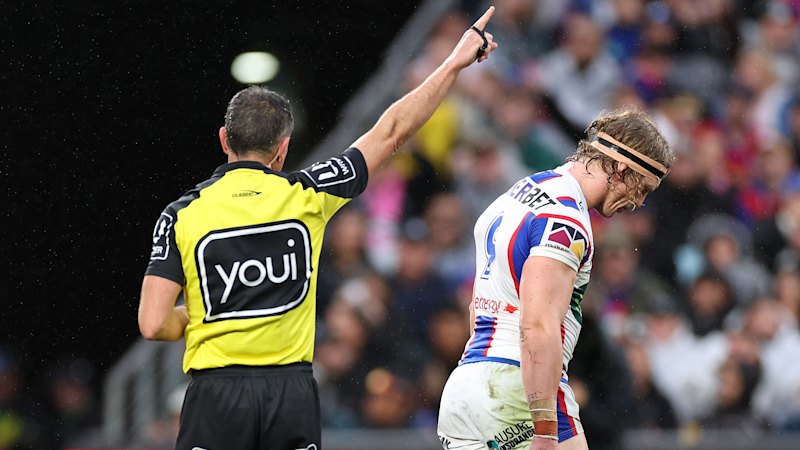
Newcastle Knights hooker Phoenix Crossland faces almost certain exclusion from Sunday’s National Rugby League grand final after being referred directly to the NRL Judiciary following a send-off for a hip-drop tackle on Penrith Panthers co-captain Nathan Cleary during their preliminary final match. The decision by the league’s Match Review Committee to bypass standard grading categories leaves the 26-year-old hooker facing a multi-match ban, putting his participation in the season-ending premiership decider in severe jeopardy. According to reporting by journalist Chris Barrett, the direct referral reflects the severity with which league administrators view dangerous contact involving lower-limb mechanics, particularly during high-profile postseason fixtures.
Key facts
What happened
The incident occurred during a critical juncture of the preliminary final clash between Newcastle and Penrith. As Penrith playmaker Nathan Cleary attempted to distribute the ball, Phoenix Crossland engaged in a tackle from behind, wrapping his arms around Cleary's upper body before dropping his full body weight onto the back of Cleary's legs. Match officials halted play immediately, issuing a red-card send-off that forced Newcastle to complete the match with 13 players on the roster and one fewer on the field.
Following the match, the NRL Match Review Committee reviewed broadcast footage and referee reports before issuing its charge sheet. Rather than assigning a standard Grade 1, Grade 2, or Grade 3 dangerous contact charge—which carry prescribed monetary fines or set suspension weeks with early plea reductions—the review coordinator referred the tackle directly to the NRL Judiciary tribunal. According to reporting by Chris Barrett, this procedural choice indicates that the review panel judged the tackle to carry a high degree of risk and potential for serious injury, placing the matter entirely in the hands of the three-person judiciary panel without a ceiling on potential suspension length.
The referral forces Newcastle’s legal team and football department into an urgent legal preparation phase early in grand final week. Without the ability to accept a reduced sentence via an early guilty plea, Crossland must either contest the charge altogether or present mitigating circumstances in an effort to secure a sentence lenient enough to permit his participation on Sunday—an outcome considered highly unlikely by sports legal experts given tribunal precedents.
Why it matters
The direct referral carries major ramifications for both the Newcastle Knights' grand final preparation and the broader landscape of rugby league officiating. From a tactical standpoint, losing Crossland deprives Newcastle of their primary dummy-half and defensive organizer around the ruck. Crossland has played a pivotal role in Newcastle’s spine throughout the campaign, providing service to key playmakers and executing high-volume tackle counts in central defense. Replacing him for the most critical game of the year forces the coaching staff to reshuffle their starting team and bench composition on short notice, potentially thrusting backup utilities or cup-level players into high-pressure roles.
For the NRL, the swift send-off and subsequent direct referral reinforce the governing body’s uncompromising stance on tackling mechanics that place players at risk of structural leg injuries. The league has spent several seasons attempting to eradicate the hip-drop technique due to its strong correlation with syndesmosis ankle sprains, fibula fractures, and knee ligament tears. By enforcing a send-off in a preliminary final and bypassing standard charge tiers, the judiciary framework sends an unequivocal message to clubs, coaches, and players that safety standards remain absolute regardless of the stage of the season or the stature of the upcoming match.
Furthermore, the decision highlights the immense stakes surrounding player conduct during finals football. Missing a grand final through suspension represents one of the most severe personal penalties a professional rugby league player can experience, altering career trajectories and club statistics in a single incident.
The background
The "hip-drop" tackle entered the broader rugby league lexicon during the late 2010s, describing a tackling technique where a defender grabs a ball carrier from behind or the side, swivels their hips, and drops their entire body weight directly onto the exposed lower legs of the opponent. The mechanical hazard stems from trapping the ball carrier's feet under the defender's hips while the torso continues forward momentum, generating severe rotational and compressive forces on the ankle and knee joints.
In response to a rising frequency of severe lower-body injuries identified by medical staff and club doctors, the Australian Rugby League Commission (ARLC) and NRL management issued formal directives to referees and the Match Review Committee in 2020 to strictly penalize hip-drop tackles. Initial enforcement relied on minor dangerous contact charges, but persistent use of the tackle led to escalating sanctions, including on-field sin-bins, red-card send-offs, and multi-week judiciary suspensions.
Under standard NRL Judiciary regulations, most dangerous contact infractions fall into Grade 1, Grade 2, or Grade 3 categories. Grade 1 charges typically incur monetary fines or a single-week suspension, while Grade 3 charges carry base penalties of three to four weeks. However, under NRL Rule 51, the Match Review Committee reserves the authority to issue a direct referral for incidents deemed excessively dangerous, highly reckless, or involving extreme force. A direct referral removes the prescheduled penalty point matrix, requiring the judiciary panel—typically chaired by a legal judge alongside former professional players—to determine an appropriate ban length after hearing evidence from both league prosecutors and club defense counsel.
Direct referrals during finals series are rare in modern NRL history. Historical precedent regarding grand final suspensions includes notable cases such as Melbourne Storm captain Cameron Smith missing the 2008 Grand Final following a tackle charge, and South Sydney Rabbitohs hooker Issac Luke missing the 2014 decider due to a dangerous throw suspension. These precedent-setting cases demonstrated that tribunal panels strictly enforce judiciary rules regardless of whether a player faces missing a championship decider.
Reaction
Following the match review decision reported by Chris Barrett, reaction across the rugby league community focused on the severity of the sanction and its tactical implications. Newcastle Knights officials have expressed deep disappointment over the prospect of losing their starting hooker for the championship decider, with club representatives expected to review video footage alongside legal counsel to construct their defense strategy.
Penrith Panthers personnel expressed concern for Nathan Cleary's physical condition while acknowledging the referee's on-field ruling. While Penrith team management avoided commenting directly on potential judiciary sentences to adhere to NRL media guidelines, medical personnel immediately focused on assessing Cleary for lower-limb joint damage resulting from the contact.
Commentators and former players expressed divided opinions on social media and sports broadcasts regarding the on-field send-off. While consensus supported the classification of the tackle as a dangerous hip-drop, debates emerged over whether an immediate red card during a preliminary final was disproportionate compared to a ten-minute sin-bin. However, refereeing advocates defended the call, asserting that high-risk tackle mechanics must face immediate and rigorous enforcement to protect player welfare regardless of match context.
What we don't know yet
Several critical details remain unresolved as grand final week begins:
What to watch
In the coming days, several key milestones will clarify the outcome of the incident and its impact on the NRL Grand Final:
Reporting on the judiciary referral, tackle incident, and potential grand final suspension for Phoenix Crossland was originally published by sports journalist Chris Barrett.
How this story was produced
This report was written by The Global Wire newsroom from reporting first published by Chris Barrett. We verify the core facts against the original report, write our own account, and add the background and consequences a short wire item leaves out. Drafting is AI-assisted inside an editor-supervised pipeline, and every story is checked for accuracy of attribution, structure and duplication before it appears — full detail in our AI and funding disclosure.
Spotted an error? Tell us at corrections@horizonglobalnews.com and read our corrections policy or editorial standards.




Reader comments
Loading comments…