

Jeffries Outlines Democratic Campaign Strategy to Flip Trump Districts and Reclaim House Majority
House Democratic Leader Hakeem Jeffries declared his party is on track to retake the chamber by replicating the wide-ranging 2018 midterm wave across battleground districts.
By The Global Wire Newsroom · Reported from ABC News
Link preview · horizonglobalnews.com
Jeffries Outlines Democratic Campaign Strategy to Flip Trump Districts and Reclaim House Majority
House Democratic Leader Hakeem Jeffries declared his party is on track to retake the chamber by replicating the wide-ranging 2018 midterm wave across battleground districts.
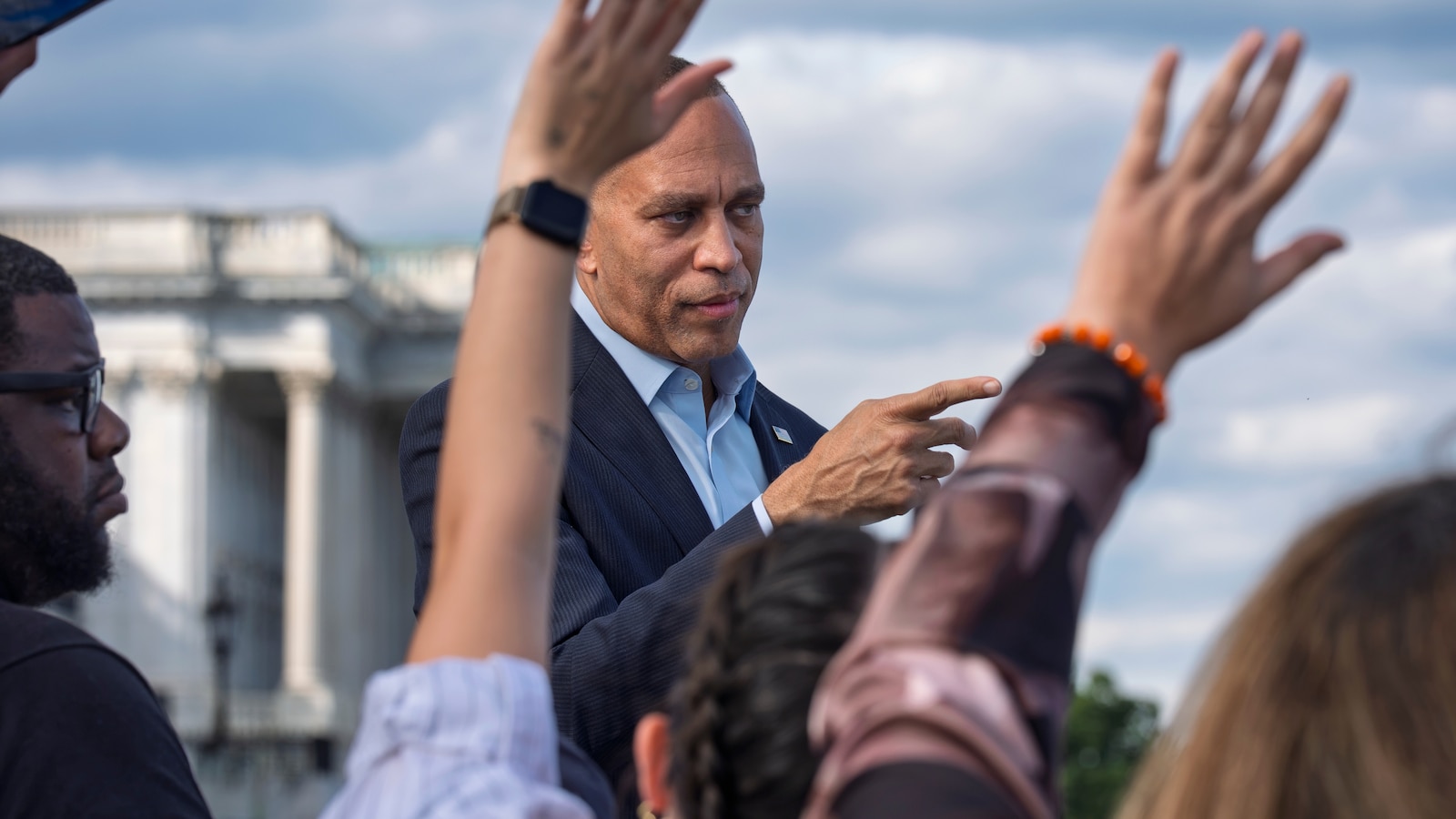
House Democratic Leader Hakeem Jeffries declared that his party is positioned to regain the majority in the United States House of Representatives by expanding its campaign footprint into competitive congressional districts won by Donald Trump. Speaking on the strategy driving Democratic campaign efforts, Jeffries indicated that party organizers are actively working to flip Republican-held seats in swing territory, modeling their outreach on the midterm election of 2018. During that cycle, a surge in opposition turnout swept Democrats into power with a net gain of 40 seats. The current effort targets crossover districts where voters have previously backed Trump for president while electing moderate or suburban Republicans to Congress, reflecting a calculated attempt to leverage thin legislative margins to secure the 218 seats required for control.
Key facts
What happened
In a series of campaign briefings, House Democratic Leader Hakeem Jeffries outlined an aggressive expansion of the party's electoral map, aiming to defeat vulnerable Republican incumbents in competitive suburban and rural districts across the country. According to reporting by ABC News, Jeffries emphasized that Democrats are actively pursuing victories in districts that supported Donald Trump, arguing that voter dissatisfaction with congressional governance and federal policy initiatives creates an environment comparable to the 2018 midterm wave.
The Democratic Congressional Campaign Committee (DCCC) has directed resources toward a dual-track effort: protecting vulnerable Democratic incumbents in swing districts while financing aggressive challenges against Republicans in split-ticket territories. Party strategists are targeting suburban communities in states such as New York, California, Pennsylvania, Michigan, and Virginia, where moderate voters have previously demonstrated a willingness to split their ballots or defect from the Republican line.
Jeffries framed the midterm strategy as a direct continuation of the grassroots coalition that enabled Democrats to pick up 40 seats eight years earlier. Campaign operations are prioritizing voter registration, early mail-in ballot mobilization, and targeted advertising focused on healthcare costs, reproductive rights, and economic stability. By focusing on districts where Trump's presidential margins were narrow or where suburban demographics have shifted, Democratic leadership aims to chip away at the narrow Republican majority seat by seat.
Republicans, operating through the National Republican Congressional Committee (NRCC), have responded by bolstering defensive operations in suburban enclaves while seeking to expand their own targets into working-class Democratic districts. The competing campaign committees have directed tens of millions of dollars into television, digital, and ground-level field operations, turning dozens of individual district contests into multi-million-dollar nationalized battlegrounds.
Why it matters
Control of the House of Representatives carries immediate and profound consequences for federal governance, fiscal policy, and legislative oversight. The party holding the majority determines the legislative agenda, controls all committee chairmanships, holds subpoena power for congressional investigations, and manages the federal budget process through the origination of revenue bills required by the U.S. Constitution.
In a hyper-polarized political environment, even a single-seat majority grants the Speaker of the House immense power over which bills reach the floor for a vote. If Democrats succeed in flipping the necessary seats to capture the 218-seat threshold, they will acquire the authority to block executive branch legislative priorities, initiate oversight hearings into federal agencies, and dictate the terms of statutory spending caps and debt ceiling negotiations. Conversely, failure to regain the chamber would solidify Republican control over federal policy-making and legislative scheduling.
For financial markets and corporate sectors, legislative control in Washington directly impacts tax regulatory frameworks, energy subsidies, healthcare reimbursement rules, and international trade oversight. A divided federal government—with one party holding the executive branch and another controlling the House—typically leads to fiscal standoffs, potential government shutdown threats, and prolonged negotiations over annual appropriations bills.
Furthermore, the outcome of House contests serves as a primary barometer of national political sentiment. The performance of candidate platforms in crossover districts provides empirical data on how independent and suburban voters assess current economic conditions, governance strategies, and national leadership.
The background
The dynamics governing U.S. midterm elections are deeply rooted in political history and electoral geography. Under Article I of the U.S. Constitution, all 435 members of the House of Representatives face election every two years. Historically, midterm elections function as a referendum on the sitting president and the governing party in Washington. Since the Civil War, the president's party has lost House seats in almost every midterm contest, with rare exceptions occurring only during moments of national crisis or extraordinary economic expansion, such as 1998 and 2002.
The reference point cited by Jeffries—the 2018 midterm election—stands as one of the most significant electoral shifts in recent American political history. In November 2018, during Donald Trump's first term in office, voter turnout reached historic highs for a midterm cycle. Democrats gained a net of 40 House seats, fueled by substantial swings in suburban congressional districts surrounding major metropolitan areas like Atlanta, Philadelphia, Chicago, Dallas, and Orange County, California. That election marked a major structural realignment, as college-educated suburban voters who had traditionally leaned Republican shifted toward Democratic candidates.
Following the 2020 census, state legislatures and independent commissions re-drew congressional district boundaries during the national redistricting process. This redistricting cycle created a map featuring fewer competitive "swing" districts and an increased number of safely partisan seats. Consequently, the battle for House control has concentrated on a small fraction of the 435 districts—roughly 30 to 40 highly competitive seats nationwide.
Hakeem Jeffries assumed the leadership of the House Democratic Caucus in January 2023 following the stepping down of long-time Speaker Nancy Pelosi from Democratic leadership. As the first Black lawmaker to lead a major political party caucus in either chamber of Congress, Jeffries has focused on maintaining party unity across progressive and moderate factions while building candidate recruitment pipelines tailored specifically to split-ticket and suburban districts.
Reaction
Following Jeffries' public assessment of the campaign map, national political strategists and party officials offered divergent evaluations of the electoral terrain. Republican leadership and the NRCC dismissed the Democratic projections as overly optimistic, pointing to their own internal polling and messaging focused on inflation, border security, and crime. Republican spokespersons argued that voters in Trump-leaning districts remain aligned with conservative policy priorities and will reject Democratic candidates aligned with national party leadership.
Independent political analysts and non-partisan handicappers, such as the Cook Political Report, Sabato's Crystal Ball at the University of Virginia Center for Politics, and Inside Elections, maintain that control of the House remains a close contest. Analysts note that while the historical precedent of midterm headwinds favors the out-of-power party, structural gerrymandering and candidate quality in individual districts will play a decisive role in determining the final seat tally.
Within the Democratic coalition, moderate members representing swing districts have emphasized the need to focus campaign messaging on localized economic concerns, infrastructure investment, and pragmatic governance. Conversely, progressive leaders have urged the party to maintain robust mobilization efforts around civil rights, environmental protection, and social safety net programs to ensure high turnout among young voters and minority communities.
What we don't know yet
Several critical variables remain unresolved as the midterm campaign unfolds:
What to watch
In assessing whether Democrats can execute their strategy to flip Trump districts, several specific indicators and milestones warrant close monitoring:
This report contains information originally reported by ABC News.
How this story was produced
This report was written by The Global Wire newsroom from reporting first published by ABC News. We verify the core facts against the original report, write our own account, and add the background and consequences a short wire item leaves out. Drafting is AI-assisted inside an editor-supervised pipeline, and every story is checked for accuracy of attribution, structure and duplication before it appears — full detail in our AI and funding disclosure.
Spotted an error? Tell us at corrections@horizonglobalnews.com and read our corrections policy or editorial standards.



Reader comments
Loading comments…