

Indonesian Conservationists Rescue Orangutan Mother and Infant From Borneo Wildfire Haze
Indonesian wildlife authorities have rescued a mother orangutan and her baby from dense wildfire smoke on the island of Borneo as seasonal land-clearing fires threaten endangered wildlife.
By The Global Wire Newsroom · Reported from thestar.com.my
Link preview · horizonglobalnews.com
Indonesian Conservationists Rescue Orangutan Mother and Infant From Borneo Wildfire Haze
Indonesian wildlife authorities have rescued a mother orangutan and her baby from dense wildfire smoke on the island of Borneo as seasonal land-clearing fires threaten endangered wildlife.
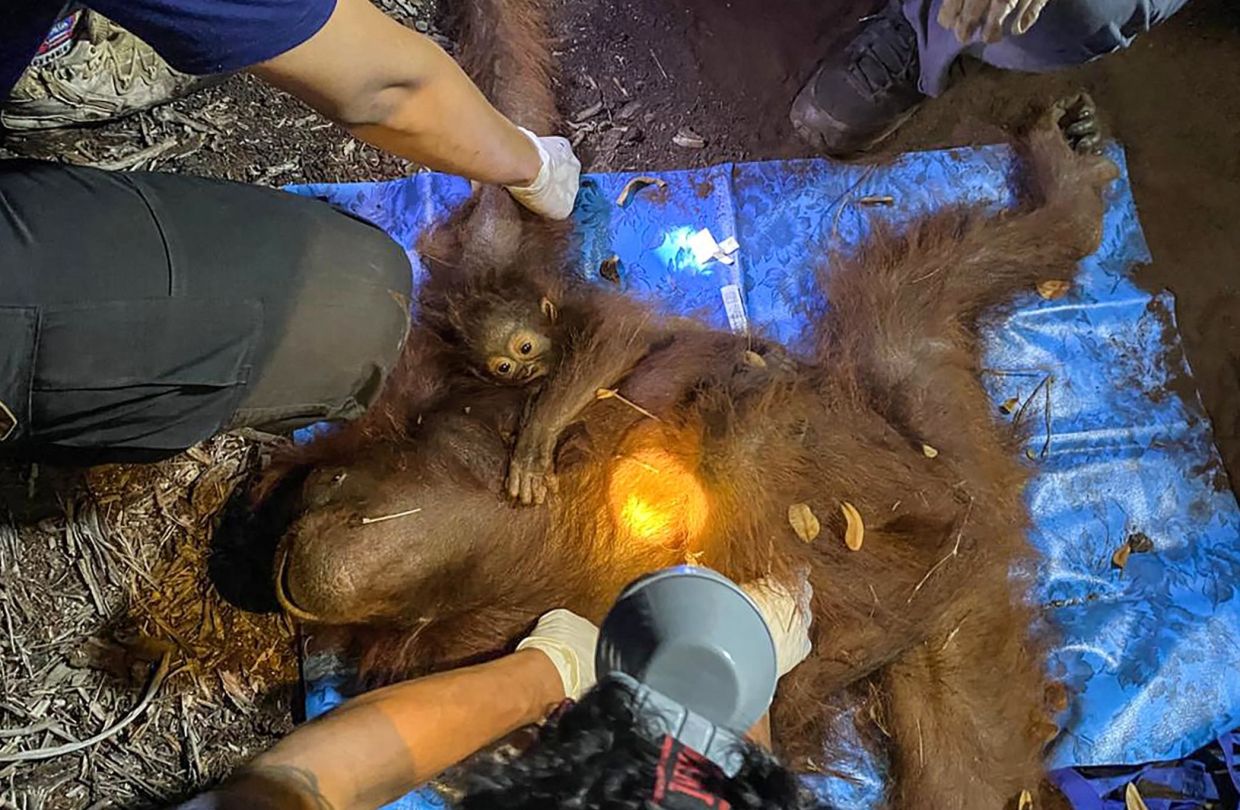
Indonesian wildlife authorities executed an emergency rescue operation on the island of Borneo on Sept. 3, 2026, successfully extracting a mother orangutan and her young baby from a forest habitat severely degraded by thick wildfire haze. Officials confirmed the intervention as seasonal land-clearing fires and prolonged dry weather continue to burn across parts of Southeast Asia, destroying tropical rainforest ecosystems and forcing critically endangered primates out of their natural canopy into burnt or human-adjacent areas.
Key facts
What happened
On Sept. 3, 2026, Indonesian wildlife authorities responded to an emergency situation on the island of Borneo where a mother orangutan and her infant were discovered stranded in a forest area saturated with dense wildfire smoke, according to reporting by *The Star* (*thestar.com.my*).
The animals were trapped in a location where advancing fire and heavy atmospheric smoke compromised their ability to forage, find clean air, and navigate the forest canopy. In such scenarios, conservation teams from Indonesia's Natural Resources Conservation Agency (BKSDA), frequently operating alongside non-governmental rescue organizations, deploy specialized response units equipped with veterinary supplies, tranquilizer darts, and transport cages.
Rescuers located the mother and child in the fire-affected zone and carried out a health and safety assessment. To safely remove the pair without causing physical injury or separating the infant, medical personnel tranquilized the adult female while keeping the infant secured. Both primates underwent immediate preliminary medical checks to evaluate their hydration levels, body temperature, and pulmonary condition following exposure to toxic smoke.
Following physical containment, rescued orangutans are typically moved out of immediate danger zones. Depending on their health status and the severity of habitat destruction in their home range, retrieved animals are either translocated directly to protected, unburned primary rainforest reserves or admitted to specialized wildlife rehabilitation facilities in Kalimantan for extended medical treatment and monitoring. While official statements released on Thursday confirmed the successful rescue of the pair, specific details regarding their long-term relocation venue remain subject to ongoing veterinary evaluation.
Why it matters
The extraction of the mother and baby orangutan highlights the severe ecological toll of Indonesia's recurring wildfire crises. Bornean orangutans (*Pongo pygmaeus*) are classified as critically endangered on the International Union for Conservation of Nature (IUCN) Red List of Threatened Species. Over the past three decades, habitat destruction caused by logging, agricultural conversion, and massive peatland fires has reduced the wild Bornean orangutan population by more than 50 percent, leaving fragmented pockets of survival across the island. Every breeding female lost or severely injured during fire outbreaks poses a direct threat to the long-term genetic viability of the species.
Wildfires during dry spells present multiple lethality vectors for arboreal mammals. The burning of forest understory and canopy trees destroys essential food sources, such as wild figs and bark, forcing hungry primates to descend to the ground. Once on the forest floor, displaced orangutans face increased exposure to heat, disorientation from smoke, and elevated vulnerability to human conflict. Starving animals that wander into commercial oil palm plantations or smallholder fruit orchards are frequently targeted by farmers or illegal wildlife traffickers.
At the systemic level, these rescues illustrate the deep intersection between regional air pollution, climate change, and biodiversity loss. Indonesian wildfires are largely concentrated in carbon-dense peat swamp forests. When drained for agriculture and ignited, peat soils smolder underground for weeks, releasing huge quantities of stored carbon dioxide into the atmosphere and producing toxic particulate matter (PM2.5). This transboundary haze spreads across thousands of kilometers, affecting public health, air transportation, and economic productivity across Indonesia, Malaysia, and Singapore, while simultaneously laying waste to irreplaceable tropical biodiversity.
The background
Borneo, the third-largest island in the world, is politically divided among Indonesia (which governs roughly 73 percent of the island across its Kalimantan provinces), Malaysia (states of Sabah and Sarawak), and the independent nation of Brunei. The island’s ancient rainforests originally provided an interconnected canopy ideal for orangutans, which are Asia’s only great apes and the world’s largest tree-dwelling mammals.
Historically, primary tropical rainforests in Borneo remained too damp to burn naturally. However, starting in the late 20th century, extensive logging concessions and government-sponsored agricultural initiatives—most notably the Mega Rice Project in Central Kalimantan during the 1990s—drained vast areas of peat swamp forest through thousands of kilometers of artificial canals. Drained peat dries out rapidly, converting moist damp soil into highly flammable organic material.
During periods dominated by the El Niño Southern Oscillation, which brings prolonged dry weather to maritime Southeast Asia, illegal land-clearing practices using slash-and-burn methods trigger catastrophic fires. Historic fire crises in 1997–1998, 2015, and 2019 destroyed millions of hectares of forest. The 2015 fires alone burned an estimated 2.6 million hectares across Indonesia, generating economic losses exceeding $16 billion and exposing tens of millions of people to hazardous air quality index levels.
In response to international and domestic pressure, the Indonesian government under the Ministry of Environment and Forestry (KLHK) enacted regulatory reforms. Indonesia established the Peatland and Land Restoration Agency (BRGM) to re-wet drained peatlands and implemented a permanent moratorium on new land-clearing licenses in primary forests and peatlands. Under Law No. 32/2009 on Environmental Protection and Management, individuals or corporations caught engaging in illegal land burning face severe criminal sanctions, including prison terms of up to 10 years and heavy financial penalties. Nevertheless, monitoring thousands of square kilometers of dense, remote terrain remains an immense logistical challenge, especially during intense dry spells when localized burnings easily spread into protected conservation areas.
Reaction
The rescue of the mother and infant orangutan has drawn renewed attention from environmental advocacy groups, regional governments, and wildlife conservationists who monitor Southeast Asia's seasonal fire patterns. Non-governmental organizations such as the Borneo Orangutan Survival (BOS) Foundation, International Animal Rescue (IAR), and the Centre for Orangutan Protection routinely emphasize that emergency rescues, while vital, are a reactive solution to a broader structural problem of forest fragmentation and illegal land clearing.
Indonesian forestry officials and the Ministry of Environment and Forestry typically point to the ongoing mobilization of *Manggala Agni*—Indonesia's specialized forest fire-fighting force—alongside local police, military units, and volunteer brigades deployed to suppress hotspots across vulnerable Kalimantan districts.
At the international level, regional bodies monitor fire outbreaks through the ASEAN Specialized Meteorological Centre (ASMC) and the ASEAN Agreement on Transboundary Haze Pollution. Neighboring countries, particularly Malaysia and Singapore, consistently urge robust enforcement against illegal land burning to prevent smoke plumes from crossing international borders and impacting public health and regional tourism.
What we don't know yet
Despite the official confirmation of the rescue, several significant operational and environmental details remain undisclosed in initial reporting by *The Star*. The precise geographic location of the rescue operation within Borneo was not specified, leaving it unclear whether the intervention occurred in West, Central, East, or South Kalimantan province.
Furthermore, detailed medical diagnostics regarding the physical condition of the mother and baby have not been made public. It is not currently known if either animal suffered from acute smoke inhalation, carbon monoxide poisoning, or burn injuries requiring long-term hospitalization.
The specific long-term disposition of the pair also remains unconfirmed. Authorities have not indicated whether the animals were translocated to an unburned national park—such as Tanjung Puting or Sebangau—or placed in a rehabilitation sanctuary for temporary care. Finally, the cause of the specific fire that threatened the orangutans has not been identified, and officials have not announced whether law enforcement has launched an investigation into potential illegal burning on surrounding commercial concessions or private land plots.
What to watch
In the coming weeks, environmental monitors and regional authorities will focus on several critical indicators to gauge the severity of the ongoing fire season in Borneo:
This report is based on original news coverage published by *The Star* (*thestar.com.my*).
How this story was produced
This report was written by The Global Wire newsroom from reporting first published by thestar.com.my. We verify the core facts against the original report, write our own account, and add the background and consequences a short wire item leaves out. Drafting is AI-assisted inside an editor-supervised pipeline, and every story is checked for accuracy of attribution, structure and duplication before it appears — full detail in our AI and funding disclosure.
Spotted an error? Tell us at corrections@horizonglobalnews.com and read our corrections policy or editorial standards.





Reader comments
Loading comments…