

Football Community Honors Two Police Officers Killed in Deadly A66 Highway Collision
Supporters have paid tribute to Constables Matthew Blades and Tom Clough following a fatal vehicle crash on Northern England's A66 trunk road.
By The Global Wire Newsroom · Reported from Lizzie Edmonds
Link preview · horizonglobalnews.com
Football Community Honors Two Police Officers Killed in Deadly A66 Highway Collision
Supporters have paid tribute to Constables Matthew Blades and Tom Clough following a fatal vehicle crash on Northern England's A66 trunk road.
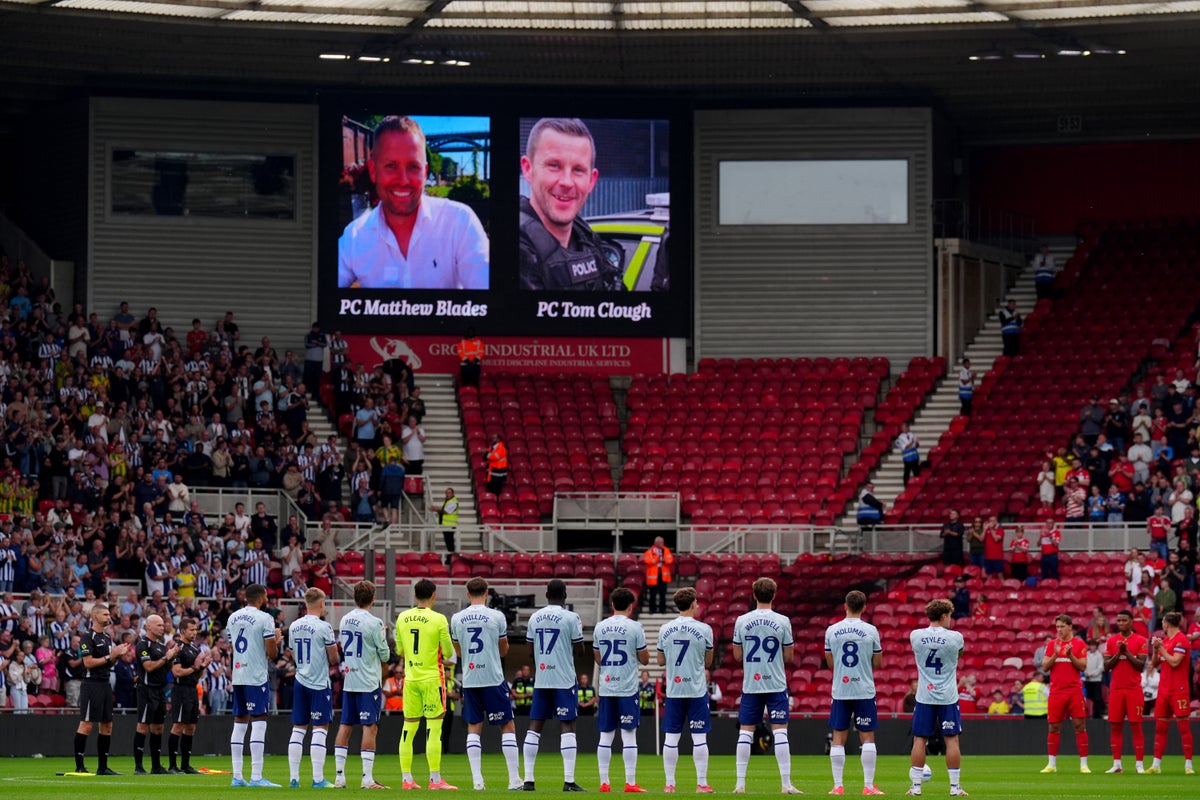
Football supporters across Northern England have gathered to pay tribute to two police officers who lost their lives in a major vehicle collision on the A66 trunk road. Police Constable Matthew Blades, aged 37, and Police Constable Tom Clough, aged 38, were killed in the incident, prompting expressions of grief and solidarity from sports fans during weekend fixtures. The tragic losses, made public in reporting by journalist Lizzie Edmonds on August 29, 2026, have sent shockwaves through both the law enforcement community and the wider public. Supporters paid tribute to the two officers at matchday gatherings, honoring their service and acknowledging the profound loss felt by their colleagues, families, and surrounding communities.
Key facts
What happened
Police Constables Matthew Blades, 37, and Tom Clough, 38, were involved in a fatal vehicle crash along the A66 highway, according to reporting by Lizzie Edmonds. The incident resulted in the immediate deaths of both officers, cutting short the lives of two serving members of law enforcement.
Following the announcement of the fatal crash, football fans organized moving tributes during matchday fixtures to honor the memory of Constable Blades and Constable Clough. Stadium commemorations in British football typically take the form of pre-match or mid-match applause, moment-of-silence observances, stadium public address announcements, or the display of memorial banners created by supporter groups. Fans gathered at football grounds used these gatherings as a platform to demonstrate collective support for the emergency services and pay respect to the fallen constables.
The initial news coverage confirmed the names and ages of both officers—Constable Matthew Blades, 37, and Constable Tom Clough, 38—as well as the highway where the crash occurred. However, specific operational details regarding the circumstances surrounding the collision have not yet been released. It has not been specified whether the officers were on duty or off duty at the time of the crash, the exact geographic coordinates or junction along the A66 where the impact occurred, or whether additional vehicles and passengers were involved in the collision.
Why it matters
The loss of two serving police officers in a single collision represents a grave tragedy for law enforcement agencies and emergency response networks across Great Britain. Fatalities among frontline police personnel create immediate structural and psychological burdens on local police forces, requiring operational redeployments, critical incident stress management, and comprehensive support services for grieving colleagues and family members. When officers die, the loss impacts entire police divisions, affecting operational readiness and team morale across departments.
This event also highlights the important role that football grounds and supporter communities play as centers for civic expression and collective mourning in the United Kingdom. British football stadiums routinely serve as civic gathering places where local populations acknowledge local tragedies, express solidarity with emergency services, and honor public servants who have lost their lives in the line of duty or through tragic accidents. The tributes paid by supporters underline the deep connection between regional communities and their local police services.
Furthermore, fatal crashes on major trans-Pennine arteries such as the A66 draw renewed attention to road safety, infrastructure quality, and traffic enforcement along critical cross-country routes. Serious incidents along high-speed corridors frequently prompt multi-agency reviews involving transport oversight bodies, local authorities, and police crash investigation units to analyze road layout, driver conditions, and potential physical hazards.
The background
To fully understand the context of this tragic incident, it is essential to consider the geography and strategic role of the A66 trunk road, as well as the administrative mechanisms governing police fatalities and football stadium tributes in the United Kingdom.
The A66 is one of Northern England’s principal strategic East-West transport corridors. Spanning approximately 115 miles, the highway connects Workington on the Cumbrian coast in the west to Middlesbrough and the Tees Valley in the east. The route crosses the northern Pennines, passing through high-elevation terrain, rural stretches, and key transportation nodes such as Penrith, where it intersects the M6 motorway, and Scotch Corner, where it meets the A1(M) motorway. Historically, the A66 has contained both dual-carriageway and single-carriageway sections. The transition between multi-lane high-speed sections and single-lane stretches has made the A66 a focal point for road safety concerns, leading National Highways to advance major capital proposals, including the multi-billion-pound A66 Northern Trans-Pennine dualling project, aimed at converting remaining single-carriageway sections into dual-carriageways to improve safety and travel reliability.
Within British policing, line-of-duty and off-duty officer fatalities trigger standardized institutional procedures managed by individual police forces, police authorities, and national representative organizations such as the Police Federation of England and Wales. Established welfare organizations, including Care of Police Survivors (COPS) and Police Care UK, provide immediate and long-term financial, psychological, and practical assistance to the surviving families and dependents of fallen officers. In addition, national commemorations such as the annual National Police Memorial Day honor police personnel who have lost their lives while serving the public.
Football matchday tributes represent an established tradition within English football culture. Governed by informal arrangements between football clubs, local supporter organizations, and local police liaison officers, these tributes allow communities to pause and pay respect to civic figures, emergency personnel, or victims of regional tragedies. Tributes often include black armbands worn by players, physical floral tributes laid outside stadium gates, official commemorative matchday program entries, and coordinated applause during designated minutes of a match.
Reaction
The deaths of Constable Matthew Blades and Constable Tom Clough elicited heartfelt tributes from football supporters, who utilized weekend fixtures to express respect and condolences for the fallen officers, as reported by Lizzie Edmonds. Fans across the stands joined together to create solemn moments of remembrance, showcasing strong public support for the officers and their families.
In similar emergency service fatalities, public and institutional reactions typically proceed across multiple tiers. Senior leadership within law enforcement—including force Chief Constables and regional Police and Crime Commissioners—routinely issue formal statements acknowledging the sacrifice of the personnel, detailing assistance programs made available to the families, and offering official support to affected operational teams. Local branches of the Police Federation traditionally coordinate support funds and organize memorial books for officers and members of the public to record their condolences.
Additionally, local emergency services and civic leaders frequently offer public condolences, emphasizing the shared bond between police officers, emergency workers, and the communities they serve.
What we don't know yet
Several significant details surrounding the collision remain unconfirmed based on available reporting. The precise section of the A66 where the crash occurred—whether in Cumbria, County Durham, or North Yorkshire—has not been specified in the initial account by Lizzie Edmonds. Furthermore, the exact date and time of the incident, along with prevailing weather or visibility conditions at the moment of the crash, have not been detailed.
It remains unverified whether Constable Blades and Constable Clough were on duty conducting operational police work or traveling off duty when the crash took place. The initial reports also omit details regarding the types of vehicles involved, whether the officers were traveling in a police vehicle or a civilian automobile, the suspected cause of the collision, and whether any other individuals were injured or required emergency medical treatment.
Finally, the specific football clubs, stadiums, and matches where the fan tributes took place were not named in the initial dispatch, leaving open questions regarding which specific supporter groups organized the ceremonies.
What to watch
In the coming days and weeks, several key developments will provide further clarity regarding the collision and its aftermath:
This account is based on original news reporting published by journalist Lizzie Edmonds.
How this story was produced
This report was written by The Global Wire newsroom from reporting first published by Lizzie Edmonds. We verify the core facts against the original report, write our own account, and add the background and consequences a short wire item leaves out. Drafting is AI-assisted inside an editor-supervised pipeline, and every story is checked for accuracy of attribution, structure and duplication before it appears — full detail in our AI and funding disclosure.
Spotted an error? Tell us at corrections@horizonglobalnews.com and read our corrections policy or editorial standards.





Reader comments
Loading comments…