

Ceuta T-Shirt Proceeds Fund Far-Right Remigration Group, Report Finds
A campaign selling €35 T-shirts under the slogan 'We are all caballas' diverts €10 per item to Save Europe Act, according to reporting by Jesús Maturana.
By The Global Wire Newsroom · Reported from Jesús Maturana
Link preview · horizonglobalnews.com
Ceuta T-Shirt Proceeds Fund Far-Right Remigration Group, Report Finds
A campaign selling €35 T-shirts under the slogan 'We are all caballas' diverts €10 per item to Save Europe Act, according to reporting by Jesús Maturana.
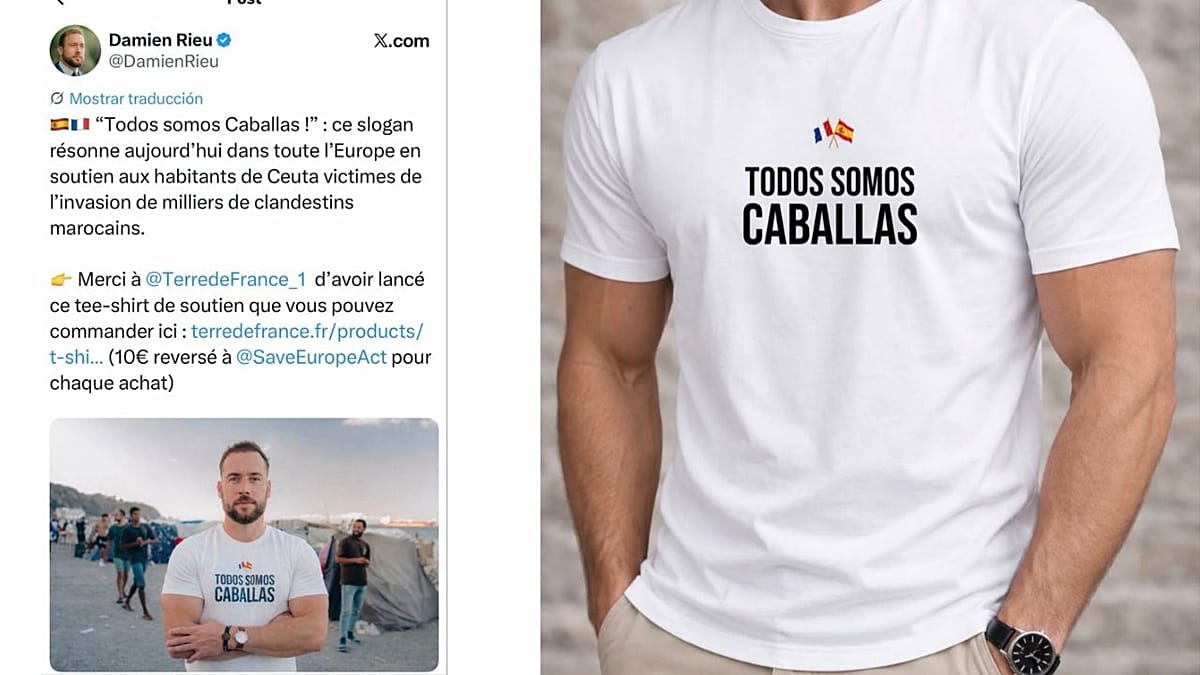
A commercial initiative marketing T-shirts under the banner of civic support for the Spanish autonomous city of Ceuta has come under intense public scrutiny following disclosures that a substantial fraction of sales revenue is being funneled to an extreme far-right organization. The apparel, bearing the slogan "We are all caballas" — a phrase incorporating the historical demonym used by residents of the North African enclave — is offered to consumers at €35 per unit. According to investigative details reported on October 3, 2026, by journalist Jesús Maturana, €10 from every shirt purchased is routed directly to Save Europe Act, a political movement advocating for "remigration," the systematic repatriation of non-European immigrants and their descendants. The revelations have raised significant questions regarding political financing transparency, the commercial exploitation of regional identity, and the funding mechanisms of radical political factions operating within the European Union.
Key facts
What happened
The commercial effort was presented to the public as a gesture of solidarity with Ceuta, a Spanish territory located on the northern coast of Africa. The promotional branding centered around the phrase "We are all caballas," designed to appeal to local pride and broader national sympathy for the enclave. However, investigative reporting by Jesús Maturana revealed that the venture functions as a fundraising mechanism for ideological causes far removed from conventional regional charity.
Purchasers paying the €35 asking price for the garment contribute €10 per transaction directly to Save Europe Act. Save Europe Act is an activist movement associated with the European far right, characterized principally by its commitment to remigration policy. Remigration is an ideological framework that calls for the mass relocation of foreign-born individuals, ethnic minorities, and naturalized citizens back to their countries of origin or heritage, regardless of legal residency or citizenship status.
The campaign's structural framework highlights a growing trend wherein consumer merchandise is leveraged to generate revenue for political movements without explicit upfront declarations of political affiliation. By wrapping an ideological campaign in the imagery of regional identity and local solidarity, the sellers positioned the product within mainstream consumer markets while simultaneously siphoning funding to a fringe political network.
Why it matters
The discovery that consumer purchases are quietly backing far-right political movements underscores significant vulnerabilities in the regulation of micro-donations and political e-commerce within Spain and the broader European Union. When commercial products are used as conduits for political fundraising, standard campaign finance disclosures and non-profit reporting requirements can be effectively bypassed, leaving buyers unaware that their expenditures are financing targeted political agendas.
Furthermore, the choice of Ceuta as a branding focal point carries heavy geopolitical and social resonance. Ceuta, along with its sister city Melilla, represents the only land border between the European Union and Africa. As a consequence, the enclave remains at the center of ongoing political debates regarding border security, asylum policy, and territorial sovereignty. By appropriating the local demonym "caballa"—a word deeply tied to Ceuta's municipal identity—the campaign seeks to capitalize on public concern over border stability to subsidize an extreme political movement.
From a regulatory perspective, the issue touches on consumer protection laws regarding misleading commercial practices. If product listings fail to clearly inform buyers that a fixed portion of the purchase price constitutes a financial donation to a political group, vendors may face legal challenges under national and European fair-trading statutes. Additionally, political monitoring groups view such merchandise sales as an increasingly common strategy employed by radical organizations seeking to establish self-sustaining financial models independent of traditional institutional funding.
The background
Ceuta is a Spanish autonomous city situated on the North African coast, bordered by Morocco to the south and west and by the Mediterranean Sea to the north and east. Occupying approximately 18.5 square kilometers, Ceuta has been under Spanish sovereign administration since the 17th century, having previously been held by Portugal. Its unique geographical location makes it a critical geopolitical point for both Spain and the European Union, serving as an external frontier subject to complex diplomatic relations with Morocco and recurring debate over migration control.
The demonym "caballa" has long been an integral element of Ceuta's local heritage. Derived from the Spanish term for the chub mackerel (*Scomber colias*), an abundant species in the surrounding waters that historically sustained the local fishing and canning industries, the term evolved into a proud marker of regional identity. Residents of Ceuta routinely identify as *caballas*, and the term is widely used in local civic, cultural, and sporting contexts without political connotation.
In contrast, Save Europe Act operates within the ideological framework of the modern European far right, closely aligned with the Identitarian movement. Identitarianism emerged in Western Europe during the early 2010s, emphasizing ethnocultural preservation and opposing multiculturalism. Central to this ideology is the concept of "remigration," a term coined to describe the forced or policy-driven return of non-European immigrants and their descendants to their ancestral countries. Far-right movements across Europe, including groups in Germany, France, Austria, and Spain, have increasingly adopted remigration as a core policy objective.
Over the past decade, political networks on the fringe have increasingly turned to digital storefronts, private brand apparel, and crowdfunding mechanisms to bypass conventional banking restrictions and political financing limits. By packaging ideological messaging into lifestyle apparel or localized solidarity campaigns, these groups generate continuous revenue streams while expanding their promotional reach among younger or less politically engaged demographics.
Reaction
The revelation of the financial link between the Ceuta solidarity T-shirt and Save Europe Act is expected to draw sharp reactions from multiple sectors, including municipal authorities in Ceuta, political representatives, and consumer watchdog organizations. Given the cultural significance of the term "caballa," local civic groups and residents in Ceuta typically resist attempts by external political actors to co-opt regional symbols for partisan or xenophobic agendas.
Consumer protection agencies across Spain are likely to be called upon to examine whether the marketing of the garment violates consumer transparency laws by concealing the political destiny of a third of the purchase price. Regulatory bodies in Spain require commercial operations that include charitable or political donations within their pricing structure to explicitly declare the beneficiary and the proportion of funds allocated.
While official statements from Save Europe Act or the commercial vendors responsible for the campaign were not detailed in the initial disclosures by Jesús Maturana, political analysts anticipate that far-right organizations will defend the commercial strategy as a legitimate form of activist fundraising. Conversely, mainstream political parties in Spain are expected to condemn the misuse of local identity symbols to advance remigration agendas, particularly within border territories where social cohesion is a priority for municipal authorities.
What we don't know yet
Several critical details regarding the production and financial operations of the T-shirt campaign remain unverified based on current reporting. It is currently unknown which specific corporate entity or individual registered the sales platform distributing the shirts, as well as the total number of units sold to date. Consequently, the total amount of money transferred to Save Europe Act through this mechanism cannot be independently calculated.
Furthermore, available reports do not specify whether the product website explicitly disclosed the €10 transfer to Save Europe Act in its fine print or if the connection was uncovered entirely through external investigative work. The legal structure of Save Europe Act within Spain—whether it operates as a registered political association, an informal collective, or a non-profit organization—also remains unconfirmed in the reporting. Understanding this structural status is essential for determining whether the entity is subject to formal auditing by electoral authorities or financial regulators.
What to watch
Key developments to monitor in the coming weeks include potential administrative or legal actions by Spanish consumer rights bodies, such as the Ministry of Consumer Affairs, regarding marketing transparency and political fundraising disclosures. Investigators will likely look into whether the e-commerce platform hosting the sales complies with national trade laws.
In addition, observers will watch for responses from the Autonomous Government of Ceuta and municipal councilors regarding the unauthorized commercialization of the city's demonym for radical political funding. On a broader scale, European Union authorities monitoring illegal political finance and foreign influence may track whether similar e-commerce fundraising models linked to remigration movements are operating across other EU member states.
Finally, the reaction of online payment processors and hosting services will be a crucial indicator of the campaign's longevity, as financial service providers frequently terminate accounts associated with undisclosed political fundraising or organizations advocating for forced population transfers.
***
This report is based on original reporting published by journalist Jesús Maturana on October 3, 2026.
How this story was produced
This report was written by The Global Wire newsroom from reporting first published by Jesús Maturana. We verify the core facts against the original report, write our own account, and add the background and consequences a short wire item leaves out. Drafting is AI-assisted inside an editor-supervised pipeline, and every story is checked for accuracy of attribution, structure and duplication before it appears — full detail in our AI and funding disclosure.
Spotted an error? Tell us at corrections@horizonglobalnews.com and read our corrections policy or editorial standards.





Reader comments
Loading comments…