

Ben Shelton Ousts Defending Champion Carlos Alcaraz in Record 3:33 a.m. U.S. Open Finish
American Ben Shelton eliminated reigning champion Carlos Alcaraz in a historic late-night clash that concluded at 3:33 a.m. in New York, setting the record for the latest finish in U.S. Open history.
By The Global Wire Newsroom · Reported from cbsnews.com
Link preview · horizonglobalnews.com
Ben Shelton Ousts Defending Champion Carlos Alcaraz in Record 3:33 a.m. U.S. Open Finish
American Ben Shelton eliminated reigning champion Carlos Alcaraz in a historic late-night clash that concluded at 3:33 a.m. in New York, setting the record for the latest finish in U.S. Open history.
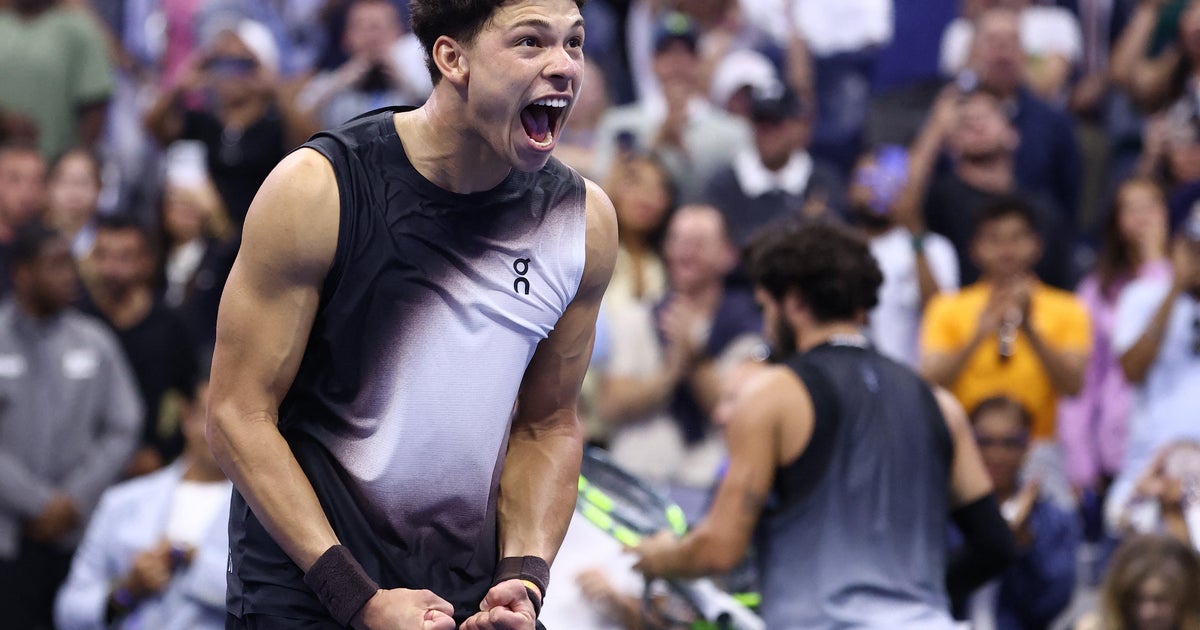
In an extraordinary conclusion to a night session at Flushing Meadows, American Ben Shelton defeated reigning champion Carlos Alcaraz early Wednesday morning, ending the Spaniard's title defense in the latest-finishing match ever recorded in the history of the U.S. Open. The marathon contest concluded at 3:33 a.m. Eastern Time on September 9, 2026, surpassing the tournament's previous record for the latest match completion and eliminating one of the sport's premier players from the final Grand Slam event of the season.
Key facts
What happened
According to reporting by CBS News, Ben Shelton pulled off the victory over Carlos Alcaraz in an extended battle that stretched deep into the early morning hours in Queens, New York. The match, anchored as the marquee late contest inside Arthur Ashe Stadium at the USTA Billie Jean King National Tennis Center, saw the two players push each other through an exhausting display of power and athleticism long after most of the venue's spectators had departed.
The encounter was scheduled as the second match of the evening session, a format that frequently risks delayed start times if the preceding women's or men's match runs long. As the night wore on and the clock crossed midnight, Shelton and Alcaraz traded games in a high-intensity environment under the stadium's retractable roof superstructure. Shelton maintained his aggressive baseline play and potent service game against Alcaraz, whose defensive scrambling and stroke production were tested by both his opponent and increasing physical fatigue.
The match reached its climax at 3:33 a.m. on Wednesday, when Shelton secured the final point to seal the victory. The result officially closed out Alcaraz's tenure as defending champion, sending the Spaniard out of the tournament and advancing Shelton into the subsequent round of the men's singles draw.
Why it matters
The outcome carries immediate and far-reaching consequences for the men's singles draw at Flushing Meadows while reigniting a contentious global debate regarding player welfare and tournament scheduling in professional tennis. From a competitive standpoint, removing Alcaraz—a multi-time Grand Slam champion and primary title contender—fundamentally alters the path to the trophy for the remaining field. For Shelton, defeating an elite player on the sport's largest stage represents a defining milestone in his career, cementing his standing among the top tier of American men's tennis players.
Beyond the tournament draw, a finish at 3:33 a.m. highlights the physical and logistical strain created by traditional night-session planning at major tournaments. Professional athletes competing at the highest level require precise physical preparation, hydration, and restorative sleep. Playing past 3:00 a.m. disrupts an athlete's circadian rhythm, severely compresses their recovery window, and heightens the risk of soft-tissue injuries in subsequent matches. A player finishing at 3:33 a.m. typically faces mandatory media obligations, drug testing, physical therapy, and cool-down routines that delay sleep until 6:00 a.m. or later, placing them at a distinct physical disadvantage against opponents who completed their matches during normal hours.
The late finish also poses severe challenges for fans, stadium workers, and local infrastructure. By the time the match concluded, large portions of Arthur Ashe Stadium's 23,771-seat capacity were vacant, as spectators were forced to leave early to catch public transit options like the New York City Subway's 7 train or the Long Island Rail Road before service reductions took effect. Broadcast partners also face diminished viewership numbers in local time zones when premium sporting events extend into the pre-dawn hours.
The background
The U.S. Open, which began in 1881 as the U.S. National Championship, introduced night play under artificial lights in 1975 at the West Side Tennis Club in Forest Hills before moving to its current home in Flushing Meadows in 1978. Night sessions inside Arthur Ashe Stadium, which opened in 1997, have become a cornerstone of the tournament's identity and commercial success. Designed to capture prime-time North American television audiences and accommodate working fans, the standard night session ticket includes two matches beginning at 7:00 p.m. ET.
Because Grand Slam men's matches are played in a best-of-five-set format, match durations can easily exceed four or five hours. When the opening match of a night session extends to three sets or experiences rain delays before the roof is closed, the second match often cannot begin until after 10:00 p.m. or 11:00 p.m.
Prior to Wednesday's match, the record for the latest finish at the U.S. Open was 2:50 a.m., set during the 2022 quarterfinals when Alcaraz defeated Italy's Jannik Sinner in a five-set match that lasted five hours and 15 minutes. Other notable late-night finishes at Flushing Meadows include 2:26 a.m. completions recorded by Mats Wilander and Mikael Pernfors in 1993, Rafael Nadal and Philipp Kohlschreiber in 2018, and Alexander Zverev and Borna Coric in 2021.
Late-night finishes are an ongoing issue across all four Grand Slam events. The absolute record for the latest finish in Grand Slam history occurred at the 2008 Australian Open in Melbourne, where Australia's Lleyton Hewitt defeated Cyprus's Marcos Baghdatis at 4:34 a.m. At Roland Garros in 2024, Novak Djokovic completed a five-set victory over Lorenzo Musetti at 3:07 a.m.
In January 2024, the ATP and WTA governing bodies issued joint operational directives aimed at curbing late matches on the standard professional tours. The guidelines specified that no match should be assigned to a court after 11:00 p.m. unless approved by an ATP/WTA supervisor, and recommended that night sessions start no later than 7:30 p.m. However, the four Grand Slam tournaments operate independently under the jurisdiction of the International Tennis Federation (ITF) and their respective national associations—in this case, the United States Tennis Association (USTA)—and are not bound by ATP or WTA tour scheduling rules.
Reaction
Specific post-match statements from Shelton or Alcaraz were not included in the initial report by CBS News. However, completions occurring at this hour invariably prompt widespread commentary from players, coaches, media analysts, and tournament administrators.
In similar historical circumstances, victorious players routinely describe feelings of intense fatigue mixed with adrenaline, noting the cognitive difficulty of staying focused during pre-dawn tiebreaks. Defeated players frequently voice frustration over the physical toll imposed by playing during hours normally reserved for deep sleep.
Tennis commentators and former players have increasingly criticized tournament organizers for allowing matches to start late in the evening without relocating them to vacant outer courts. Player advocacy groups, including the Professional Tennis Players Association (PTPA), have repeatedly called for standardized Grand Slam curfews similar to Wimbledon's mandatory 11:00 p.m. local noise and transport curfew, arguing that midnight play compromises athletic integrity and health.
What we don't know yet
Several technical details regarding the record-breaking match remain unconfirmed in the immediate reporting. The available summary from CBS News does not detail the exact set scores, total match duration in hours and minutes, or specific match statistics such as ace totals, break-point conversion rates, and total points won.
It is also unknown at what exact time the preceding night-session match concluded, how long the court preparation took, and the precise time Shelton and Alcaraz hit their first official warm-up serves. Additionally, tournament officials have not publicly clarified whether moving the match to another available court—such as Louis Armstrong Stadium, which also features a retractable roof—was considered by the USTA referee team as the evening progressed.
Finally, the extent of Shelton's physical recovery before his next match remains uncertain. How his body responds to severe sleep disruption and intense physical exertion will become clear only when he takes the court for his subsequent fixture.
What to watch
In the immediate future, tennis observers should monitor Shelton's recovery protocol and physical performance in his upcoming match. Analysts will track whether he exhibits signs of lingering lethargy, reduced service speed, or muscular tightness resulting from his 3:33 a.m. finish.
Attention will also turn to the USTA leadership and tournament director to see if this historic finish prompts administrative policy shifts for the remainder of the event. Key indicators to watch include whether the tournament alters scheduled night-session start times, implements a strict cutoff hour after which matches are moved to open courts, or reduces night sessions to a single marquee match inside Arthur Ashe Stadium in future years.
Finally, player representatives and tour officials are likely to raise this result during upcoming player council meetings ahead of the remaining Asian and European hard-court swings, keeping the broader debate over standardized Grand Slam curfews active throughout the professional tennis calendar.
This report is based on original reporting published by CBS News.
How this story was produced
This report was written by The Global Wire newsroom from reporting first published by cbsnews.com. We verify the core facts against the original report, write our own account, and add the background and consequences a short wire item leaves out. Drafting is AI-assisted inside an editor-supervised pipeline, and every story is checked for accuracy of attribution, structure and duplication before it appears — full detail in our AI and funding disclosure.
Spotted an error? Tell us at corrections@horizonglobalnews.com and read our corrections policy or editorial standards.





Reader comments
Loading comments…