

NFL Office Intervenes to Eject Rams Safety Kamren Kinchens Over Helmet Hit on Christian Watson
NFL executive Troy Vincent ordered the disqualification of Kamren Kinchens following a collision with Christian Watson, reigniting debates over centralized league intervention.
By The Global Wire Newsroom · Reported from sports.ndtv.com
Link preview · horizonglobalnews.com
NFL Office Intervenes to Eject Rams Safety Kamren Kinchens Over Helmet Hit on Christian Watson
NFL executive Troy Vincent ordered the disqualification of Kamren Kinchens following a collision with Christian Watson, reigniting debates over centralized league intervention.
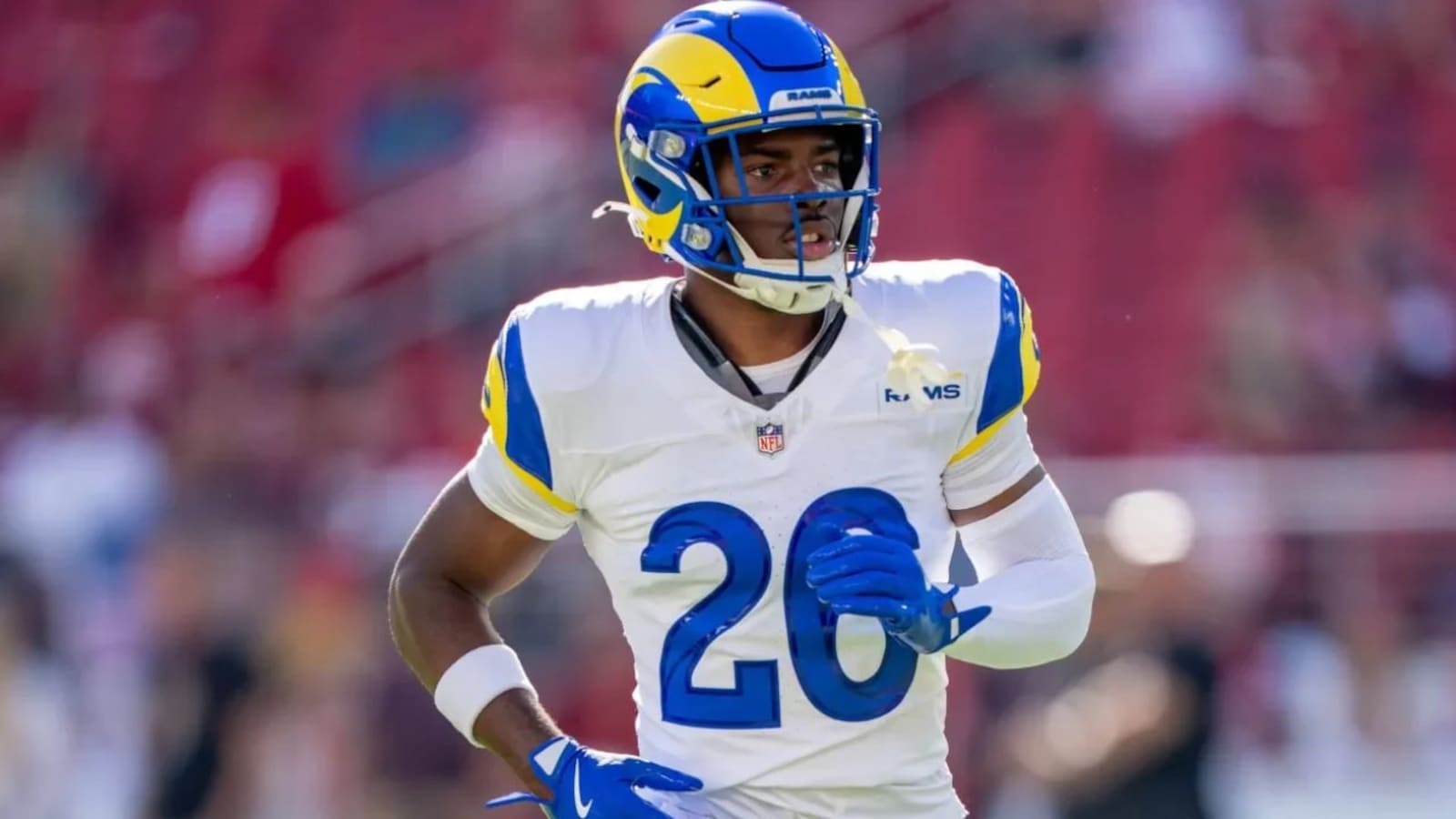
Los Angeles Rams safety Kamren Kinchens was disqualified from a regular-season contest against the Green Bay Packers following a helmet-to-helmet collision with wide receiver Christian Watson, in a ruling directed from the league office by National Football League executive vice president of football operations Troy Vincent. The ejection, which unfolded during a game that reached the halftime intermission tied at 13-13 after offsetting penalties restricted Green Bay to a field goal on the sequence, has reignited scrutiny regarding centralized administrative intervention in on-field officiating and the application of strict player safety standards.
Key facts
What happened
The sequence occurred during the first half of the matchup between the Los Angeles Rams and the Green Bay Packers. On a passing play directed toward Green Bay wide receiver Christian Watson, Rams safety Kamren Kinchens initiated contact that resulted in helmet-to-helmet impact between the two players. The force and trajectory of the collision immediately prompted penalty flags on the field.
Rather than leaving the final disciplinary outcome exclusively to the discretion of the on-field officiating crew, the incident triggered direct administrative oversight from league headquarters. Troy Vincent, who oversees football operations for the NFL, issued the definitive directive to eject Kinchens from the remainder of the contest. The administrative intervention superseded standard on-field deliberations, leading to the immediate removal of the defensive back.
Complicating the enforcement of the foul, the officiating crew determined that offsetting infractions occurred on the play. Because the penalties cancelled each other out in terms of net yardage and down advancement, Green Bay did not receive the automatic first down or the typical 15-yard advancement associated with an unnecessary roughness penalty against a defenseless player. Consequently, the drive stalled, leaving the Packers to settle for a field goal. That score preserved parity between the two franchises, sending the teams into the halftime locker rooms locked in a 13-13 stalemate.
Why it matters
The disqualification of Kinchens carries immediate competitive, institutional, and regulatory consequences across professional football. On the field, losing a primary defensive back fundamentally disrupts defensive rotations, altering pass coverage schemes and forcing coaching staffs to alter personnel packages against perimeter threats such as Watson. When an ejection occurs prior to the second half, a defense must endure significant snap volume without one of its designated starters or key depth contributors.
Institutionally, the decision underscores the evolving distribution of power between game officials on the turf and senior league executives watching remotely. While the NFL has steadily expanded the scope of centralized video review from its operations center in New York, the explicit involvement of an executive vice president in dictating an in-game player ejection represents a pronounced exercise of centralized authority. For decades, the ejection of a participant was the sole purview of the referee and the on-field officiating crew, reserved for flagrant personal fouls or non-football conduct such as fighting. Executive intervention to mandate a disqualification introduces precedent that coaches, players, and front offices must navigate, raising questions about standard operating procedures, transparency, and consistency across different officiating crews.
From a financial and labor standpoint, in-game ejections for safety-related infractions trigger formal scrutiny under the disciplinary policies negotiated between the NFL and the NFL Players Association (NFLPA). Under the league's schedule of infractions, unnecessary roughness involving impermissible helmet contact carries pre-established baseline fines, with subsequent offenses subjecting players to compounding monetary forfeitures or formal league suspensions without pay.
The background
The NFL's enforcement mechanisms regarding head contact have evolved dramatically over the last two decades. Prompted by growing medical research into traumatic brain injuries, chronic traumatic encephalopathy (CTE), and widespread litigation from retired players, the league enacted comprehensive reforms designed to penalize and eliminate dangerous tackling techniques. In 2010, the competition committee instituted strict protections for defenseless receivers, barring defenders from launching into opponents or targeting the head and neck area. In 2018, the league broadened these restrictions by introducing the use-of-the-helmet rule, making it a foul for any player to lower their head and initiate contact with the helmet against an opponent.
To standardize enforcement and correct egregious on-field errors, the league established centralized replay operations at Art McNally GameDay Central inside league headquarters at 345 Park Avenue in Manhattan. Under Rule 19 of the NFL Rule Book, the league expanded the authority of centralized replay officials to assist on-field crews with objective administrative calls, such as ball spots, boundary determinations, and penalty assessments involving non-judgment infractions.
Simultaneously, the league granted football operations administrators—most notably Troy Vincent—the mandate to maintain competitive integrity and player safety. Vincent, a former NFL cornerback who served as president of the NFLPA before joining the league's executive leadership, has frequently stated that the league must act aggressively to remove non-football acts and high-risk techniques from the field. In recent seasons, the league office has occasionally utilized its command center to intervene when an on-field action constitutes an egregious violation of safety rules, even when on-field referees hesitate to issue an immediate disqualification.
For Kinchens, a third-round selection by the Rams out of the University of Miami in the 2024 NFL Draft, the transition to professional tackling standards represents a steep learning curve where split-second angles can draw severe institutional penalties. Watson, drafted by the Packers in the second round of the 2022 draft out of North Dakota State, has previously dealt with multiple soft-tissue injuries and physical stoppages during his career, making high-impact collisions an area of acute concern for Green Bay's medical and coaching staff.
Reaction
The decision by the league office sparked immediate discussion among team personnel, commentators, and spectators regarding the parameters of centralized disqualifications. While official post-game statements typically emerge during post-match press conferences and pool reporter interviews, reactions to in-game ejections generally divide along predictable institutional lines.
Defensive players and coaching staffs frequently express frustration when split-second collisions are interpreted as deliberate, malicious targeting, particularly when receivers shift their body posture or lower their center of gravity immediately prior to impact. Conversely, offensive personnel and league health advocates consistently endorse strict enforcement, arguing that without the threat of immediate disqualification and subsequent financial penalties, defensive players will continue to risk catastrophic injuries to opponents.
Official accountability is formally conducted through pool reporter inquiries, in which an accredited member of the Pro Football Writers of America (PFWA) is designated to question the referee regarding controversial rulings, officiating rationale, and the specific sequence of communication between the stadium crew and the league office in New York.
What we don't know yet
Several substantive details remain unconfirmed in the immediate aftermath of the ruling. The reporting does not clarify the exact nature of the offsetting penalty that cancelled out the yardage consequence of Kinchens' hit, leaving open whether the infraction committed by Green Bay was a pre-snap procedural foul, a concurrent holding violation, or post-play unsportsmanlike conduct.
Furthermore, the medical status of Christian Watson following the impact has not been detailed. It remains unconfirmed whether Watson was required to enter the NFL's mandatory concussion protocol, whether he cleared sideline neurological examinations, or whether he was ruled out for the remainder of the contest. Finally, the specific mechanics of the communication channel—how Vincent relayed the directive to the referee and whether on-field officials initially intended to eject Kinchens independently—have not been disclosed by the league.
What to watch
The trajectory of this incident will be governed by several standardized administrative and competitive checkpoints over the coming days:
This account is based on reporting published by NDTV Sports.
How this story was produced
This report was written by The Global Wire newsroom from reporting first published by sports.ndtv.com. We verify the core facts against the original report, write our own account, and add the background and consequences a short wire item leaves out. Drafting is AI-assisted inside an editor-supervised pipeline, and every story is checked for accuracy of attribution, structure and duplication before it appears — full detail in our AI and funding disclosure.
Spotted an error? Tell us at corrections@horizonglobalnews.com and read our corrections policy or editorial standards.




Reader comments
Loading comments…