

Boston Dynamics Unveils Second-Generation Stretch Robot with Rapid Repair Capabilities
The upgraded logistics robot introduces hardware and software refinements designed to slash warehouse maintenance downtime to approximately one hour.
By The Global Wire Newsroom · Reported from Neetika Walter
Link preview · horizonglobalnews.com
Boston Dynamics Unveils Second-Generation Stretch Robot with Rapid Repair Capabilities
The upgraded logistics robot introduces hardware and software refinements designed to slash warehouse maintenance downtime to approximately one hour.
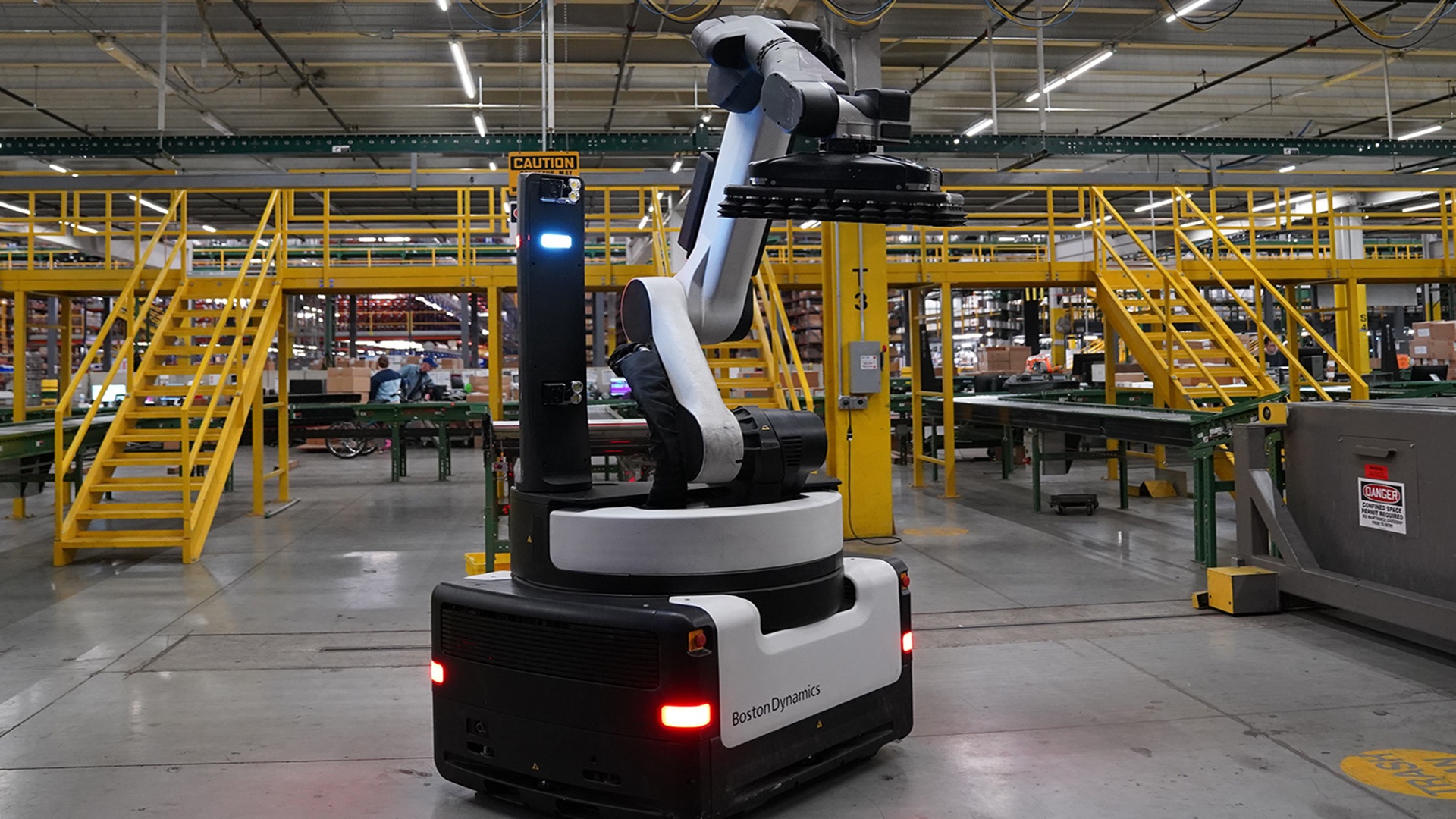
WALTHAM, Mass. — Boston Dynamics has introduced the second generation of its purpose-built warehouse automation robot, Stretch, incorporating significant hardware redesigns and software updates aimed at reducing maintenance turnaround times to just one hour. The industrial robotics developer, a subsidiary of South Korea's Hyundai Motor Group, engineered the updated machine to address operational friction in freight terminals and distribution centers, where equipment failures often create cascading bottlenecks across freight networks. According to reporting by Neetika Walter, the revisions focus heavily on serviceability and sustained operational uptime, targeting one of the commercial logistics sector's most persistent obstacles to broad robotic adoption.
Key facts
What happened
Boston Dynamics rolled out the second iteration of its Stretch platform on November 3, 2026, targeting commercial logistics operators who demand higher machine availability during peak distribution cycles. As reported by Neetika Walter, Stretch Gen 2 integrates an overhauled hardware framework alongside expanded software intelligence, purposefully designed to streamline troubleshooting, field servicing, and routine parts replacement.
Under the new architecture, mechanical assemblies that previously required prolonged diagnostic windows or specialized field engineering can now be serviced or swapped out within an estimated one-hour timeframe. This modular service philosophy reflects feedback collected from commercial distribution hubs that operated the first-generation units in live freight scenarios. In logistics settings where automated systems operate inside tight tractor-trailer containers and around complex conveyor systems, mechanical wear on pick heads, pneumatic lines, and joint actuators is frequent and punishing. The Gen 2 updates introduce reinforced components intended to withstand these repeated physical stresses, while simultaneously reorganizing internal component layouts so technicians can access critical failure points without dismantling peripheral sub-assemblies.
On the software side, the update enhances vision processing and machine learning models that govern object identification, pick-and-place trajectories, and collision avoidance. Warehouse environments are notoriously variable: cartons shift during maritime transit, packaging breaks, and unstandardized freight configurations frequently confuse computer vision arrays. The revised operating software improves autonomous recovery protocols when a pick attempt fails, reducing the frequency of instances where a human supervisor must manually intervene to reset the system.
Why it matters
In modern supply chain management, uptime is the fundamental metric that governs the return on investment for capital-intensive automation. High-volume fulfillment centers operate on compressed schedules, especially during peak retail surges such as the fourth-quarter holiday corridor. In these environments, an automated unloading bay that falls offline for four to eight hours does not simply lose its own throughput; it creates demurrage fees for idling tractor-trailers, backs up receiving docks, and forces warehouse managers to redirect scarce human labor away from fulfillment lines to manual unloading.
Achieving a one-hour servicing benchmark represents a critical threshold for industrial automation. When equipment can be restored to service within an hour, warehouse managers can incorporate repairs into scheduled shift transitions or minor lull periods without restructuring daily logistics operations. This reliability directly influences the total cost of ownership. Automated machinery requires substantial upfront capital expenditure, often running into hundreds of thousands of dollars per unit when auxiliary integration, safety fencing, and fleet management software are factored in. If maintenance overhead and prolonged downtime depress net productivity, warehouse operators revert to traditional manual labor or simpler stationary conveyor systems.
Furthermore, the logistics sector continues to confront systemic labor shortages in physically grueling warehouse roles. Unloading shipping containers is among the most injury-prone jobs in the supply chain, involving repetitive lifting of heavy boxes in unconditioned, tight spaces where temperatures can swing wildly. By hardening the physical reliability of Stretch and ensuring that routine breakdowns do not take bays out of commission for entire shifts, Boston Dynamics is attempting to validate mobile manipulation as an indispensable, permanent tier of industrial logistics infrastructure.
The background
Founded in 1992 as a spin-off from the Massachusetts Institute of Technology, Boston Dynamics built its initial reputation on legged locomotion research backed largely by the U.S. Defense Advanced Research Projects Agency. Platforms like BigDog, LS3, and the humanoid Atlas established the company's technical supremacy in balance, dynamic control, and hydraulic actuation. However, for decades the firm faced persistent scrutiny over its ability to convert extraordinary research feats into commercially viable, revenue-generating products.
Commercialization began in earnest following a series of corporate acquisitions. Google's parent company, Alphabet, acquired Boston Dynamics in December 2013, later selling it to Japan's SoftBank Group in 2017. In June 2021, South Korea's Hyundai Motor Group acquired an 80 percent controlling interest in an agreement valuing the robotics firm at $1.1 billion, signaling a strategic pivot toward industrial automation, automotive manufacturing synergy, and commercial logistics.
To capture market share outside academic and defense research, Boston Dynamics introduced the quadruped robot Spot in 2019 for industrial inspection, followed by the unveiling of Stretch in March 2021. Unlike Spot or Atlas, Stretch was conceived from the ground up as a practical, single-task industrial machine. It discarded legs in favor of a compact, omnidirectional wheeled base capable of navigating standard warehouse docks and maneuvering directly into the back of 53-foot intermodal containers. The robot was fitted with a high-degree-of-freedom custom robotic arm, an array of vacuum suction cups, and real-time computer vision sensors.
By early 2022, logistics giants began committing capital to pilot the hardware. DHL Supply Chain announced a $15 million investment in January 2022 to deploy Stretch units across its North American distribution network, followed by agreements with other international freight handlers. While initial deployments validated the robot's ability to unload up to 800 cases per hour under optimal conditions, real-world field trials exposed the harsh realities of maritime freight: deformed cardboard, crushed boxes, extreme ambient dust, and mechanical wear that complicated maintenance. Stretch Gen 2 is the direct evolutionary response to those early multi-year commercial trials.
Reaction
Industry analysts and logistics technology observers have long tracked the deployment of autonomous mobile manipulation, noting that the field has struggled more with maintenance economics than with baseline robotic capability. Automation consultants frequently point out that while enterprise supply chains are eager to deploy robotic arms that can lift 50-pound payloads repeatedly, third-party logistics providers operate on narrow operating margins—often between 3 and 8 percent—leaving minimal tolerance for unpredictable servicing delays.
Enterprise logistics operators are expected to scrutinize the Gen 2 platform during upcoming supply chain industry forums, including major material handling conferences like ProMat and MODEX, where commercial fleet buyers review technical performance verifications. Key industry bodies, such as the Material Handling Institute, will be evaluating whether field repairability metrics align with broader industrial automation standards, such as those established by the Robotic Industries Association and the International Organization for Standardization.
While corporate logistics executives have maintained broad public enthusiasm for automated solutions to mitigate warehouse labor turnover, labor organizations representing warehouse and freight workers have consistently maintained a watchful stance. Groups such as the International Brotherhood of Teamsters monitor warehouse automation deployments closely, emphasizing worker safety, workstation ergonomics, and the protection of baseline logistics employment as facilities integrate mobile unloading platforms alongside human dockworkers.
What we don't know yet
Despite the operational details reported by Neetika Walter, several significant commercial parameters regarding Stretch Gen 2 remain undisclosed. The release did not detail whether the one-hour repair threshold applies exclusively to modular component swaps—such as replacing an end-of-arm vacuum manifold, battery pack, or primary camera sensor—or if it extends to complex structural repairs involving drive assemblies or robotic arm joints.
Furthermore, Boston Dynamics has not published specific pricing adjustments for the Gen 2 platform, nor has the company confirmed whether existing first-generation fleets can be retrofitted with the new modular hardware components or software updates. The commercial warranty structure, service-level agreements, and availability of on-site spare part inventories represent critical unknowns for fleet managers calculating long-term operational expenditures. The company has also not yet released audited, continuous throughput statistics illustrating how the Gen 2 performs across diverse cargo mixes, such as irregular or unbanded freight, compared to its predecessor.
What to watch
The most decisive metric for Stretch Gen 2 over the coming twelve months will be the rate of contract expansions among initial commercial partners such as DHL Supply Chain, Maersk, and retail distribution networks. Observers should watch upcoming corporate quarterly disclosures and enterprise automation announcements to determine whether pilot operations convert into enterprise-wide fleet deployments across regional distribution centers.
Another critical indicator will be competitive responses from peer robotics developers operating in the logistics automation domain. Companies such as Dexterity, Berkshire Grey, and robust supply chain automation suppliers like Symbotic are aggressively developing specialized container-unloading and palletizing systems. The degree to which Boston Dynamics can establish Stretch Gen 2 as the de facto standard for mobile container unloading will depend directly on verified field reliability data.
Finally, the performance of the robot during peak holiday freight surges in late 2026 and 2027 will offer the first true stress test of the one-hour repair claim. Whether warehouse maintenance teams can successfully diagnose, service, and redeploy units without specialized manufacturer engineering support will determine the ultimate viability of the platform.
This report draws upon original coverage published by Neetika Walter on November 3, 2026, detailing the technical updates and servicing improvements engineered into Boston Dynamics' Stretch Gen 2 platform.
How this story was produced
This report was written by The Global Wire newsroom from reporting first published by Neetika Walter. We verify the core facts against the original report, write our own account, and add the background and consequences a short wire item leaves out. Drafting is AI-assisted inside an editor-supervised pipeline, and every story is checked for accuracy of attribution, structure and duplication before it appears — full detail in our AI and funding disclosure.
Spotted an error? Tell us at corrections@horizonglobalnews.com and read our corrections policy or editorial standards.





Reader comments
Loading comments…