

Stellar Collisions May Solve Mystery of Ancient Black Holes Found by Webb Telescope
New research suggests runaway collisions in early star clusters could explain the compact, glowing objects known as Little Red Dots and their oversized central black holes.
By The Global Wire Newsroom · Reported from Robert Lea
Link preview · horizonglobalnews.com
Stellar Collisions May Solve Mystery of Ancient Black Holes Found by Webb Telescope
New research suggests runaway collisions in early star clusters could explain the compact, glowing objects known as Little Red Dots and their oversized central black holes.
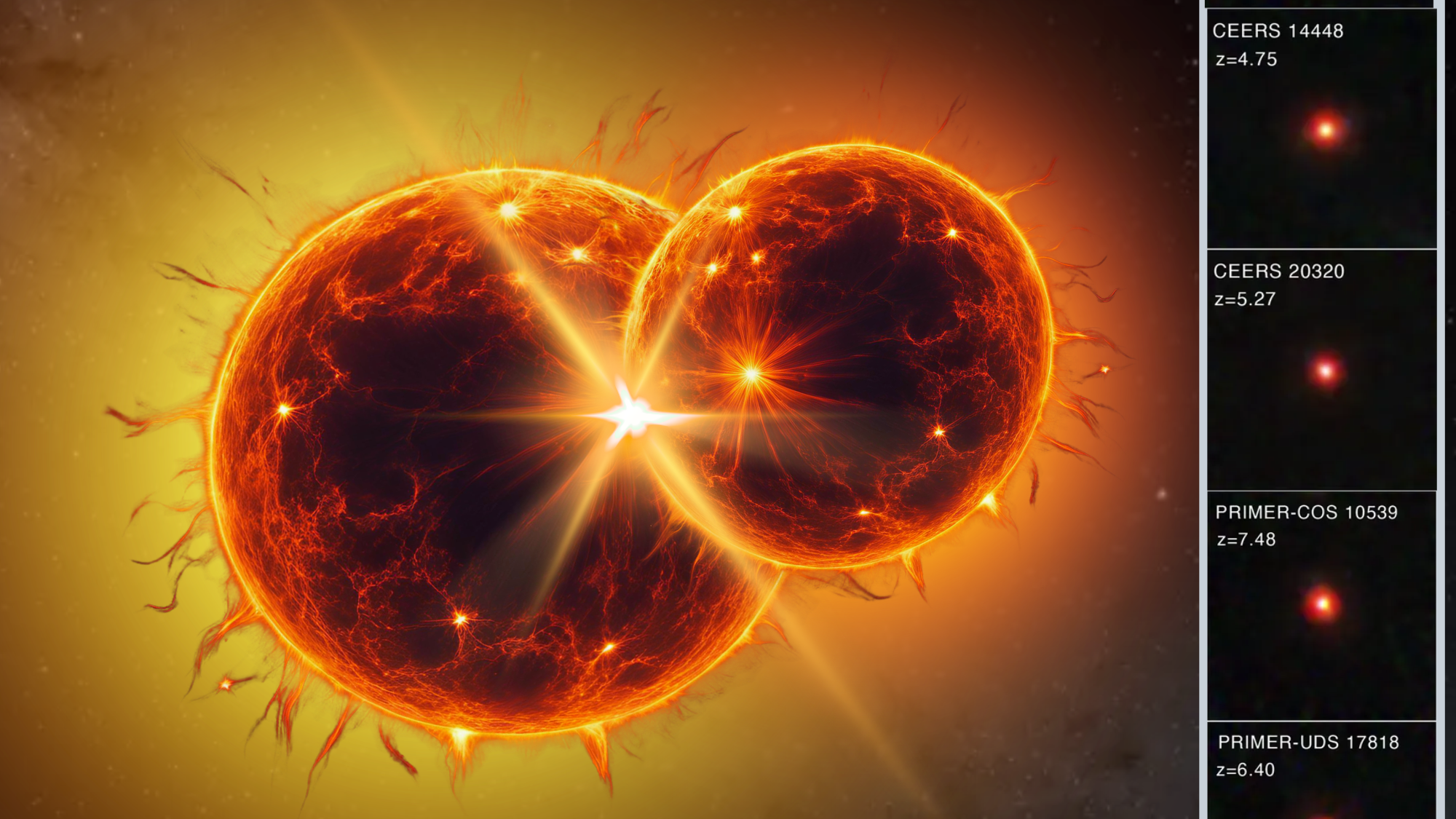
Astrophysicists investigating the early cosmos have put forward a mechanism that may resolve one of the most perplexing discoveries made by modern space observatories: the unexpected prevalence of compact, highly luminous celestial objects known as "Little Red Dots." According to reporting by science journalist Robert Lea, researchers are examining whether collisions between ancient stars within extremely dense primordial clusters could account for both the distinct observational signatures of these objects and the rapid formation of supermassive black holes that standard cosmological models struggle to explain. The findings address a central puzzle emerging from deep-field infrared observations, which have revealed an abundance of massive black holes active within the first billion years following the Big Bang.
Key facts
What happened
Since the commissioning of the James Webb Space Telescope in mid-2022, deep infrared surveys have revealed an unexpectedly large population of small, reddish objects at high redshifts, typically spanning z = 4 to z = 9. These objects, dubbed "Little Red Dots" by researchers analyzing deep-sky imaging from instruments such as the Near-Infrared Camera, appear exceptionally compact—often measuring only a few dozen to a few hundred light-years across—yet they radiate energy comparable to entire modern galaxies.
Spectroscopic analysis of these bodies has yielded conflicting interpretations. Broad emission lines, such as hydrogen Balmer transitions observed in the rest-frame optical spectrum, typically indicate gas swirling at thousands of kilometers per second around an actively accreting supermassive black hole. However, if standard scaling relations derived from the local universe are applied to these systems, the deduced black hole masses appear disproportionately large compared to their host stellar systems, in some cases accounting for 10 to 100 percent of the total host galaxy mass, rather than the typical 0.1 percent observed in modern galaxies.
As reported by Robert Lea, researchers are now pointing to dense stellar dynamics as a unifying explanation. Under this framework, primordial star clusters formed in the early universe reached central densities millions of times higher than those seen in the local Milky Way. In such environments, individual stars inevitably collided and merged before completing their standard evolutionary lifecycles. This chain of runaway collisions could build exceptionally massive stellar objects that rapidly collapsed into heavy black hole seeds, offering a plausible route to bypass the standard time constraints that limit black hole growth through gas accretion alone. At the same time, the high-velocity gas dynamics, extreme stellar densities, and dust shrouds within these environments could mimic or alter the spectral features that currently divide observers, offering a physical foundation for the disparate interpretations currently debated across the astronomical community.
Why it matters
The existence of mature, supermassive black holes within the first several hundred million years of cosmic time represents a significant challenge to modern astrophysics. Under the standard Lambda Cold Dark Matter model of cosmology, structures form hierarchically: small fluctuations collapse first, slowly assembling into stars, small star clusters, and dwarf galaxies before merging into larger structures over billions of years.
When a black hole grows primarily by accreting surrounding interstellar gas, radiation pressure pushes back against the infalling material. The maximum rate at which spherically symmetric accretion can occur without blowing the fuel source away is defined by the Eddington limit. If the first black holes formed exclusively from the collapse of the earliest generation of stars—often called Population III stars, with initial masses of perhaps tens or hundreds of times that of the Sun—growing them to millions or billions of times the solar mass by redshift z = 6 requires either unbroken, maximum-efficiency Eddington accretion or episodes of sustained "super-Eddington" accretion. Both scenarios require fine-tuned, uninterrupted fuel supplies that are difficult to reconcile with hydrodynamic feedback mechanisms, which typically disperse cold gas clouds.
By demonstrating that runaway stellar collisions within ultra-dense clusters can directly create heavy seed black holes—possessing thousands or tens of thousands of solar masses—or create observational signatures that alter mass estimates, researchers can potentially resolve this tension without overturning general relativity or broad cosmological frameworks. Furthermore, identifying the nature of Little Red Dots is critical for calibrating estimates of how radiation from early galaxies and their central engines contributed to cosmic reionization, the transformative epoch during which neutral hydrogen in the intergalactic medium was stripped of its electrons by high-energy photons.
The background
For decades before the deployment of the James Webb Space Telescope, high-redshift black hole research relied heavily on ground-based optical and infrared observatories, alongside the Hubble Space Telescope and the Chandra X-ray Observatory. These facilities routinely identified extremely bright quasars powered by billion-solar-mass black holes at redshifts beyond z = 6, but those detections represented only the rarest, most luminous statistical outliers across enormous volumes of space.
The deployment of the James Webb Space Telescope in December 2021, followed by its placement at the Sun-Earth L2 Lagrange point and the release of its first science images in July 2022, provided unprecedented sensitivity in the near-infrared and mid-infrared spectrum between 0.6 and 28 microns. This capability allowed astronomers to peer directly into the rest-frame optical light of typical, lower-luminosity galaxies existing during the first billion years after the Big Bang.
Instead of finding a sparse population of modest infant systems, deep surveys such as the Cosmic Evolution Early Release Science survey and the JWST Advanced Deep Extragalactic Survey detected hundreds of compact, faint red sources. The debate over these objects quickly polarized the field. One group of researchers argued that the broad emission lines detected by the Near-Infrared Spectrograph proved these objects were active galactic nuclei hosting surprisingly massive black holes obscured by heavy columns of dust. Another group argued that the lack of corresponding X-ray detections by facilities like Chandra, coupled with specific spectral breaks, indicated that Little Red Dots were instead "hyper-compact" starburst galaxies containing billions of stars packed into volumes of space no larger than a standard globular cluster.
This division led researchers to analogize the field to the classical parable of the blind men describing an elephant from isolated touchpoints, where disparate analytical approaches to the same observational datasets yield fundamentally divergent conclusions about the nature of the beast.
Reaction
The scientific discourse surrounding Little Red Dots has stimulated active debates across theoretical and observational astrophysics. While direct institutional statements on individual papers remain rare prior to broader consensus, working groups within the international astronomical community have organized dedicated symposia and review panels at major gatherings, including meetings of the American Astronomical Society and the European Astronomical Society.
Specialists in stellar dynamics and numerical simulations have generally welcomed collisional frameworks, noting that N-body simulations have long predicted that core collapse in ultra-compact clusters should trigger runaway mergers if the cluster's relaxation time is shorter than the lifespan of massive stars. Conversely, observers working on X-ray astronomy have emphasized caution, noting that if Little Red Dots host massive black holes accreting gas at high rates, the absence of soft and hard X-ray detections in stacked Chandra data requires extreme physical mechanisms, such as Compton-thick shielding or fundamentally non-standard accretion disk structures.
Researchers focused on stellar population synthesis have highlighted that explaining Little Red Dots entirely through dense stellar clusters requires exotic initial mass functions dominated by intermediate-mass stars, which currently lack local analogs. Consequently, theorists are actively publishing competing models, with debates centering on whether the observed properties require an active black hole, an extreme stellar system, or a hybrid structure generated by dense stellar collisions.
What we don't know yet
Significant gaps remain in observational data and theoretical models. Foremost among these is whether Little Red Dots host genuine supermassive black holes or whether their broad spectral emission lines are produced by stellar winds, expanding supernova envelopes, or the dynamical motion of stars within steep gravitational potentials. If black holes are present, their true masses remain uncertain by up to two orders of magnitude because traditional virial mass estimators rely on scaling relations calibrated entirely on modern, low-redshift systems.
Additionally, it remains unproven whether dense stellar clusters at high redshift can sustain the specific conditions required for runaway mergers without being disrupted by early supernova feedback. Current computer simulations struggle to resolve individual stellar physical collisions while simultaneously tracking the large-scale gas hydrodynamics of an entire protogalaxy. Finally, it is unknown why Little Red Dots appear abundant between redshifts 4 and 9 but largely disappear from view at lower redshifts, leaving open the question of what these systems evolve into over cosmic time.
What to watch
Progress over the coming months and years will depend heavily on upcoming observational campaigns and refined computational models. The Space Telescope Science Institute, which operates Webb science operations from Baltimore, Maryland, continues to allocate high-priority observing time in Cycles 3 and 4 to deep spectroscopic follow-ups of confirmed Little Red Dots. Researchers will watch closely for high-resolution spectra capable of disentangling broad Balmer emission lines from complex narrow-line components, which can provide conclusive signatures of active galactic nuclei.
Simultaneously, coordinated multi-wavelength campaigns are underway. Observers are pairing Webb infrared data with deep radio observations from the Atacama Large Millimeter/submillimeter Array in Chile and ultra-deep X-ray observations to establish firm upper limits on high-energy radiation. On the theoretical side, astrophysical teams are running high-resolution smoothed-particle hydrodynamics and direct N-body simulations on supercomputing clusters to model the exact light curves and spectra produced when dense star clusters undergo catastrophic core collapse, which will provide testable predictions against future telescope datasets.
This account incorporates reporting originally published by Robert Lea regarding observational and theoretical developments in the study of early-universe Little Red Dots and black hole seed formation.
How this story was produced
This report was written by The Global Wire newsroom from reporting first published by Robert Lea. We verify the core facts against the original report, write our own account, and add the background and consequences a short wire item leaves out. Drafting is AI-assisted inside an editor-supervised pipeline, and every story is checked for accuracy of attribution, structure and duplication before it appears — full detail in our AI and funding disclosure.
Spotted an error? Tell us at corrections@horizonglobalnews.com and read our corrections policy or editorial standards.




Reader comments
Loading comments…